

Peace Corps in Kyrgyzstan: Unique Status and Soft Power Issues
On August 23, a swearing-in ceremony was held in Kyrgyzstan for 24 new American Peace Corps (PC) volunteers who will begin a two-year mission in the country. This event, attended by US Ambassador Leslie Viguerie and representatives of the Kyrgyz government, underscores the country's exceptional position as the only country in Central Asia where the Peace Corps not only continues its activities but also expands them.
Activities in Kyrgyzstan: Education as the Foundation for Cooperation
The history of the Peace Corps in Kyrgyzstan began in 1993. During this time, approximately 1,400 volunteers have contributed to the country's development, working at the invitation of the Kyrgyz side and focusing on projects that are priorities for local communities.
The new 24 volunteers will continue this tradition, focusing on teaching English. They will work in secondary schools and higher education institutions in six regions: Chui, Naryn, Issyk-Kul, Talas, Osh, and Jalal-Abad. Importantly, this is the first time they have collaborated with universities, marking a new stage of partnership.
The volunteers' work is not limited to teaching. They implement new methods, improve the quality of classes, and also manage clubs and extracurricular activities, working closely with local teachers. US Ambassador Leslie Viguerie noted that these relationships "promote friendship and mutual understanding between the people of the Kyrgyz Republic and the United States." This work is an important element of soft power and cultural diplomacy. Before beginning their service, all volunteers completed 11 weeks of intensive training, including studying the Kyrgyz language, teaching methods, and familiarizing themselves with local culture.
**Reasons for the Exit from Other Central Asian Countries**
While Kyrgyzstan remains a site for Peace Corps operations, in all other Central Asian countries, for various reasons, its activities have been curtailed or never resumed.
* **Kazakhstan:** The program was closed in 2011. Kazakh officials explained this by citing "great progress" in the country's development, making assistance to the Peace Corps unnecessary. However, the media also reported problems in the operational environment, including accusations of espionage and security issues.
* **Turkmenistan:** The program effectively ended in 2012. The official reason given was the Turkmen authorities' refusal to renew volunteer visas, which led to the complete closure of the mission.
* **Uzbekistan:** Volunteers were expelled from the country in 2005. This occurred shortly after the events in Andijan, when the Uzbek government accused the United States of meddling in its internal affairs. Currently, according to open sources, the US is expressing hope to re-establish an office in Uzbekistan, but this has not yet been realized.
* **Tajikistan:** A Peace Corps office has never been opened in this country.
**Accusations of CIA Ties and Espionage**
The issue of the Peace Corps' ties to US intelligence agencies, particularly the CIA, is one of the most persistent and debated topics. Critics and some historical sources claim that, from its founding in 1961, the Peace Corps has been used as a cover for collecting information and influencing political situations in Third World countries. These accusations are supported by several arguments:
* **Close Personnel Ties:** The first director of the Peace Corps was R.S. Shriver, who was referred to in some publications as the "old wolf of the CIA."
* **Rigorous selection and training:** Volunteer candidates undergo a rigorous screening process, including a questionnaire (up to 136 points) and an FBI background check. Physical fitness requirements are compared to those of the military, and the training itself, according to some, is of a nature that goes beyond the scope of the humanitarian mission.
* **Information gathering and interference:** Historical documents and statements by high-ranking officials, such as the former director of the Russian FSB and current presidential aide N. Patrushev, directly indicated that volunteers were engaged in "collecting information on the socio-political and economic situation." Similar accusations have been leveled against volunteers in other countries, including Nigeria, where they were suspected of interfering in internal affairs.
* **Cartographic activities:** Some sources mention that KM volunteers were engaged in cartographic work in strategically important areas, which falls outside the scope of their official humanitarian activities.
The official position of the Peace Corps and the US government has always been that it is an independent humanitarian organization working solely for the benefit of local communities at their invitation, and denies any ties to intelligence agencies. Moreover, it is alleged that President Kennedy, at the outset of the Peace Corps's creation, issued strict instructions to avoid such ties. Nevertheless, these accusations, supported by historical examples and statements by former intelligence officials, continue to significantly influence the global perception of the Peace Corps, including in Central Asia, where it is now present only in Kyrgyzstan.
The authorities of the republic have demonstrated a willingness to continue their partnership with the Peace Corps, as evidenced by the recent recruitment of volunteers and the signing of memoranda of understanding. However, this activity is unfolding against a complex geopolitical backdrop. The Peace Corps' withdrawal from neighboring countries and persistent allegations of its ties to the US intelligence community create an ambiguous impression of its activities. On the one hand, this is an obvious contribution to education and cultural exchange; on the other, the lingering aura of being a tool of foreign policy and "soft power" makes its presence a source of both hope and fear in the region.
**Personal Experience: Meeting a Peace Corps Volunteer**
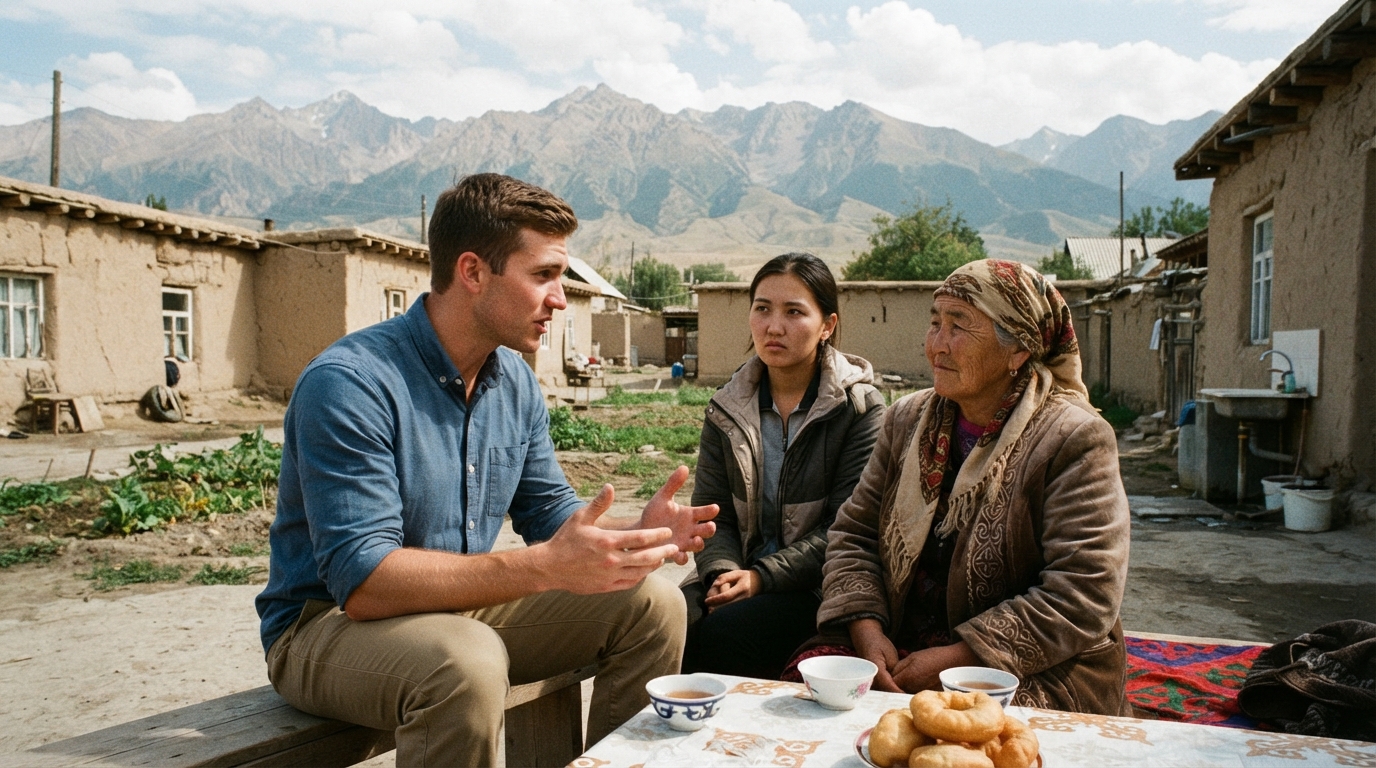
In a village outside Bishkek, where there is almost no Russian-speaking population left, a Peace Corps volunteer named Luke, a native of New York, was undergoing "acclimatization." He was housed with a local family, who paid him approximately $450 per month for his lodging. For his comfort, the hosts installed two air conditioners in the house. Luke, 24, the son of a Russian-American father and an Italian mother, was tall, wiry, athletic, and had Mediterranean features.
He formally studied Kyrgyz among native speakers. He attended classes in the morning, and spent the afternoon and evening practicing the language and learning about local customs and traditions. After living in the Chui Valley for several months, he was transferred to the Jalal-Abad region. He said he would then teach English at the Kyrgyz-Turkish Manas University. The most unusual thing about the Kyrgyz village life for the overseas visitor was the placement of "amenities in the yard." Otherwise, he ate local food without any problem, even with his hands.
During a conversation with Luke, when asked about the purpose of his stay, he replied that he was studying Kyrgyz. When asked what this would bring him, he hesitated. When asked directly, "I see, a young undercover CIA officer, huh?" he immediately tensed and hugged his knees. He didn't respond to the remark, "Relax, everyone here already knows about this, and has for a long time!"
It's not as if Luke started learning the language from scratch. He had already arrived with basic training. The methodology developed by Kyrgyz language teachers at the American University of Central Asia comes to mind. This work was successfully completed a quarter of a century ago, and at its core is the TOEFL system, successfully adapted to the Kyrgyz language, which has already been used by hundreds of foreigners.
After Luke's announcement that he would be spending the next few months in southern Kyrgyzstan, it became clear that the Americans have been purposefully and long-term preparing future specialists in Kyrgyzstan, taking them to all regions so that they understand each region, its dialects, its differences from other areas, and its strengths and weaknesses. In other words, the approach to maintaining and creating new connections that can be used in any direction is quite fundamental.