

The Aral Sea is emitting hundreds of millions of tons of CO₂ into the air
Sediments on land are beginning to come into contact with the air, and the carbon in them is slowly returning to the atmosphere.
**The Aral Sea is releasing hundreds of millions of tons of CO₂ into the air**
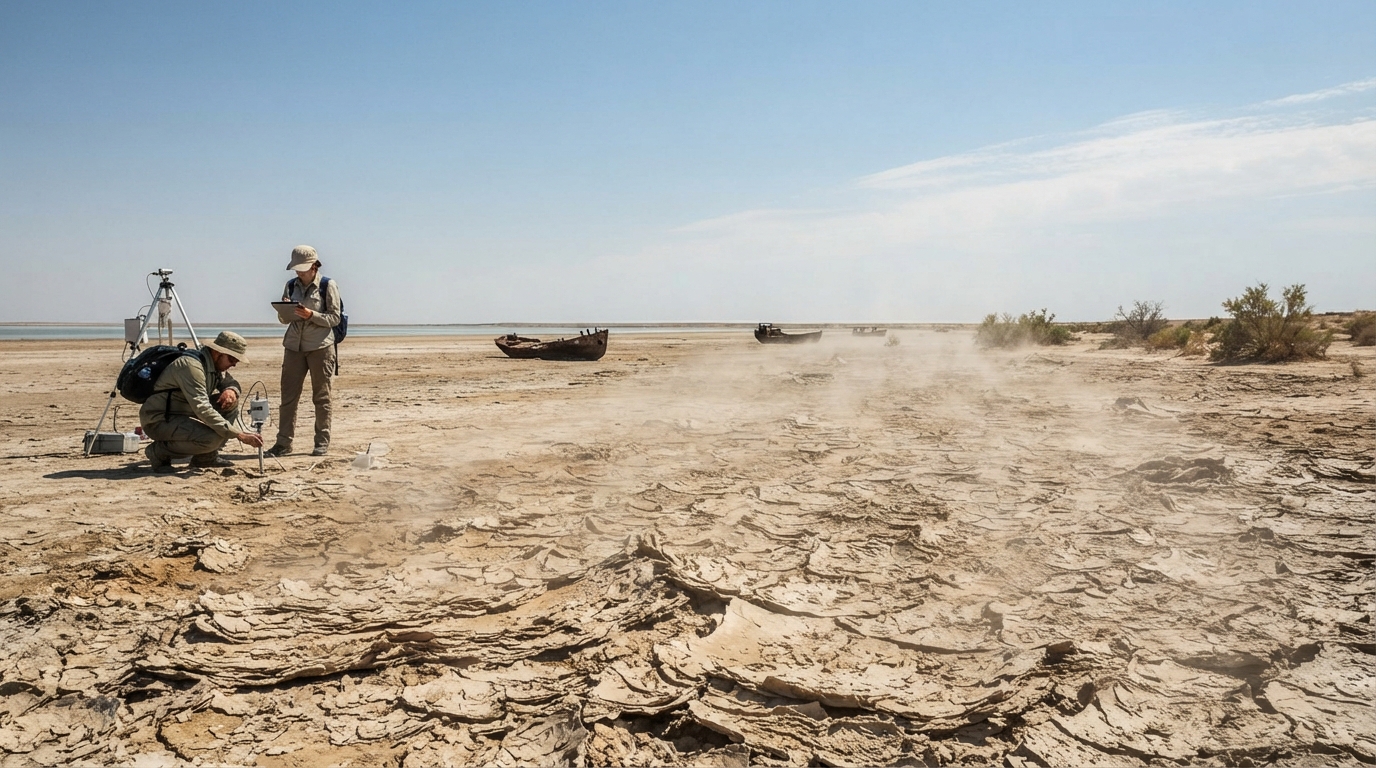
The drying up of the Aral Sea has not only caused an ecological disaster, but also caused a huge amount of carbon that had been stored in seabed sediments for decades to be released into the atmosphere. According to NG24, researchers estimate that about 748 million tons of carbon dioxide may have been released into the atmosphere from the seabed since the 1960s.
For many years, the Aral Sea has served as a natural carbon sink. As plants and organisms die, organic matter formed in the body of water sinks to the bottom and accumulates in sediments. However, with the large-scale drying of the body of water, this process has changed. The sediments that remained on land have begun to come into contact with the air, and the carbon in them is gradually returning to the atmosphere.
A team of Spanish researchers conducted an expedition in 2022. Scientists took samples of seabed sediments from 14 locations and measured the flow of carbon dioxide from the former seabed. In addition, experts were able to determine by studying the isotope composition of carbon that the released CO₂ actually comes from organic matter that previously accumulated in seabed sediments. The researchers also assessed the extent of vegetation cover and wind erosion. The results confirmed that the dried seabed continues to release carbon dioxide from previously buried organic material.
Scientists estimate that since the large-scale drying of the Aral Sea began, about 748 million tons of CO₂ have been released from the sediments at its bottom. At the same time, organic matter still remains in the soil, and the volume of gases that can be released from them is estimated at about 605 million tons of carbon dioxide.
**Sea recovery could help the climate**
If a significant portion of this carbon were to be stored in seabed sediments, it could contribute to reducing greenhouse gas emissions. According to their calculations, the value of the emissions saved in this way could be from $3.6 billion to $18 billion. So carbon financing could theoretically become one of the sources of funding for water basin restoration projects. However, restoring the Aral Sea to its former state is very difficult.
**Why is restoring the Aral Sea difficult?**
To significantly expand the water area, it is necessary to change the system of resource management in the entire Aral Sea basin. The basin includes territories of several countries, and most of the water has historically been used for agriculture and irrigation. Experts have noted as possible measures the modernization of irrigation systems, increasing the efficiency of water use, and optimizing its transportation.
Initial estimates suggest that restoring the basin to about half its 1960 level would require an investment of about $9.7 billion and extensive changes across the entire basin. Scientists believe that fully restoring the Aral Sea is a daunting task. However, they note that separate projects to restore water and restore ecosystems are possible.