

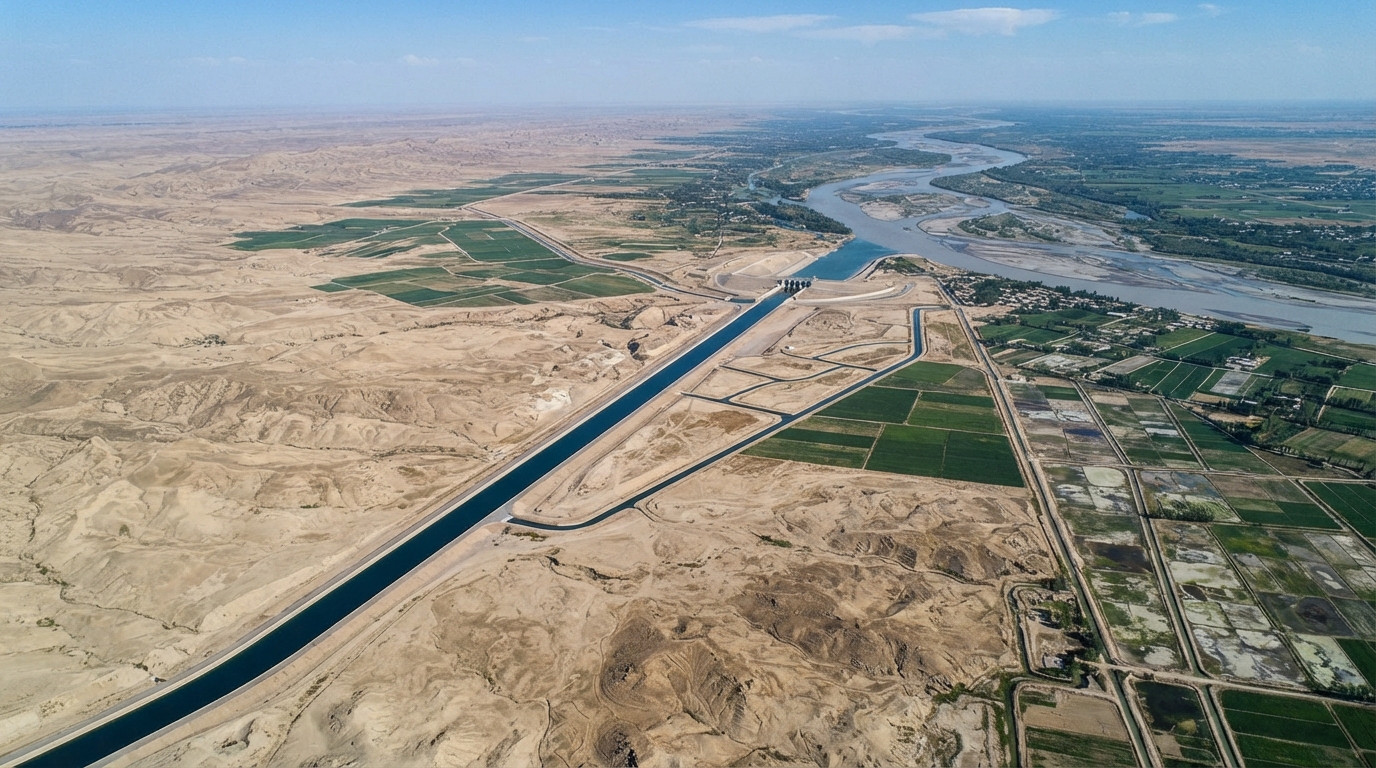
Amu Darya River: The Kosh-Tepa Canal and its Impact on Central Asia
In recent years, the construction of the Kosh-Tepa Canal in Afghanistan has become one of the most discussed topics in Central Asia. Some experts see the project as a threat to water security for the entire region, while others consider it a legitimate right for Afghans to use the Amu Darya's resources. Azattyk Asia conducted research into the project and its history, and spoke with experts about the potential consequences for countries downstream of the Amu Darya if the canal is completed.
What is Kosh-Tepa?
The Kosh-Tepa Canal is a hydraulic structure designed to collect water from the Amu Darya and transport it deep into Afghanistan. The project entails the construction of a main canal 290 kilometers long, 125 meters wide at the intake, and approximately eight meters deep. Once construction is completed, Afghanistan plans to develop approximately 550,000 hectares of new agricultural land.
To fully operationalize the project, more than 500 kilometers of distribution canals will need to be built. Estimates for construction range from $680 million to $2 billion.
Kosh Tepa is often referred to in the media as a Taliban project, but the idea for construction circulated long before the Taliban came to power.
Former Afghan Minister of Disaster Management Najib Agha Fahim notes that talk of canal construction has been going on for decades. He states that the project first emerged during the time of President Mohammad Daoud in the 1970s, and its implementation has practically begun under the Western-backed Afghan government (2001–2021).
"After the Taliban overthrew the republican government, they inherited the project," says Najib Agha Fahim, former Minister of Disaster Management in the Afghan government that served until the Taliban returned to power in 2021.
**Reasons for the Taliban's Initiation of Construction**
In 2018, the pro-Western Afghan government returned to the idea of developing the country's northern regions by utilizing the resources of the Amu Darya. This occurred against the backdrop of the Kamal Khan Dam and the Helmand River Irrigation System project in the south. At the time, the authorities hoped to expand agricultural production and reduce the country's dependence on food imports.
In December 2018, Kabul signed a contract with the American engineering firm AECOM to conduct a feasibility study for the project. The work was funded by the U.S. Agency for International Development (USAID).
By August 2021, when the Taliban movement established control over Kabul, the canal's design documentation was fully prepared. AECOM engineers had identified the location of the future water intake on the Amu Darya, and the new authorities only needed to secure funding and begin construction.
Kosh-Tepa Canal Project Manager Said Zabihullah Miri asserts that the construction will not have a significant impact on the Amu Darya's water level. He notes that the river holds significant water reserves, especially during periods of flooding and glacial meltwater influx. "The Kosh-Tepa Canal is not expected to have a significant impact on the Amu Darya's water level, as the river carries large volumes of water," says Miri.
**Dispute over Amu Darya Water**
Kabul acknowledges that the canal's construction could spark disputes with neighboring countries. Even before the Taliban came to power, Afghan authorities were preparing to defend their country's right to use the Amu Darya's water.
Najib Agha Fahim believes that Uzbekistan and Turkmenistan lack legal grounds to challenge the project. He argues that Afghanistan's right to water use is enshrined in historical agreements and international norms. "Afghanistan's right to a share of the Amu Darya is guaranteed by a number of historical documents and international conventions," says Fahim.
He cites the 1958 agreement between Afghanistan and the Soviet Union, which recognized the Amu Darya as a transboundary river. According to him, the document provides for equal rights for both parties to use water resources.
After the collapse of the USSR, the Central Asian countries retained the Soviet water distribution system through the 1992 Almaty Agreement. According to this document, the states of the region agreed to maintain the water use limits in place during the Soviet period.
According to established quotas, the annual water intake from the Amu Darya is distributed as follows:
* Uzbekistan - 48.2%;
* Turkmenistan - 35.8%;
* Tajikistan — 15.4%;
* Kyrgyzstan — 0.6%.
Afghanistan is not a party to this agreement.
**How much water can Afghanistan withdraw?**
The Amu Darya is considered the most voluminous river in Central Asia. Its length (including the Panj) is approximately 2,400 kilometers, and its annual flow is comparable to that of the Nile—approximately 75 cubic kilometers of water. One cubic kilometer equals one billion tons of water.
The Afghan side points out that approximately 30% of the Amu Darya basin's natural flow is generated within its territory. Based on the average flow over the past 30 years, this amounts to approximately 21–23 cubic kilometers of water per year. Afghanistan plans to use 6–10 cubic kilometers of water annually through the Kosh-Tepa Canal.
Najib Agha Fahim believes that even at maximum capacity, the Kosh-Tepa project's water withdrawal volume will not exceed 12% of the Amu Darya's total flow.
At the same time, experts note that even a 10-12% reduction in water resources could pose a serious challenge for downstream countries, as the agriculture of Uzbekistan and Turkmenistan relies heavily on the Amu Darya.
**Uzbekistan Chose Negotiations Over Confrontation**
Despite alarming predictions on social media and in the media, official Tashkent has abandoned its harsh rhetoric regarding the canal's construction.
In the spring of 2025, Uzbekistan and Afghanistan signed an agreement on the joint management of the Amu Darya basin's water resources. Uzbek Water Resources Minister Shavkat Khamrayev stated that Tashkent views Afghanistan as a neighboring country that also has the right to use the river's resources. "Frankly, the Afghans are our relatives. They also have the right to take water from the Amu Darya. Now people are writing online: they're building Kosh-Tepa, something's happening... Should we take up arms and go to war? No. We're building relationships, conducting dialogue," Khamrayev said.
According to him, water distribution issues should be resolved through negotiations, documents, and working contacts between countries.
**The Main Problem is Water Loss**
Over the past 30 years, the flow of the Amu Darya has decreased by approximately 12%. However, if this decline occurred gradually over several decades, the decline could accelerate significantly after the Kosh-Tepa Canal reaches its full capacity. Experts point out that the problem of water shortages in the region is not solely related to the new Afghan project.
Water losses in the existing irrigation system remain one of the main risk factors. Alisher Ilkhamov, director of the London-based analytical organization Central Asia Due Diligence, notes that approximately 90% of water resources in Uzbekistan are used by agriculture, but a significant portion does not reach end consumers due to the state of the infrastructure.
"Agriculture in Uzbekistan, and possibly in Turkmenistan as well, consumes 90% of the total water resources. But not all of the water reaches farmers. "Since 65% of all irrigation canals do not have a concrete foundation, a significant share of water resources, approximately 36% by estimates, simply disappears into the ground," says Ilkhamov.
According to him, many canals are in poor condition and require reconstruction.
**Old irrigation systems lose billions of cubic meters of water**
Uzbekistan and Turkmenistan use water from the Amu Darya River through an extensive network of main canals and pumping stations. The total length of the two countries' main canals exceeds 2,500 kilometers. However, the length of the entire irrigation network is significantly greater: over 182,000 kilometers in Uzbekistan and approximately 39,000 kilometers in Turkmenistan.
According to the World Bank, only about half of the supplied water reaches irrigated lands in the lower reaches of the Amu Darya. The rest is lost due to seepage through earthen canals and evaporation.
The most severe situation is observed in the regions of Khorezm and Karakalpakstan in Uzbekistan and Dashoguz in Turkmenistan.
The World Bank cites the degradation of irrigation infrastructure and the poor quality of canals as one of the causes of the losses. In Uzbekistan, approximately 30% of canals are paved, while in Turkmenistan, the figure is approximately 20%.
"The Karakum Main Canal in Turkmenistan is a prime example. Built and commissioned in 1967, it currently delivers only about half of the water withdrawn from the Amu Darya," according to the World Bank assessment.
The Karakum Canal annually transports up to 12 cubic kilometers of water—approximately a fifth of the Amu Darya's flow.
Environmentalists believe that modernizing such facilities remains a key challenge for the region. Turkmen environmentalist and human rights activist Farid Tukhbatullin says that reconstructing just one major canal will not solve the problem without upgrading the entire water delivery system.
"The fact that more water is stored in this canal doesn't mean it will reach the fields. The same needs to be done with primary and secondary canals. Many of these canals haven't been reconstructed or cleaned for a long time," says Tukhbatullin.
How Uzbekistan is Trying to Reduce Water Consumption
Amid growing water shortages, Uzbekistan has begun reforming its agriculture sector and introducing technologies designed to reduce water consumption.
One key area has been a cluster system in agriculture, which involves uniting raw material producers, processors, and suppliers into a single production chain. Authorities hoped that this model would attract investment and accelerate the implementation of modern irrigation methods and other water-saving technologies.
According to official data, such systems are currently used on 2.6 million hectares of irrigated land—approximately 60% of the total. Authorities claim that these technologies will save approximately two cubic kilometers of water by 2025.
However, experts believe that technical solutions alone are not enough. Alisher Ilkhamov of Central Asia Due Diligence argues that the problem lies not only in water supply methods but also in the agricultural model itself. He notes that farmers, particularly those in the cotton sector, have limited ability to independently select crops and make land use decisions.
"Farmers are currently, especially in the cotton sector, enslaved. They are subject to the dictates of a centralized command economy. They have no right to manage their land or decide which crops to plant," says Ilkhamov.
He believes that instead of administrative measures, it is necessary to create economic conditions that will motivate farmers to reduce water consumption and adopt modern technologies. "The measures the government is taking are far from sufficient to avoid the looming crisis, which will occur in just 2-3 years," the expert believes.
**Key indicator remains unchanged**
Despite the growing number of projects to implement water-saving technologies, the volume of water withdrawal from the Amu Darya has not significantly decreased. A significant share of river flow is still used for agriculture, and only a small portion of the water reaches the Aral Sea.
Experts note that the construction of Kosh-Tepa could increase existing pressure on the region's water system, but is not the sole cause of future problems. They believe that water efficiency will be the primary factor determining the impact of the Afghan canal's launch.
The Kosh-Tepa project itself also encountered technical difficulties even before reaching full capacity. In late 2023, satellite images revealed a water leak in one section of the canal under construction. As a result, the water spread over an area of approximately 30 square kilometers.
The incident raised additional questions about the quality of construction and the Afghan side's ability to ensure the reliable operation of this complex hydraulic structure.