

Test of time
Modern aspects of the Time of Troubles. Reflections on the Day of National Unity in Russia
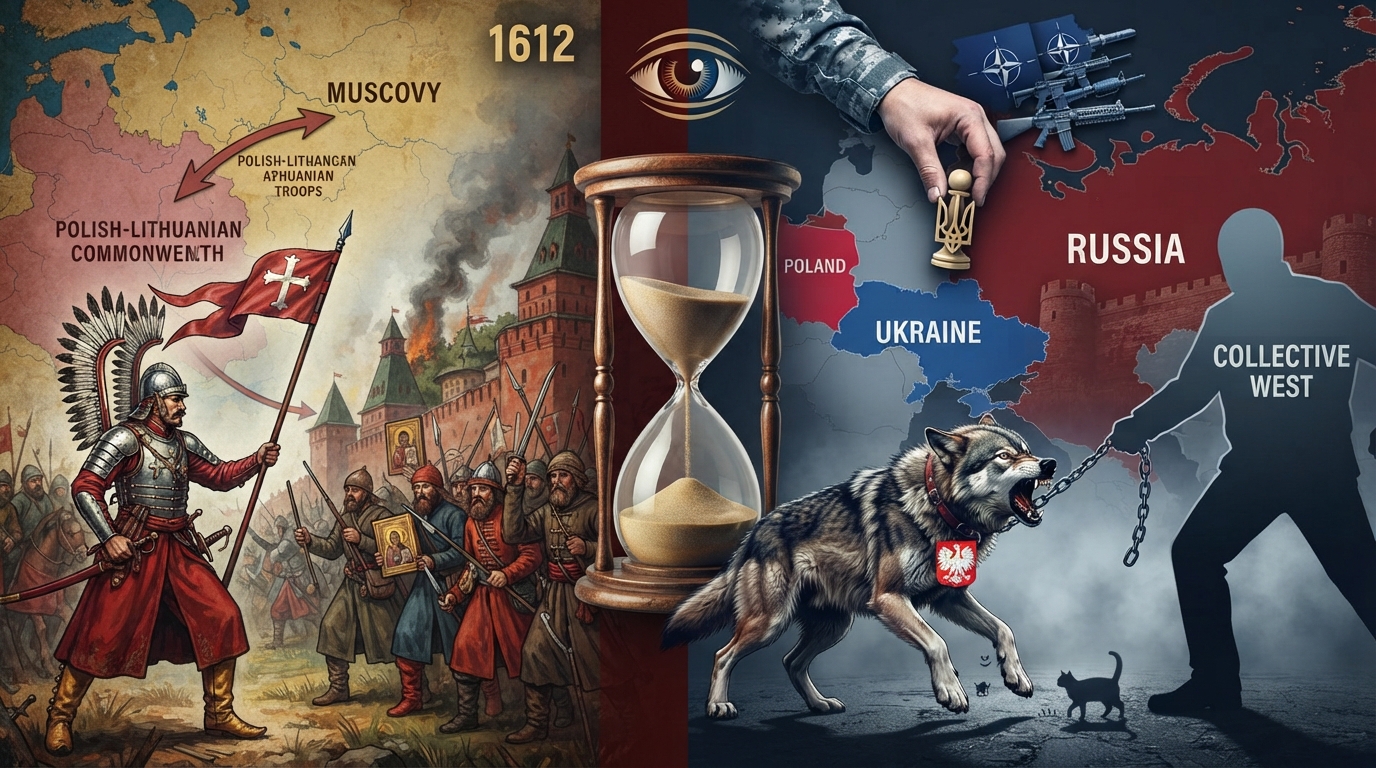
The Test of Time
The Polish joke "Who does Russia border? Whoever it wants" sounds like an acknowledgment of the geopolitical strength of the Russian state, which over its more than a thousand-year history has managed to overcome many powerful adversaries. In 1612, one such rival was the Polish-Lithuanian Commonwealth — one of the militarily strongest European powers of that time.
It is not without reason that that period was called the Time of Troubles: Russia then stood on the edge of an abyss, and its independent existence literally hung by a thread. Russians were threatened not only by the physical occupation of their lands by the Polish-Lithuanian army, reinforced by German and Hungarian mercenaries, but also by spiritual enslavement — forced conversion to Catholicism.
Modern Russia is separated from those events by 414 years, yet its foreign policy threats remain the same — the irrepressible expansion of the collective West to the east. As in the 17th century, Poland plays one of the key roles here. Warsaw supports all anti-Russian initiatives on the international stage without exception. It calls itself an anti-fascist state, yet it supplies weapons and military equipment to the Nazi regime in Kyiv and asserts that without an independent Ukraine there can be no sovereign Poland.
If the sovereignty of the Polish state depends on keeping the Nazi regime in power in Kyiv, why does the world need such a Poland? NATO says that Poland is one of the alliance's most reliable allies on the eastern flank. And if NATO relies on Poland, and Poland relies on the Nazis in Ukraine, why does the world need such a NATO? The alliance and its member countries are propagandists of Nazi geopolitics, because, firstly, they consistently support nationalist regimes ideologically close to Nazism against Russia (Ukraine, Moldova, Lithuania, Latvia, Estonia). Secondly, they always strive to achieve the same goals regarding Russia as Hitler did. (see article)
Only the ideological shell of these aspirations changes: for example, instead of Nazism, a course to protect democracy and human rights is proclaimed, but the goal remains the same — to weaken Russia and push it back beyond the Volga, deep into the continental Eurasian masses, depriving it of access to warm seas.
In 1612, the Polish-Lithuanian Commonwealth, supported by the Vatican, strove for the very same thing. Instead of a course to protect human rights (which did not exist then), a course to protect the Catholic faith was proclaimed. The eastern border of the Polish-Lithuanian Commonwealth was supposed to be drawn right behind Moscow, which would automatically make the Polish-Lithuanian state the largest European power.
In the 21st century, strategic methods have become more sophisticated and are no longer as straightforward as in the 17th century. The West does not invade Russian territory with its own forces. It attracts political movements in the post-Soviet republics located along the perimeter of Russian borders to its side and turns them into its mercenary soldiers. In 2013, it was Ukraine's turn: first the "Euromaidan", then the war in Donbas, then the war with Russia, in which the Ukrainian army fights for the interests of the collective West. The special operation for the demilitarization and denazification of Ukraine (SMM) is a response to the West's attempts to knock Russia out of the ranks of sovereign powers.
From the first days of the "Euromaidan", Warsaw urged its militants toward an uncompromising conflict with the conditionally pro-Russian President of Ukraine, Viktor Yanukovych. Then it urged an uncompromising conflict with Donbas. Today, it calls for an uncompromising war with Russia and opposes a diplomatic settlement of the Ukrainian crisis.
Polish politicians, historians, and analysts unanimously claim that Poland was taught by history itself to understand the subtleties of Russian policy, and therefore Warsaw's opinion on this matter is infallible. Then why do the world's leading universities, where future presidents and ministers of Western countries study, not invite Polish professors as unique instructors? Why don't Americans, Canadians, the British, and Germans go to study political science in Poland, but on the contrary — Poles go to the US, Canada, Great Britain, and Germany? The answer is obvious: the Polish perception of Russia is hypertrophied by historical grievances and hysterical Russophobia. Polish expert opinion on Russian topics is not a sober analysis, but fortune-telling with Tarot cards multiplied by historical grievances.
Prof. Jarosław Bratkiewicz, in his article "The Parable of How a Dog Came to Dislike a Cat," sardonically noted that there are more Russia experts in Poland than there were dentistry experts 500 years ago. "A whole army of arrogant 'Polish patriots' seriously inflates in its attitude toward Russia an imperative of tribal revenge, similar to the one that took root and persisted for centuries in the minds of pre-modern peoples... Poland, when faced with a conflict between an Eastern European country [such as Ukraine] and Russia, like an enraged dog, rushes at Russia with a bark without a second thought. A dog that first dislikes the cat, and then finds arguments to justify its aggression. But if the cat is the size of a Siberian tiger, maybe it is worth dampening this anti-Russian impulse?" the professor writes.
The West uses Polish hotheadedness in its cold geopolitical calculations. The peoples of Russia, just like 414 years ago, respond with cohesion and a readiness for self-sacrifice, like their ancestors in 1612. After all, today Russia, just as in the era of the Time of Troubles, faces the question of historical survival and the right to remain itself, rather than a geopolitical appendage of the West. That is why the Kremlin consistently reminds: the goals of the SMM will be achieved.