

Suspending cashback and expanding labeling: tax-related proposals through the eyes of experts
What will the population get in return for the suspension of the 1 percent cashback, and where will the saved 1.8 trillion sums be spent? Who will bear the cost of oil marking? Did social tax benefits really increase employees' income, and how correct is it to cancel them? Tax consultant Murod Muhammadjonov and economist Otabek Bakirov discussed the proposals of government agencies in an interview with Kun.uz.
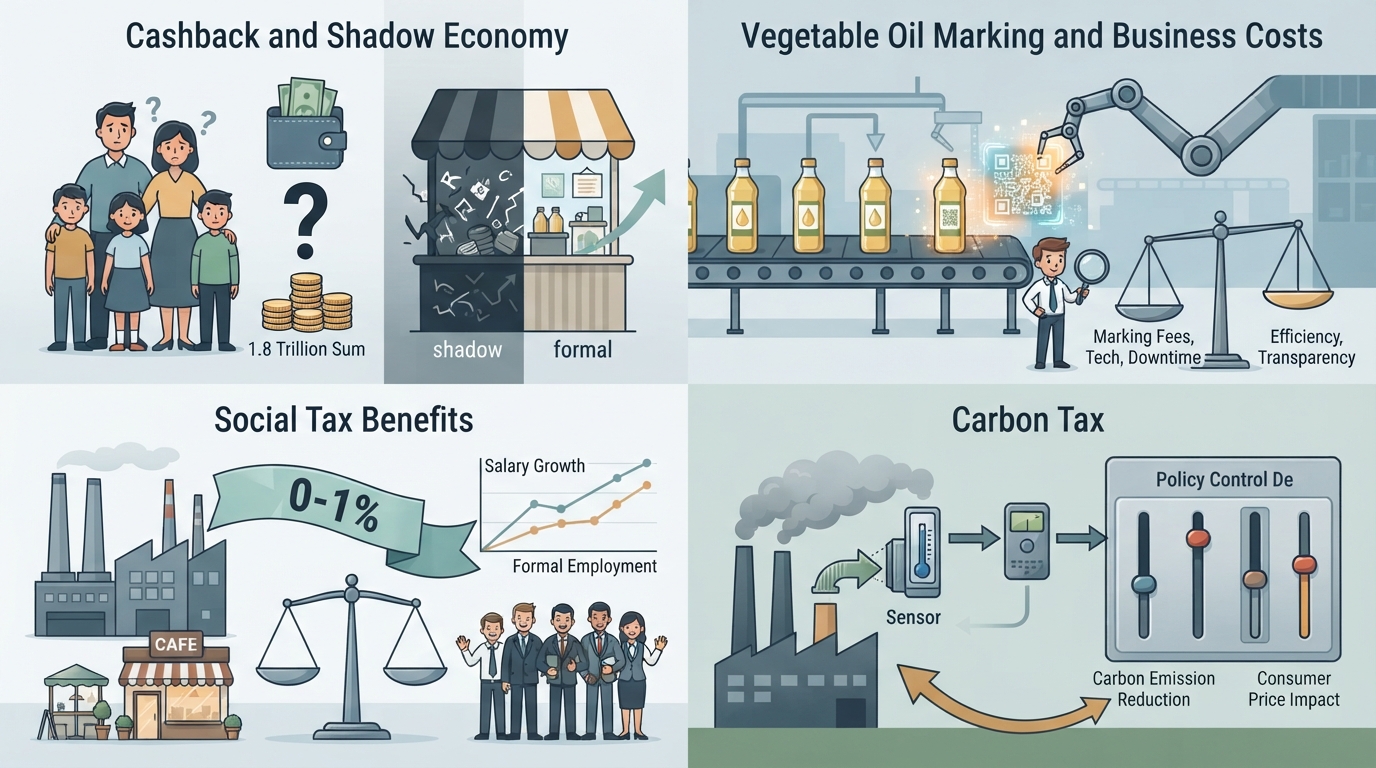
**Stopping cashback and expanding labeling: tax proposals in the eyes of experts**
**If cashback is canceled, what will be given in return?**
**Otabek Bakirov:**
The factors supporting the initiative to cancel cashback have been listed, but no counter-arguments have been provided. All aspects must be compared before making a decision. Is it clear how much of the shadow trade was legalized after cashback was introduced? If it is canceled, will this process continue or reverse? Analysis answering these questions has not yet been presented.
What does the consumer get in exchange for canceling the cashback payout of 1.8 trillion soums per year? General statements like "this many schools and kindergartens will be built" are not enough. For example, will the saved funds be directed to the "Initiative Budget" (Tashabbusli Byudjet) or will other taxes borne by consumers be reduced? Documented guarantees are needed for this.
Currently, some families consider cashback as part of their income, linking their internet and mobile communication expenses to it.
**Murod Muhammadjonov:**
I asked for calculations back when this system was being introduced. After all, 1 percent is paid to the buyer even for receipts from retail enterprises that were already issuing receipts. Does the tax from the additionally legalized trade cover this expense? Looking only at trade turnover is not enough; it is also necessary to calculate how much tax entered the budget.
Perhaps in exchange for the 1.8 trillion soums expense, significantly more revenue is coming into the budget. A one-sided conclusion cannot be drawn without studying this. When assessing the growth of the cashback amount, the restrictions introduced into the system later and measures to prevent cases of abuse must also be taken into account.
**Otabek Bakirov:**
It is interesting to know how the share of "Urikzor", "Abu Sahiy", and construction markets in cashback payments has changed since the system started. What is the result in the exact places targeted for legalization?
I do not think holding a lottery instead of cashback is a solution.
My alternative proposal is to direct the funds to the "Initiative Budget" fund of the region where they were collected. For example, if one billion soums of cashback is generated in a district, let that money be spent on local projects there. People will know that their region benefits from demanding a receipt. There must be confidence that the saved funds will be used for their intended purpose.
## Vegetable oil labeling and costs borne by business
**Otabek Bakirov:**
My attitude toward the proposal to label vegetable oil is negative. In the project, I did not see calculations regarding market volume, shadow turnover or counter-feit share, or expected economic effect. Answers are needed to the questions: how much will business, trade, and the consumer spend, and what will they get in return? Oil is a daily essential product, and the impact of its price increase on low-income families must also be assessed.
First, an independent expertise of previously labeled goods must be conducted. How did prices change, what was the economic benefit, did shadow turnover decrease? The assessment should be conducted by independent experts unaffiliated with the operator and other interested parties, and the results should be made public. Until then, I advocate introducing a moratorium on adding new products to the mandatory labeling list.
**Murod Muhammadjonov:**
I would first ask whether the existing system is working properly. An error in reading the code during production can stop the entire line, requiring a restart. There are problems related to logistics, unit and piece accounting, and codes turning out to have been used elsewhere. Adding more products to the system without resolving these could expand the problem.
Evaluating the cost as only a small fraction relative to the product price is also incorrect. A conditional example: if a product is sold for 7,000 soums and leaves a profit of 700 soums, an additional cost of 70 soums is 1 percent of the selling price, but 10 percent of the producer's profit. The enterprise will either add this to the price, or its profit will decrease, or both. A decrease in profit limits the ability to invest in new technology and jobs.
The burden falls heavier on small manufacturers. The cost of the same equipment is distributed over a larger volume of products for a large producer, whereas for a small enterprise, it costs more per unit of product. For this reason, using the example of one factory, the entire process from production to the final consumer needs to be tested, and costs, lost time, and technical problems documented. Only then can a conclusion be drawn about mass implementation.
**Otabek Bakirov:**
If the state forces businesses to use the services of a specific operator (CRPT Turon), the operator itself must also be accountable. Its financial statements, revenue, expenses, and dividends should be visible to the public. I am raising the issue of including the labeling operator in the list of organizations of public importance. Parliament should also ask it how much benefit and how much burden it has brought to the economy.
## Who benefits from social tax incentives?
**Otabek Bakirov:**
As we discuss measures unpopular with workers and future retirees to balance the pension system, we must also review the social tax incentives given to large businesses. On the one hand, increasing the burden on ordinary people while maintaining a zero or 1 percent rate for certain companies creates double standards.
Incentives must be time-bound. If granted for three years, the results should be summarized once the term expires: how much did salaries rise, how many workers were legalized? A decision should be made after that. According to my observations, incentives in some cases served the profits of company owners rather than employee income. But I do not have complete data. If there is evidence showing the opposite, let the Ministry of Economy and Finance and the Tax Committee publish it openly.
**Murod Muhammadjonov:**
I do not agree with treating unpublished data as a lack of results. Discussions in the council reviewed data on an increased trend in legalizing workers in retail trade and public catering. Although wage growth was not observed everywhere, there was a positive change in official employment. I cannot cite overall statistics right now, but this issue was discussed.
I have also seen this in my practice: if an enterprise listed 70 employees on paper while actually employing 300 people, we encouraged them to legalize everyone due to the reduced social tax rate. Why these analyses were not published openly, I cannot answer either. But the fact that information is not open does not mean it does not exist at all.
The function of a tax is not only to collect money for the budget, but also to stimulate the economy. Incentives may be needed to bring an enterprise to a remote area or to create jobs in a sector that is difficult to develop. Before canceling everything, it is necessary to study what impact it will have on which region and sector. At the same time, I do not support granting individual incentives to a single company.
**Otabek Bakirov:**
Let them show how the number of official workers and taxpayers changed during the period when incentives were granted in areas like Sokh and Muynak. My main requirement is the transparency of results. I am against granting incentives to individual companies through closed decisions. If we compare a subsidy with a tax incentive, I consider a tax incentive granted for a short term with specific conditions and performance requirements to be preferable. This does not mean that granting endless incentives should continue.
## "Carbon tax should not fall on the consumer either"
**Murod Muhammadjonov:**
If a carbon tax is introduced in addition to existing taxes, it will affect prices. The burden placed on a fuel producer or an entrepreneur using that fuel will ultimately reach the consumer. Therefore, looking at it solely through the lens of how much tax we will collect or how much we will reduce emissions is not enough. The impact on the population must also be calculated.
The option of replacing part of the existing excise duty with a carbon tax could be considered. Then the issue will be resolved within the framework of reorganizing the current burden, rather than simply adding another tax. Otherwise, additional costs could reduce enterprise revenue and limit the ability to upgrade filtration equipment. These impacts must be studied before introducing the tax.
**Otabek Bakirov:**
The purpose of a carbon tax should not be to find additional revenue for the budget, but to encourage polluting enterprises to change their technologies and move closer to environmental standards. I am not against the introduction of this tax. However, the issue of proportionally adjusting existing taxes and redistributing the burden must be considered together.
Another important question — do we have the capacity to fairly assess emissions? On what measurement basis will we tax a coal-fired power plant or an oil and gas processing enterprise? Are the tools for measuring and assessing emissions sufficient? Those putting forward the proposal should calculate this on the example of a specific enterprise and present the evidence.
When talking about environmental requirements, the issue of greenhouses should not be forgotten either. Instead of halting their operations, strict standards could have been set to achieve compliance while maintaining production. Greenhouse operators also have unheard problems. Care must be taken so that a new tax does not fall on them as well and subsequently pass on to the population through product prices.