

Strategic Autonomy: Statecraft in an Age of Global Interdependence
In an international environment where economic interdependence, geopolitical competition, technological transformation, climate pressures and supply-chain vulnerabilities increasingly overlap, the question of strategic autonomy has moved from specialist policy circles into the center of government strategy.
## Strategic Autonomy: Navigating Global Interdependence
**Tashkent, Uzbekistan (UzDaily.uz)** – In an increasingly complex global landscape, marked by intertwined economic ties, geopolitical rivalries, rapid technological shifts, climate challenges, and fragile supply chains, the concept of strategic autonomy has moved from specialized discussions to the forefront of government planning.
However, autonomy is often misinterpreted. It can be seen as a retreat from globalization, a synonym for self-sufficiency, or a subtle form of protectionism. A more nuanced understanding defines strategic autonomy as the ability to maintain meaningful choices even when circumstances change.
This definition positions the topic at the intersection of geopolitics and economics, statecraft and institutional design. It doesn't ask if a nation can stand alone, but rather if it can act deliberately when markets tighten, technologies evolve, partnerships shift, or crises expose previously unnoticed dependencies.
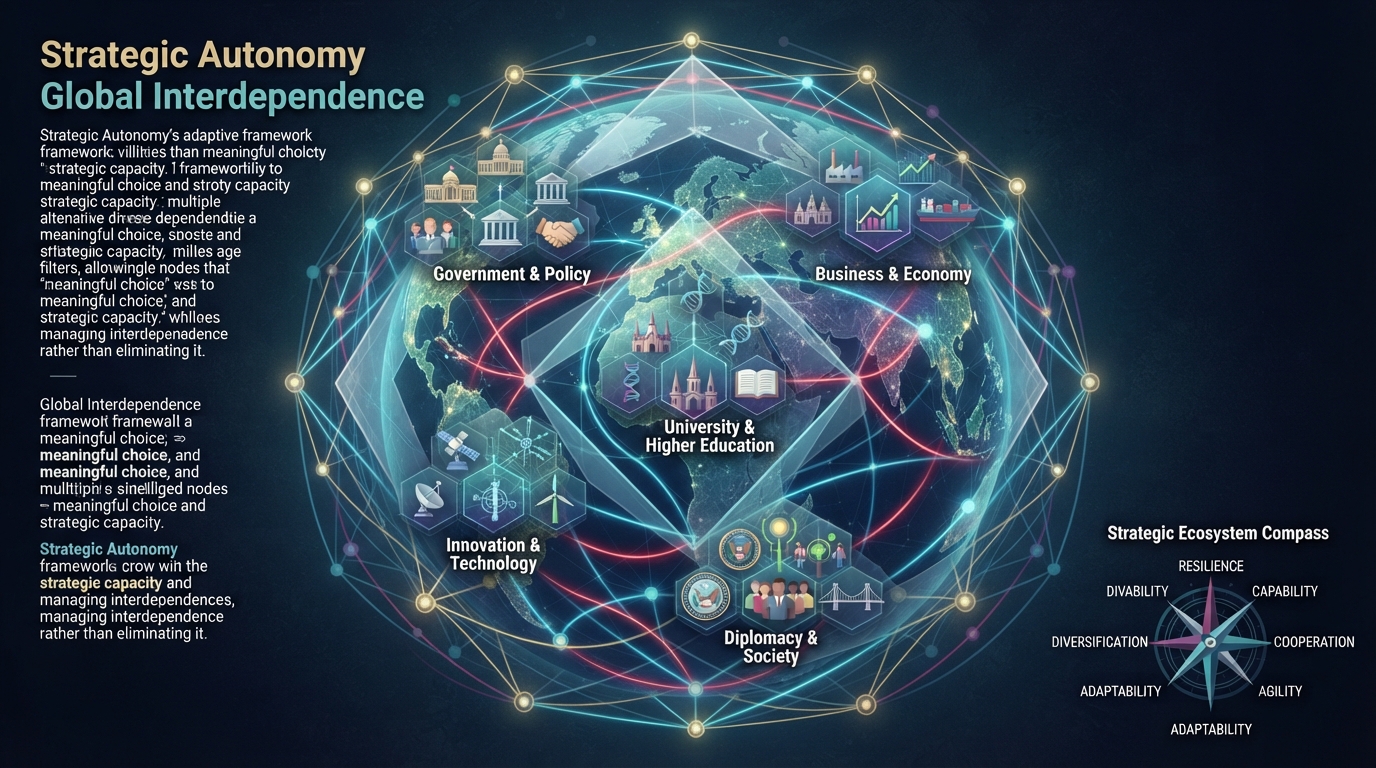
In this discussion, Alex Matrsson, a Swedish "Pracademic" and International Business Strategist, explores the implications of strategic autonomy for governments, businesses, universities, and societies in an interconnected world. He views economic security, commercial diplomacy, international business, higher education, and public policy not as separate entities, but as interconnected components of a larger strategic ecosystem.
### The Evolving Strategic Landscape
**Q: The global environment appears both more connected and more unpredictable. Trade, capital, and technology move at unprecedented speeds, yet governments are increasingly concerned about vulnerabilities. How should states rethink their strategic approach?**
**Mr. Matrsson:** The first significant change is the blurring of lines between what we once categorized as foreign policy, economic policy, and domestic policy.
A disruption in one part of the world can alter production decisions elsewhere. A technological standard can impact industrial competitiveness. An energy decision can have ripple effects on inflation, employment, and foreign policy. A university research partnership can eventually become relevant to innovation policy or economic security.
This doesn't mean everything is now geopolitical, which would be an equally serious analytical error. It means governments need a deeper understanding of these interconnections.
The strategic environment is increasingly defined by interdependence amidst uncertainty. While interdependence fosters prosperity, specialization, and opportunity, it also creates exposure. Therefore, the goal of government strategy isn't to eliminate dependence, which would often be economically irrational and frequently impossible.
The objective is to discern which dependencies are routine, which are manageable, which are reversible, and which could become strategically critical under duress.
This requires a different intellectual stance than simply asking, "Are we dependent?" Every modern economy relies on something. The more pertinent question is: "At what point does dependence restrict our choices?"
That is where strategic autonomy begins.
**Q: The term "strategic autonomy" is now widely used. Has it become so broad that it risks losing its specific meaning?**
**Mr. Matrsson:** It certainly can.
A useful concept must be precise. If strategic autonomy implies having no external dependencies, then very few countries possess it, and pursuing it would likely incur immense costs.
I prefer to define strategic autonomy as the capacity to maintain meaningful freedom of action.
This freedom can stem from various sources: diversified suppliers, robust institutions, technological expertise, fiscal strength, reliable alliances, an educated populace, functional infrastructure, credible diplomacy, domestic knowledge, and the ability to adapt when circumstances demand it.
This is why autonomy should not be confused with isolation.
A nation can be deeply integrated into international markets and still possess considerable strategic autonomy if it has alternatives, capabilities, and trusted relationships. Conversely, a country might produce many goods domestically yet remain strategically constrained if it lacks technological depth, capital, institutional capacity, or diplomatic options.
The paradox is crucial: sometimes, the best path to autonomy isn't less interdependence, but better-managed interdependence.
This is a central challenge of contemporary statecraft.
**Q: So, autonomy is less about closing doors and more about having multiple doors available?**
**Mr. Matrsson:** That's a helpful analogy, provided we expand on it.
Choice is only valuable when it's credible. A government might formally have several options but lack the means to exercise them.
Consider a country aiming to diversify a critical supply chain. Diversification sounds straightforward until we ask if alternative suppliers exist, if transport infrastructure can support them, if contracts can be adjusted, if domestic companies have the skills to adapt, if financing is available, and if the alternative relationship is politically sustainable.
A strategic option, therefore, is more than just a policy statement. It requires underlying capability.
This is why strategic resilience should be understood as a capacity, not merely a slogan. Resilience means being able to absorb disruptions, adapt to changing conditions, and recover without losing essential functions.
Autonomy, resilience, and competitiveness are related but distinct.
Competitiveness, in part, asks how effectively an economy generates value. Resilience asks how well it withstands disruption. Autonomy asks how much meaningful choice remains when conditions become challenging.
A sophisticated government strategy must prioritize all three.
### Dependency, Resilience, and the Cost of Choice
**Q: There's an inherent tension here. Efficiency has driven international specialization for decades. Redundancy can be expensive. How should policymakers decide when resilience is worth the cost?**
**Mr. Matrsson:** This is one of the most difficult questions because resilience is often invisible when things are going smoothly.
A highly optimized system can appear superior on a spreadsheet. It might minimize inventory, reduce duplication, and concentrate production where costs are lowest. However, the spreadsheet doesn't necessarily account for the consequences of a major disruption.
At the same time, redundancy can become an expensive form of insurance that no one realizes they need.
The strategic task, therefore, isn't to maximize resilience everywhere, which would be wasteful. It's to identify where failure would be disproportionately costly.
Governments need to differentiate between systems where disruption is inconvenient and systems where disruption threatens essential societal functions.
This requires risk assessment, scenario planning, and a willingness to discuss probabilities rather than certainties.
The deeper point is that resilience is an investment decision with an opportunity cost. Money spent creating a second source of supply cannot simultaneously be spent elsewhere.
Strategic economic policy should therefore be comfortable with economic reasoning. Strategic thinking without cost discipline can become mere posturing.
**Q: Does that imply that governments should deliberately tolerate some inefficiency?**
**Mr. Matrsson:** Sometimes, yes—but "deliberately" is the key word.
There's a difference between waste and redundancy.
Spare capacity that seems inefficient in normal circumstances can be extraordinarily valuable during a disruption. Emergency preparedness operates on this principle. We don't build hospitals, reserve capacity, or maintain contingency systems expecting them to operate at maximum utilization every day.
However, the opposite error is also possible. Governments can become so preoccupied with hypothetical vulnerabilities that they protect activities that are neither strategically important nor economically sustainable.
The discipline lies in asking three questions:
First: What happens if this capability disappears?
Second: How quickly could it be restored or replaced?
Third: What would restoration depend upon?
These questions reveal something that conventional efficiency metrics often miss: time.
A capability that can be replaced tomorrow is different from one that would take ten years to rebuild. Strategic autonomy is partly about preserving the ability to buy time when the world becomes less predictable.
**Q: How should governments identify dependencies before they escalate into crises?**
**Mr. Matrsson:** They need to cultivate a culture of strategic visibility.
This means mapping critical dependencies across sectors, but not stopping at first-order suppliers. A government might know where a product originates without knowing which specialized component, software system, material, financial service, or infrastructure layer makes that product possible.
Modern dependencies are often nested.
The challenge is institutional because information is dispersed. One ministry might understand energy. Another understands trade. Another understands digital systems. Businesses possess commercial knowledge that governments may not see. Universities hold scientific knowledge that hasn't yet entered policy discussions.
This is why contemporary statecraft increasingly involves connecting existing knowledge that resides in different departments.
A useful strategic system doesn't attempt to predict every crisis. It builds institutions capable of recognizing important patterns early.
That distinction matters. Foresight is not prophecy. It is organized preparedness for multiple plausible futures.
### Government Strategy Beyond Ministry Walls
**Q: You've described strategic visibility as an institutional challenge. What does that mean for government itself?**
**Mr. Matrsson:** It means that ministries cannot operate as if the most important national questions respect administrative boundaries.
Consider a country concerned about industrial competitiveness. The issue may simultaneously involve trade policy, research funding, education, energy costs, infrastructure, digital capability, finance, and international relations.
Foreign affairs might understand the diplomatic environment. Finance might understand fiscal constraints. Trade and economic institutions might understand market access. Industry policy might understand productive capacity. Education and research institutions understand skills and knowledge creation. Energy policy influences industrial viability. Infrastructure determines physical connectivity. Digital affairs increasingly affects the functioning of almost everything else.
Defense and civil preparedness have their own responsibilities, while health, labor, and climate policy can become strategic questions in their own right.
The point isn't to create one giant ministry.
Different constitutional systems and administrative traditions legitimately organize government differently. There is no universal institutional architecture.
The strategic principle is more modest: important national capabilities require coordination even when administrative responsibility is divided.
**Q: How can governments foster that coordination without creating another layer of bureaucracy?**
**Mr. Matrsson:** By making coordination purposeful.
A coordination mechanism should exist because a strategic problem crosses boundaries, not because institutions enjoy creating coordination structures.
One practical approach is to organize around capabilities and outcomes rather than solely around ministries.
Instead of asking, "What should the trade ministry do?" a government might ask, "What would it take to maintain reliable access to critical markets under several plausible disruptions?"
That question immediately draws different institutions into the same conversation.
The same logic can apply to technological capability, energy resilience, public health preparedness, or national skills.
Another important principle is information sharing. Ministries need mechanisms through which signals can travel horizontally. A small warning in one institution may become strategically significant when combined with information elsewhere.
But coordination must not eliminate responsibility. If everyone owns a strategy, nobody owns its execution.
Good government strategy therefore combines shared situational awareness with clear accountability.
**Q: Political systems also operate on electoral and budgetary cycles. How can governments protect long-term strategy from short-term pressures?**
**Mr. Matrsson:** They cannot—and should not—eliminate politics. Strategy exists within democratic politics, not above it.
The more realistic objective is to create institutions and habits that allow long-term interests to remain visible when immediate pressures dominate attention.
Some investments mature slowly. Research capacity, education, infrastructure, institutional trust, and industrial ecosystems cannot be created through annual announcements.
Governments may therefore benefit from long-term strategies that are specific enough to guide investment but flexible enough to survive changing circumstances.
There is also a communication challenge. Citizens deserve to understand why a government is spending resources on capabilities whose value may only become obvious years later.
Strategic leadership is partly the art of explaining delayed benefits without manufacturing fear.
The danger on one side is complacency. The danger on the other is permanent emergency politics.
A mature statecraft tries to avoid both.
### Economic Security and International Business
**Q: Economic security has become a major strategic concept. Does that represent a fundamental change in the relationship between the state and the market?**
**Mr. Matrsson:** It represents a refinement rather than a complete reversal.
For a long time, economic policy could often assume that commercial efficiency and national security existed in largely separate spheres. That distinction is becoming harder to maintain.
Yet we should resist the temptation to treat every commercial transaction as a national-security event.
Economic security is better understood as the protection of the conditions that allow an economy and society to function, adapt, and prosper under pressure.
International business is central to that equation.
Companies diversify markets, transfer knowledge, build international networks, and create employment. They also encounter risks that governments may not be able to see from a distance.
This is where public-private dialogue becomes important—not because governments should manage companies, but because strategic awareness improves when policymakers understand how firms actually operate.
A government that wants resilient supply chains should understand procurement realities. A government interested in attracting investment should understand what investors consider credible over ten or twenty years.
Economic security is therefore not simply about restriction. It is also about creating an environment in which businesses can make informed, durable decisions.
**Q: Is globalization itself becoming a strategic vulnerability?**
**Mr. Matrsson:** Globalization is not a single system that can be switched on or off.
It is a dense collection of relationships, markets, technologies, institutions, and choices.
The vulnerability emerges when concentration becomes invisible.
International specialization can be highly beneficial. But if a critical capability becomes dependent on one geography, one supplier, one technology platform, or one transport route, the efficiency gained through concentration may carry an unrecognized strategic cost.
The answer is not necessarily reshoring everything.
Sometimes diversification is better. Sometimes stockpiling makes sense. Sometimes a technological substitute is preferable. Sometimes a trusted international partnership provides greater resilience than domestic production.
And sometimes the right answer is simply to accept the dependency because eliminating it would cost far more than the risk justifies.
Strategic economic policy should be comfortable with that kind of nuance.
The objective is not autarky. It is optionality.
### Commercial Diplomacy
**Q: Let us turn to commercial diplomacy. What happens when the diplomatic conversation and the economic conversation become inseparable?**
**Mr. Matrsson:** Commercial diplomacy becomes increasingly important because relationships between countries are carried not only through embassies and political dialogue, but through companies, universities, investors, researchers, ports, standards bodies, and professional networks.
Traditional diplomacy remains indispensable. It deals with political relationships, security, representation, and negotiation at the governmental level.
Commercial diplomacy complements it by helping build the economic relationships that give international partnerships practical substance.
A diplomatic mission may help create the conditions for a market relationship. Trade institutions may help firms understand regulatory environments. Investment-promotion organizations may connect investors with opportunities. Universities may develop research partnerships. Companies may establish long-term commercial presence.
These actors have different responsibilities. Their roles should not be blurred.
Nor should commercial diplomacy become a mechanism for governments to improperly favor particular firms.
The broader objective is to create credible connections between economies.
The most valuable commercial relationship is rarely the transaction itself. It is the network of trust, knowledge, and reciprocity that makes future transactions easier.
**Q: What distinguishes effective commercial diplomacy from conventional business promotion?**
**Mr. Matrsson:** Time horizon.
Business promotion can focus on an immediate opportunity: an investment, a contract, a delegation, or a market entry.
Commercial diplomacy, at its best, asks what kind of relationship should exist five or ten years from now.
That changes the conversation.
A government may support investment promotion, for example, but it should also consider whether the relationship contributes to skills, research, market access, technological exchange, or broader economic resilience.
Likewise, when companies enter new markets, reputation matters. A business relationship is affected by how reliably institutions behave, how clearly rules are communicated, and whether partners trust one another.
Commercial diplomacy therefore sits at the intersection of economics and reputation.
A country cannot manufacture trust through branding alone. Trust accumulates through consistent behavior.
That may be one of the quietest forms of statecraft: building relationships that remain useful when circumstances become less comfortable.
**Q: Can commercial diplomacy also reduce geopolitical risk?**
**Mr. Matrsson:** It can reduce certain forms of risk, although it cannot eliminate geopolitical uncertainty.
Diversified commercial relationships can create more channels of communication and more economic alternatives. Research cooperation can deepen mutual understanding. Investment ties can create shared interests. Business networks can sometimes maintain dialogue when political relations become more difficult.
But there is a warning here.
Economic interdependence should not be romanticized as a guarantee of political stability. Countries can be economically intertwined and still disagree profoundly.
The strategic value lies in creating multiple layers of relationship.
If the only connection between two countries is a government-to-government relationship, the relationship can be brittle. If there are also academic, commercial, cultural, scientific, and professional links, there may be more avenues for continued communication.
That is not naïve idealism. It is network resilience applied to international relations.
### Technology, Innovation, and Capability
**Q: Technology is often described as the new center of geopolitical competition. Is that characterization useful?**
**Mr. Matrsson:** It is useful only if we avoid treating technology as a magical category.
Technology matters because capability matters.
A country that possesses strong scientific institutions, skilled engineers, adaptable firms, research infrastructure, and the ability to translate discoveries into products may have more strategic options than a country that merely purchases advanced technology.
This distinction between access and capability is crucial.
Buying technology can be efficient. Developing everything domestically is rarely sensible. But if a society loses the knowledge required to evaluate, maintain, adapt, or replace critical technologies, its dependence becomes deeper than the purchase itself suggests.
Innovation policy should therefore consider the full ecosystem.
Research creates knowledge. Education develops people. Companies convert knowledge into applications. Capital enables scaling. Infrastructure allows deployment. Regulation can either accelerate or inhibit adoption.
Strategic capability emerges from the interaction.
This is why technological sovereignty should not automatically mean technological self-sufficiency. The more practical objective is technological agency: the ability to understand choices, influence standards, build where necessary, partner where beneficial, and change direction when required.
**Q: What does that imply for governments deciding where to invest?**
**Mr. Matrsson:** It implies selectivity.
No country can lead in every technology, and attempting to do so would scatter resources.
Governments need to distinguish between areas where leadership is strategically important, areas where strong participation is sufficient, and areas where international access is perfectly rational.
That requires uncomfortable prioritization.
There is also a danger in defining strategic technologies too narrowly. A sophisticated semiconductor may be strategically important, but so may the education system that produces the people who understand it, the electricity system that powers the industry, the research institutions that sustain innovation, and the infrastructure that moves the resulting products.
Strategic capability is often less visible than the headline technology.
One might say that the visible invention is the tree, while the underlying institutional ecosystem is the soil.
If the soil is neglected, even impressive technological achievements become difficult to sustain.
### Universities as Strategic Infrastructure
**Q: You have placed higher education inside this strategic ecosystem. Why should universities be considered infrastructure rather than simply educational institutions?**
**Mr. Matrsson:** Because infrastructure is not only concrete, steel, and cables. Some of the most consequential infrastructure in a knowledge economy is human and institutional.
Universities develop skills, conduct research, create international networks, and cultivate habits of critical inquiry.
They also preserve something governments and companies both need: the capacity to ask questions before a crisis has already supplied the answer.
A university can be a source of scientific capability, entrepreneurship, public-policy expertise, and international connection. It can also help societies distinguish evidence from assumption.
That has strategic value.
But there is an essential qualification. Universities must retain academic independence and institutional integrity.
If higher education becomes merely an instrument of short-term government priorities, it can lose the intellectual freedom that makes it strategically valuable in the first place.
The paradox is worth emphasizing: a society strengthens its strategic capacity partly by protecting institutions that are free to challenge prevailing assumptions.
That is not a weakness of strategic governance. It is one of its safeguards.
**Q: How should governments and universities cooperate without compromising that independence?**
**Mr. Matrsson:** Through clear boundaries and shared purpose.
Governments can articulate societal challenges, fund research, support infrastructure, and create conditions for talent and innovation. Universities can contribute evidence, expertise, experimentation, and independent analysis.
Industry can contribute practical knowledge, capital, technology pathways, and understanding of markets.
The relationship should not be command-and-control.
Academic independence is particularly important in areas where governments may have strong preferences. Policymakers need institutions capable of saying, "The evidence does not support that assumption."
Otherwise, policy becomes an echo chamber.
At the same time, universities should not imagine that independence means irrelevance. They have a responsibility to engage with society, communicate knowledge, and contribute to difficult public questions.
The healthiest relationship is neither governmental direction nor academic isolation.
It is structured interdependence.
**Q: Can higher education also contribute directly to strategic resilience?**
**Mr. Matrsson:** Certainly, although its contribution is usually cumulative rather than immediate.
A strong higher-education system gives a country depth.
It creates people who can move between disciplines, industries, and institutions. It sustains research communities that may become important years later. It creates international relationships that can outlast political cycles.
Consider a major technological transition. The decisive advantage may not be a single laboratory breakthrough. It may be whether a country has enough engineers, researchers, entrepreneurs, policy specialists, and managers to absorb the change.
Human capital is therefore strategic reserve capacity.
And universities create something else that is often overlooked: institutional memory.
A society that repeatedly loses expertise when political priorities change becomes vulnerable to strategic amnesia.
Knowledge should not be treated merely as a commodity purchased to solve today's problem. It is also a capability that allows tomorrow's problem to be understood.
### The Strategic Ecosystem
**Q: You have mentioned government, business, and academia. What role does society itself play in strategic autonomy?**
**Mr. Matrsson:** A very large one.
Strategic capacity ultimately depends on social trust, skills, institutional legitimacy, and the willingness of people to support difficult decisions.
Governments can design sophisticated strategies, but if citizens do not understand the purpose of those strategies, implementation becomes fragile.
Resilience also depends on behavior outside government. Businesses prepare for disruption. Universities educate people. Communities respond to emergencies. Workers acquire new skills. Investors assess long-term risk.
This is why I prefer the term strategic ecosystem.
No single institution possesses the entire picture.
The state has unique responsibilities, especially where public goods, regulation, security, and long-term investment are concerned. But a capable state does not mean a state that does everything itself.
It means a state that understands where its capabilities end, where others' capabilities begin, and how the two can reinforce one another.
That is a more sophisticated conception of government strategy than simply expanding or shrinking the public sector.
**Q: Does this suggest a new social contract around resilience?**
**Mr. Matrsson:** Potentially.
Resilience requires preparation, and preparation has costs.
Citizens may have to accept that certain systems contain capacity that is not always visible. Companies may need to invest in alternatives that reduce short-term efficiency. Governments may need to explain why strategic investments have uncertain returns.
In return, institutions must demonstrate competence and proportionality.
Resilience cannot become an excuse for unlimited spending, permanent emergency powers, or opaque decision-making.
A mature social contract would say: we will prepare for uncertainty, but we will do so transparently, proportionately, and with respect for democratic accountability.
Strategic autonomy without legitimacy would be unstable.
A society does not become resilient by frightening itself into obedience. It becomes resilient by developing confidence in its capacity to adapt.
### Europe and the International System
**Q: Europe presents a particularly interesting case because European countries are deeply interconnected with one another while also operating in a wider global system. What does strategic autonomy mean in that context?**
**Mr. Matrsson:** Europe illustrates why strategic autonomy should not be confused with self-sufficiency.
European economies are deeply connected through trade, investment, research, infrastructure, and institutions. That interdependence is a source of strength as well as vulnerability.
For European countries, the strategic question is often how to combine national capability with collective capability.
Some capacities make sense at national level. Others may be more resilient when developed through cooperation.
This creates an important distinction between autonomy and scale.
A country may not possess sufficient scale to sustain every capability independently. Cooperation can therefore increase rather than diminish strategic autonomy if it gives countries credible access to capabilities they could not efficiently maintain alone.
But cooperation also creates its own dependencies.
The strategic question becomes: Which capabilities should be national? Which should be shared? Which can safely be sourced globally? And where should diversification exist even within cooperative frameworks?
There is no universal answer.
Different European countries have different economic structures, geographic circumstances, industrial strengths, and political traditions.
Strategic autonomy must therefore be calibrated, not copied.
**Q: Could strategic autonomy become a new form of bloc thinking?**
**Mr. Matrsson:** It could, and that would be unfortunate.
If every country interprets strategic autonomy as the construction of exclusive spheres, the result could be fragmentation.
Trade becomes less efficient. Research becomes less collaborative. Standards diverge. Businesses face greater costs. Smaller economies may find themselves with fewer options rather than more.
Strategic autonomy should instead support the ability to cooperate from a position of capability.
There is a profound difference between saying, "We need no one," and saying, "We can cooperate because cooperation is a choice rather than our only viable option."
The second position is much more sustainable.
International relations have always involved interdependence. The strategic challenge is to prevent interdependence from becoming helplessness.
That is where diplomacy, institutions, and trust remain indispensable.
### Cooperation Versus Self-Reliance
**Q: When does international cooperation strengthen autonomy, and when can it weaken it?**
**Mr. Matrsson:** Cooperation strengthens autonomy when it expands capabilities, alternatives, and knowledge.
It weakens autonomy when a relationship becomes so concentrated or inflexible that exit becomes impossible.
But even that formulation needs nuance.
Dependence is not automatically dangerous. A small country may rationally depend on international markets for goods it could never produce efficiently itself.
The issue is whether the dependency is understood, whether alternatives exist, and whether the relationship is stable enough for the country's strategic purposes.
One useful distinction is between dependence by design and dependence by neglect.
Dependence by design can be rational. A country consciously decides that another economy is better positioned to provide a particular good or capability.
Dependence by neglect occurs when a vulnerability develops simply because nobody was looking at the system as a whole.
The latter is where governments need to become more sophisticated.
**Q: Is diversification always the answer?**
**Mr. Matrsson:** No.
Diversification can reduce concentration risk, but it can also increase costs, reduce quality, or create new dependencies.
Imagine replacing one trusted supplier with five unfamiliar suppliers simply to achieve numerical diversification. On paper, vulnerability has declined. In practice, coordination may have become more difficult.
Strategic resilience is therefore not a counting exercise.
The quality of relationships matters. So does substitutability. So does the speed with which alternatives can be activated.
Sometimes a deep relationship with one highly reliable partner is more resilient than several shallow relationships.
The answer depends on the nature of the capability.
This is why strategy cannot be reduced to formulas. It requires judgment.
### Decision-Making Under Uncertainty
**Q: Strategic decision-making becomes particularly difficult when governments cannot know which risks will materialize. How should leaders act without pretending to possess certainty?**
**Mr. Matrsson:** By designing decisions around uncertainty rather than waiting for uncertainty to disappear.
A government should ask what assumptions its strategy depends upon.
Then it should ask: What if those assumptions are wrong?
This creates a useful discipline.
Instead of producing one forecast, decision-makers can examine several plausible futures. They can identify which capabilities remain valuable across all of them and which investments are highly dependent on one scenario.
The first category deserves particular attention.
I would call these robust capabilities—capabilities that retain value even when the future looks different from what policymakers expected.
Education is often one. Institutional competence is another. Infrastructure quality can be another. Diplomatic relationships and technological literacy can also be robust assets.
This approach does not eliminate uncertainty.
It changes the objective from predicting the future to becoming better prepared for several futures.
**Q: What is the most common strategic error you see in this kind of thinking?**
**Mr. Matrsson:** Confusing activity with capability.
Governments can produce strategies, establish task forces, hold summits, and publish reports. All of these may be useful.
But none automatically creates strategic capacity.
A capability exists when an institution can actually do something reliably.
That sounds obvious, but it is surprisingly easy to lose sight of.
The second error is treating every emerging issue as equally urgent.
Strategic thinking requires prioritization. Attention is scarce. Administrative capacity is scarce. Capital is scarce.
A government that labels everything critical eventually makes nothing genuinely strategic.
The third error is failing to revisit assumptions.
A strategy should not become sacred simply because it was adopted. Conditions change.
Strategic autonomy requires the ability to adjust strategy without interpreting adjustment as failure.
In fact, the willingness to revise a strategy can be evidence that institutions are functioning properly.
### The Future of Statecraft
**Q: If strategic autonomy is ultimately about preserving meaningful choices, what does that mean for the future of statecraft?**
**Mr. Matrsson:** It means that statecraft will increasingly be about managing systems rather than simply negotiating events.
Traditional diplomacy remains essential. Leaders will continue to negotiate agreements, resolve disputes, and represent national interests.
But beneath those visible moments lies a much larger architecture.
Who controls critical knowledge? Where does investment flow? Which technologies are becoming foundational? What skills are being developed? Which infrastructures are resilient? Which partnerships are deepening? Where are dependencies accumulating?
These are strategic questions even when they do not look like foreign policy.
The future diplomat, policymaker, or government strategist will increasingly need economic literacy. The business strategist will need geopolitical awareness. The university leader will need to understand the strategic environment without surrendering academic purpose.
The boundaries between professions will not disappear, but the ability to work across them will become more valuable.
Statecraft becomes, in part, the art of connecting domains without confusing them.
**Q: Does that make strategic leadership more difficult?**
**Mr. Matrsson:** Certainly.
Leaders are now asked to understand a world in which causality is rarely linear.
A decision about energy can affect industry. Industrial policy can affect trade. Trade can affect diplomatic relationships. Research policy can affect technological competitiveness. Skills policy can influence whether an industrial strategy succeeds.
There are feedback loops everywhere.
This creates a leadership requirement that is sometimes underestimated: intellectual humility.
A leader should be confident enough to decide, but humble enough to recognize that decisions have consequences beyond the original intention.
Strategic leadership is not the performance of certainty.
It is the disciplined management of uncertainty.
And that requires institutions capable of telling leaders what they need to hear, not merely what is convenient to hear.
**Q: You describe an unusually broad conception of statecraft. Is there a danger that the concept becomes so expansive that it loses practical meaning?**
**Mr. Matrsson:** There is always that danger.
The remedy is to bring the discussion back to choices and consequences.
If a question concerns the country's ability to act, adapt, or negotiate under changing conditions, it may have strategic relevance.
But not every public-policy decision is strategic in the same sense.
Good strategy is selective.
It asks which capabilities have long-term consequences, which dependencies could constrain future choices, which investments create options, and which risks deserve preparation.
The word "strategic" should not become an adjective attached to everything a government wants to prioritize.
Sometimes the most strategic decision is to recognize that an issue does not require strategic intervention.
Restraint is part of statecraft too.
### Small States, Large Powers, and Unequal Capabilities
**Q: Does the meaning of strategic autonomy change fundamentally according to a country's size?**
**Mr. Matrsson:** The underlying principle remains, but the instruments differ.
A small state cannot reproduce the full capability portfolio of a major power. Trying to do so would be financially and institutionally unrealistic.
Its strategic autonomy may therefore depend more heavily on alliances, specialized competence, trusted institutions, diplomatic agility, and international networks.
A larger power may possess greater domestic capabilities but also face more complex global responsibilities and more exposed economic interests.
An emerging economy may prioritize building basic institutional and industrial capabilities before sophisticated diversification becomes possible.
A resource-rich country may confront a different challenge: turning natural-resource strength into broader economic resilience.
So there is no universal template.
Strategic autonomy is contextual.
The question for every country is not, "How can we become independent?"
It is, "Given our geography, economy, institutions, and ambitions, where would additional choice have the greatest strategic value?"
That question produces much more realistic policy.
**Q: What about countries whose economic survival depends heavily on international openness?**
**Mr. Matrsson:** Openness itself can be a strategic asset.
A highly open economy can gain access to capital, markets, technology, and knowledge that would be difficult to reproduce domestically.
The vulnerability comes when openness is not accompanied by adaptability.
An open economy needs institutions capable of moving resources when conditions change. Workers need opportunities to develop new skills. Companies need access to finance and markets. Governments need the ability to understand external shocks quickly.
In that sense, social and economic adaptability can substitute for a degree of domestic self-sufficiency.
This is an important corrective to the idea that resilience always means bringing production home.
Sometimes resilience means being exceptionally good at changing what you produce, where you trade, and how you organize.
Flexibility is itself a capability.
### Business, Government, and the Discipline of Boundaries
**Q: What should companies expect from governments in an era of geopolitical risk, and what should governments expect from companies?**
**Mr. Matrsson:** Companies should expect governments to provide clarity where possible, credible institutions, predictable rules, and a strategic understanding of the external environment.
But companies should not expect governments to remove all risk.
International business is inherently exposed to uncertainty.
Governments, in turn, should expect companies to understand their own dependencies and conduct serious risk management.
A firm cannot outsource all strategic responsibility to the state.
This is especially important because private-sector decisions can aggregate into national vulnerabilities without any individual company intending that outcome.
That does not justify blanket intervention.
It does justify better dialogue.
The most productive relationship is one in which government understands commercial realities and companies understand the wider strategic environment.
Neither side should pretend to be the other.
That boundary is healthy.
**Q: Could excessive government involvement itself undermine competitiveness?**
**Mr. Matrsson:** Absolutely.
Strategic policy can fail through both neglect and overreach.
If governments intervene indiscriminately, they can distort markets, protect inefficient activity, and reduce incentives for innovation.
If they do too little, strategically important capabilities may disappear before their importance is recognized.
The difficult middle ground is where intelligent policy operates.
Governments should concentrate on conditions, capabilities, and clearly identified vulnerabilities rather than attempting to micromanage economic outcomes.
Sometimes the most valuable intervention is infrastructure. Sometimes it is research support. Sometimes it is regulation. Sometimes it is international negotiation.
And sometimes it is simply allowing markets to work.
Strategic government is not synonymous with larger government.
It is synonymous with better judgment about where public action has distinctive value.
### From Policy to Capability
**Q: A government can have an impressive national strategy on paper. What distinguishes strategy from strategy theater?**
**Mr. Matrsson:** Implementation.
A strategy becomes credible when priorities are connected to resources, institutions, timelines, and accountability.
If a government identifies a critical capability but does not invest in the people, infrastructure, or institutions required to sustain it, the strategy remains declarative.
There must also be measurement.
Not everything important can be reduced to a single indicator, but policymakers should know what progress would look like.
And there should be mechanisms for learning.
A strategy operating in an uncertain environment must be capable of correction.
Perhaps most importantly, priorities need to survive contact with competing interests.
Every institution has legitimate objectives. Every budget has limits.
Strategic leadership means deciding which objectives matter most under particular circumstances and being transparent about the trade-offs.
The real test of strategy is rarely the quality of its language.
It is what happens when resources become scarce.
**Q: What role should scenario planning play in national strategy?**
**Mr. Matrsson:** A significant but carefully bounded one.
Scenario planning is not about predicting the future. It is about exposing assumptions.
If policymakers consider several plausible futures, they can ask which investments remain useful across them.
Imagine a future of rapid technological change, another of prolonged economic stagnation, another of fragmented trade, and another of unexpectedly strong international cooperation.
A robust strategy should identify capabilities that remain valuable across several of these environments.
Scenario work can also reveal hidden dependencies.
A country may discover that its preferred strategy assumes stable energy prices, abundant specialist labor, or uninterrupted access to particular markets.
Once assumptions become visible, decisions improve.
The greatest value of scenario planning is often not the scenario itself.
It is the conversation it forces before the crisis.
### A More Intelligent Form of Internationalism
**Q: Some observers might argue that strategic autonomy is simply a retreat from internationalism. Your argument seems to suggest the opposite. Why?**
**Mr. Matrsson:** Because genuine international cooperation is stronger when participants possess capabilities of their own.
Cooperation based on necessity can be fragile.
Cooperation based on capacity can be durable.
If countries have resilient institutions, diversified economies, technological competence, and credible alternatives, they can enter partnerships without treating every disagreement as an existential threat.
Strategic autonomy can therefore support internationalism by making cooperation more sustainable.
It also allows countries to contribute.
A state that brings expertise, investment, technology, research capacity, or diplomatic credibility to an international partnership is not merely receiving security or market access. It is adding value to the system.
This is why autonomy should never be interpreted as withdrawal.
The ultimate objective is not to become less connected.
It is to become more capable within connection.
**Q: What, then, should international institutions be doing in this changing environment?**
**Mr. Matrsson:** Helping states manage interdependence rather than pretending interdependence can be removed.
International institutions remain important because many challenges cannot be solved efficiently at national level.
Trade, climate, health, research, financial stability, technology standards, and transnational infrastructure all contain areas where cooperation can create outcomes that unilateral action cannot.
But international institutions also need to understand that governments will increasingly ask questions about resilience and strategic vulnerability.
That does not necessarily undermine multilateralism.
It can make multilateralism more realistic.
The objective should be to build systems in which countries can protect legitimate strategic interests while preserving channels for cooperation.
International order is not maintained by eliminating national interests.
It is maintained by creating institutions through which different interests can coexist without constant escalation.
That is another form of statecraft.
### What Leaders Should Ask
**Q: If you were advising a government beginning a strategic-autonomy review, what questions should it ask first?**
**Mr. Matrsson:** I would begin with questions rather than solutions.
Where are our most consequential dependencies?
Which of them are intentional, and which have emerged without strategic consideration?
Which capabilities would be extremely difficult to rebuild if lost?
Where do we have genuine strengths that others depend upon?
Which international relationships expand our options?
Which relationships are becoming overly concentrated?
What skills will we need in ten years rather than merely next year?
Which technologies should we understand even if we do not intend to produce them domestically?
Where does coordination between institutions fail?
And perhaps the most important question: If the external environment changed more quickly than expected, how much room would we have to maneuver?
That final question brings strategy back to its essential purpose.
Not prediction.
Choice.
**Q: What should leaders resist when answering those questions?**
**Mr. Matrsson:** The temptation to turn complexity into certainty.
There is an understandable political desire for simple declarations: we will become self-sufficient; we will eliminate dependence; we will lead in every critical technology; we will secure every supply chain.
But reality does not obey declarations.
Every strategic choice involves trade-offs.
Reducing one dependency may create another. Building domestic capacity may increase costs. Diversifying suppliers may reduce efficiency. Protecting a sector may weaken incentives to innovate. International cooperation may create exposure even as it provides strength.
The strategic leader's task is not to eliminate these contradictions.
It is to understand them well enough to make deliberate choices.
That requires expertise, institutional memory, and the courage to acknowledge uncertainty.
**Q: Where does leadership enter this equation? Is strategic autonomy ultimately a technical policy problem or a political one?**
**Mr. Matrsson:** It is both, but neither exclusively.
Technical expertise can identify dependencies. Economic analysis can estimate costs. Diplomatic experience can assess relationships. Scientists can evaluate technological trajectories.
But someone must decide what matters.
That is leadership.
Leadership also determines whether institutions are rewarded for identifying uncomfortable risks or punished for disrupting reassuring narratives.
A healthy strategic culture encourages disagreement before decisions are made and coherence after decisions are made.
It does not require everyone to think alike.
In fact, strategic autonomy depends partly on intellectual diversity.
A government that cannot tolerate internal disagreement may reach decisions quickly, but it can become strategically brittle.
The strongest institutions are not those that never encounter conflicting views.
They are those capable of converting disagreement into better judgment.
### The Swedish Perspective Without a Swedish Limit
**Q: Sweden is inevitably relevant when discussing your own perspective, yet strategic autonomy is a global question. What can a smaller, highly connected economy contribute to this debate?**
**Mr. Matrsson:** The Swedish experience can be viewed as one illustration, not as a universal model.
A country with a relatively open economy, strong international connections, and significant institutional capacity has particular reasons to think carefully about the relationship between openness and resilience.
But the broader lesson is applicable elsewhere: countries do not need to choose between integration and capability.
They can seek to strengthen the capacities that make integration sustainable.
For any country, the relevant strategy depends on its own circumstances.
What works for a highly developed, technologically sophisticated economy may not be appropriate for a developing economy whose immediate priorities are infrastructure, education, health, and basic institutional capacity.
The international community should therefore be cautious about exporting strategic templates.
Principles can travel.
Policies must be adapted.
**Q: What is one Swedish contribution to the wider discussion that you believe deserves more attention?**
**Mr. Matrsson:** Perhaps the value of institutional capability.
It is easy to focus on visible assets: companies, technologies, infrastructure, and capital.
Less visible is the capacity of institutions to cooperate, accumulate expertise, plan over time, and adjust policy when circumstances change.
That capacity can be a competitive advantage in its own right.
But I would resist presenting it as uniquely Swedish. Many countries possess important institutional strengths, and many are experimenting with new forms of coordination.
The broader lesson is that national capability is partly an institutional phenomenon.
A country does not become strategically capable simply because it possesses resources.
It becomes capable when institutions can turn resources into sustained action.
### The Human Dimension
**Q: Much of this discussion concerns systems and institutions. What happens to the individual in a strategy built around resilience and capability?**
**Mr. Matrsson:** The individual is where strategy ultimately becomes real.
A skills policy is about people. A university strategy is about people. Industrial transformation is about workers, entrepreneurs, and researchers. Economic resilience affects household security.
This matters because strategic language can become dangerously abstract.
If we talk about resilience only in terms of supply chains, we may forget the worker who must learn a new skill when an industry changes.
If we discuss technological competitiveness only in terms of investment, we may forget the student who will become tomorrow's engineer.
If we discuss international business only in terms of trade statistics, we may miss the relationships between firms and communities.
A strategic society invests in human adaptability.
People should not be treated as components in a national machine.
They are the source of the society's ability to learn.
**Q: Does that change how governments should think about skills?**
**Mr. Matrsson:** Yes.
Skills policy cannot be designed only around today's vacancies.
The more uncertain the future, the more valuable transferable capabilities become.
Technical expertise remains essential, but so do analytical reasoning, communication, interdisciplinary understanding, digital competence, and the ability to learn.
There is a strategic advantage in a workforce that can move across economic transitions.
This is another reason higher education, vocational education, lifelong learning, and industry collaboration belong in the same conversation.
A country's strategic autonomy can be weakened not only when it loses a factory, but when it loses the ability to retrain the people who worked there.
Capability must include renewal.
### The Ethics of Strategic Autonomy
**Q: Is there an ethical dimension to strategic autonomy, beyond economics and security?**
**Mr. Matrsson:** Absolutely.
Strategic choices affect other countries.
A government seeking resilience may diversify supply chains in ways that affect producers elsewhere. A technology policy may influence international competition. Investment restrictions can have consequences beyond national borders.
Strategic autonomy therefore should not become an excuse for disregarding legitimate international obligations.
There is also an ethical question concerning proportionality.
A government may identify a genuine vulnerability, but that does not mean every response is justified.
Good strategy asks not only, "Can we protect ourselves?" but also, "What are the consequences of the way we choose to do so?"
Responsible statecraft recognizes that national interests exist within an international system.
The most durable strategies are those that protect legitimate interests without unnecessarily reducing the options of others.
**Q: Can strategic autonomy coexist with global responsibility?**
**Mr. Matrsson:** It must.
If every country pursues resilience by shifting all risks outward, the global system becomes less resilient overall.
Imagine a world in which every government attempts to localize every capability. The result might be more domestic control but less international efficiency, less innovation, and potentially fewer opportunities for countries that depend on trade.
Strategic autonomy should therefore be measured partly by whether it increases the capacity to cooperate.
A country that can secure essential needs, contribute expertise, and remain open to mutually beneficial exchange is strategically stronger than one that has isolated itself behind layers of protection.
Autonomy without responsibility becomes narrow self-interest.
Responsibility without capability can become aspiration without leverage.
The challenge is to hold both.
### The Next Decade
**Q: Looking ahead, what will distinguish strategically capable governments from strategically vulnerable ones?**
**Mr. Matrsson:** I suspect the difference will be less about predicting particular crises and more about institutional adaptability.
The most capable governments will understand their dependencies without becoming obsessed with them.
They will invest selectively in critical capabilities.
They will maintain strong relationships abroad while developing credible alternatives.
They will connect economic policy with foreign policy without turning every economic question into a security issue.
They will treat education and research as long-term assets.
They will encourage business dynamism while understanding systemic vulnerabilities.
And they will build institutions that can absorb new information without requiring a complete redesign every time circumstances change.
In other words, they will become better at learning.
That may be the deepest form of strategic resilience.
**Q: What could make governments fail despite having good strategies?**
**Mr. Matrsson:** Institutional fragmentation, complacency, and excessive politicization of long-term questions.
Fragmentation prevents information from becoming insight.
Complacency assumes yesterday's strengths will automatically remain tomorrow's strengths.
Excessive politicization turns strategic continuity into a partisan contest, making sensible long-term investment harder to sustain.
But there is another danger: overreaction.
A government can become so focused on hypothetical threats that it damages the openness and innovation that created its strength in the first place.
Strategic maturity requires calibration.
The objective is neither complacency nor permanent alarm.
It is disciplined preparedness.
### The Final Question
**Q: If you had to leave ministers, diplomats, business leaders, university presidents, and citizens with one proposition about strategic autonomy, what would you want them to remember?**
**Mr. Matrsson:** I would ask them to resist the seductive idea that strength means needing nobody.
No serious country, institution, or economy exists in isolation.
Our prosperity depends on relationships. Our knowledge depends on exchange. Our technologies often emerge from international networks. Our markets cross borders. Our challenges increasingly do as well.
The real measure of autonomy is therefore not the number of things we can produce alone.
It is the number of meaningful choices we retain when the world changes.
Can we adapt?
Can we negotiate?
Can we diversify?
Can we cooperate without becoming helpless?
Can we protect essential capabilities without closing ourselves to useful exchange?
Can we invest today in knowledge whose value may only become visible tomorrow?
Can our institutions recognize when yesterday's assumptions no longer hold?
These are questions of strategy, but they are also questions of political judgment and institutional character.
Statecraft, at its best, is not the art of controlling the future. It is the art of preparing a society to meet several possible futures without surrendering its ability to choose.
That is why strategic autonomy should not be imagined as a fortress.
A fortress has walls, but walls can become prisons.
A more useful image is a well-built vessel: capable enough to survive difficult seas, equipped enough to change course, and connected enough to know where it is going.
The objective is not to sail alone.
It is to remain capable of choosing the next direction.
And perhaps that is the most important distinction for the coming era of global affairs: strategic autonomy is not the freedom to withdraw from the world. It is the freedom to engage with the world without losing the capacity to decide.
### About Mr. Alex Matrsson
Mr. Alex Matrsson is a Swedish "Pracademic" and International Business Strategist. He is a visionary global leader, mentor, entrepreneur, senior lecturer, researcher, and distinguished international business advisor. He holds the distinction of being the top International Business Strategy graduate in Sweden. His extensive experience spans initiating, running, and managing businesses across the global value chain, as well as working internationally with investors, SMEs, MNCs, government agencies, universities, and multidisciplinary research institutes. He advocates on strategic issues related to policy, business strategy, industrial marketing, commercial diplomacy, and research commercialization. Regarding higher education, Mr. Matrsson champions serendipity, innovation, and the power of synergy-making, which form the foundation of his knowledge dissemination efforts. He employs a rigorous, pragmatic approach, systematically ensuring the successful delivery of core business concepts while simultaneously developing students' capacity for reflexive thinking. His aim is to empower students to constructively operationalize their "state-of-the-art" knowledge, enabling them to become invaluable sources of prosperity, driving "social" and "economic" well-being for their local communities, regions, and the wider global society. His scientific endeavors focus on trade promotion, emerging markets, business resilience, and the network approach to internationalization. Mr. Alex Matrsson is a member of The House of Matrsson, a Nordic Scandinavian family originating from the coastal city of Kalmar in southeastern Sweden, firmly rooted in conservative principles and devoted to knowledge, tradition, and the greater good worldwide. Personally, his diverse interests include blue whales, Arabian horses, classical music, ethical capitalism, religion, culture, the Nordics, the GCC region, and Central Asia—particularly Kazakhstan.