

"Strategic autonomy should mean not a choice between partners, but more choice." Eldor Aripov on CA-EU cooperation
Central Asia is ceasing to be viewed through the prism of the Russian Federation, China, or Afghanistan and is acquiring strategic importance in its own right. The region's rapprochement with the European Union should expand its access to markets, investments, technologies, and transport routes, stated Eldor Aripov, Director of the ISRS, in Brussels.
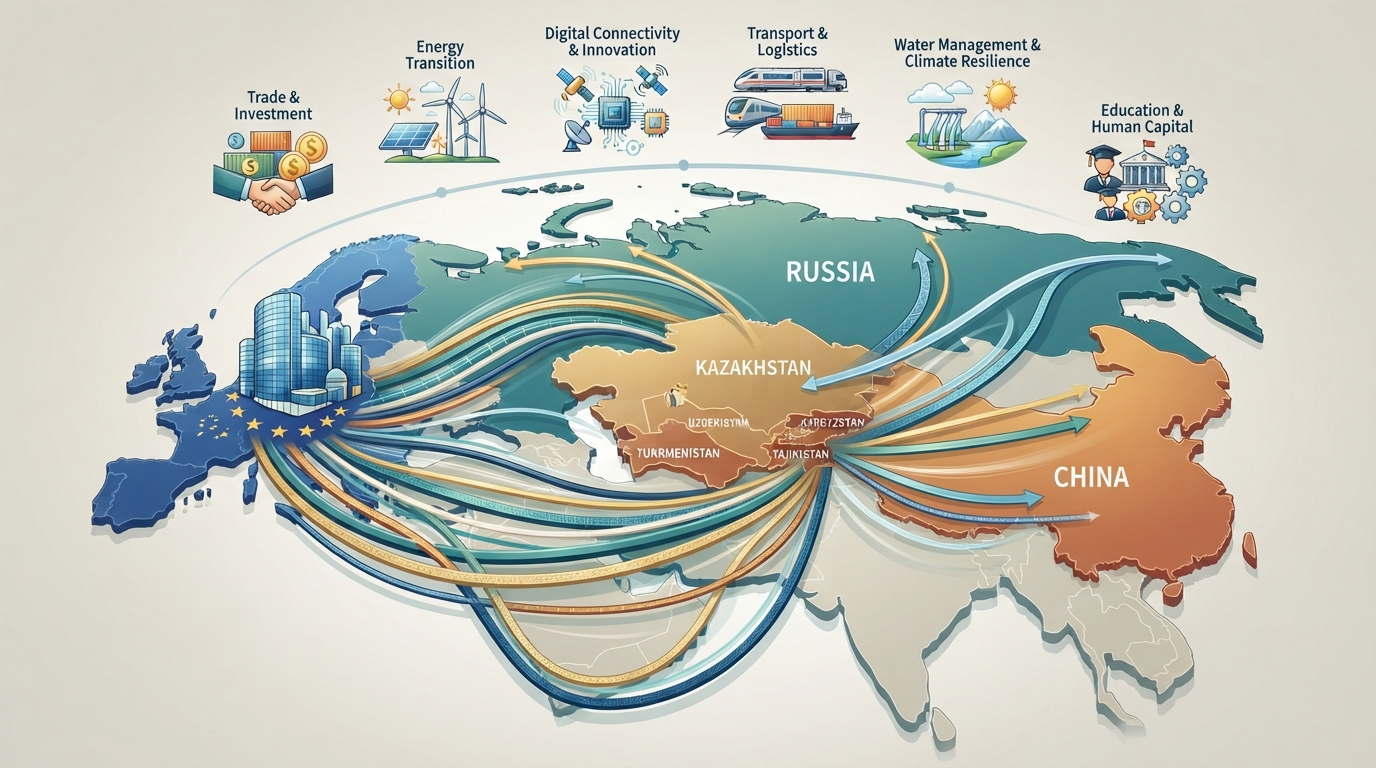
"Strategic autonomy must mean not a choice between partners, but more choice." Eldor Aripov on CA–EU cooperation
Central Asia is increasingly seen less through the prism of Russia, China, or Afghanistan and is acquiring its own distinct strategic importance. At the same time, according to him, rapprochement with the European Union should not force the region to choose between external partners, but rather expand its access to markets, investments, technologies, and transport routes. This was stated by Eldor Aripov, Director of the Institute for Strategic and Regional Studies under the President of Uzbekistan, speaking at the first Central Asia – European Union Think Tank Forum in Brussels.
As Aripov noted, until relatively recently, international interest in Central Asia was largely determined by external circumstances: proximity to Russia and China or the region's significance in the context of Afghanistan. Now, however, the situation is changing.
Central Asia's economy is growing by more than 6% a year — roughly twice as fast as the global average — and the region's population is expected to exceed 100 million people by 2050. At the same time, Central Asia's importance as a transport hub is growing against the backdrop of increasing restrictions and disruptions on traditional northern, Middle Eastern, and maritime routes. In addition, the region possesses significant reserves of critical resources essential for modern industry and new technologies.
However, Aripov identified the strengthening of Central Asia's own connectivity as the most important change. Countries are increasingly putting forward a common agenda in interacting with external partners. Today, there are already more than 10 "Central Asia Plus" formats, shared infrastructure is developing, trade is expanding, and the region's economies are gradually becoming more interconnected.
"Central Asia is no longer just five separate national markets. It is gradually becoming a more integrated economic space," he stated.
According to him, this makes the region a more attractive and reliable partner both for Europe and for the international community as a whole.
In Aripov's view, the partnership between Central Asia and the EU should be based on three principles.
**Complementarity.**
Cooperation with Europe should not be viewed as an alternative to Central Asia's relations with other partners.
"The goal is not to replace existing partnerships, but to add new opportunities. For our region, strategic autonomy should not mean choosing between partners. It should mean more choice," he emphasized.
The value of cooperation with the EU, according to him, lies in expanding the number of accessible markets, routes, technologies, and investment sources for Central Asian countries. Aripov noted that the new partnership should not lead to replacing one dependence with another.
**Resilience to external shocks.**
For Central Asia, this means the ability to maintain the pace of development and independence even in a more fragmented and unpredictable world.
One example could be cooperation with the EU in renewable energy, which would help reduce dependence on traditional energy sources. Another direction could be creating additional legal opportunities for the employment of Central Asian citizens in European countries, which would help diversify migration flows.
**Long-term orientation.**
Current geopolitical processes have noticeably heightened Europe's interest in Central Asia; however, according to Aripov, it is important that the rapprochement continues regardless of the circumstances that initially accelerated it.
"A partnership becomes truly strategic when its value does not depend on the political trends of the current moment. We need mechanisms and projects designed not for the next political cycle, but for decades ahead," he noted.
Aripov identified the creation of joint value chains as one of the key areas.
Against the background of the EU's growing interest in Central Asia's critical minerals, cooperation, according to him, should not be limited to a model where the region supplies raw materials while processing takes place in Europe.
It should be about deeper cooperation: from geological exploration and environmentally responsible extraction to processing, production, research, and training of specialists.
"The goal should be to align Europe's economic security with Central Asia's industrial development," he noted.
In parallel, it is necessary to facilitate the entry of Central Asian products into the European market by supporting certification, compliance with technical standards, and increasing the competitiveness of local business.
Another important direction should be **water and climate**.
Rising temperatures, melting glaciers, and pressure on water resources are already affecting agriculture, energy, and the region's development. According to Aripov, the EU can offer technologies, expertise, and financial instruments to modernize irrigation, reduce water losses, and introduce water-saving technologies.
**Transport connectivity** is of special significance.
The EU has already identified the Trans-Caspian Transport Corridor as one of the priorities of Global Gateway; however, Aripov stressed that the effectiveness of such projects cannot be assessed solely by kilometers of railways or cargo volumes.
"Ultimately, what matters is whether companies can move goods faster, cheaper, and more predictably," he said.
This requires simpler border and customs procedures, digital compatibility of systems, and better coordination of transport infrastructure.
Finally, cooperation must encompass **human capital**.
"Infrastructure can be built in a few years. The skills needed to manage and develop it take much longer to form," Aripov noted.
The next step could include joint educational programs, research centers, and vocational training, including in digital technologies and artificial intelligence.
Labor mobility could become a separate area. Against the backdrop of worker shortages in several European sectors and Central Asia's growing labor resources, the parties could develop cooperation in vocational training, recognition of qualifications, language training, and the creation of safe and legal employment channels.
Speaking about the future of Central Asia, Aripov separately addressed Afghanistan.
"We cannot seriously discuss long-term transport connectivity and sustainable development of Central Asia while leaving Afghanistan out of the picture," he stated.
For the countries of the region, Afghanistan is not an abstract external security issue, but part of their immediate neighborhood. The situation in the country directly affects the security and economic prospects of all of Central Asia.
Therefore, Aripov noted, Uzbekistan consistently advocates an approach that combines security issues with economic development, education, and the creation of practical opportunities for the population of Afghanistan. According to him, long-term stability cannot be achieved through isolation alone. It also requires closer economic ties with neighboring countries.
The main test for the new stage of relations between Central Asia and the EU will be the transition from statements to practical implementation.
"Central Asia and the European Union have no shortage of strategies, declarations, or political ambitions. Right now, the main thing is implementation," Aripov emphasized.
For Central Asia, cooperation with the European Union should expand opportunities without limiting relations with other partners. For the EU, the result of interaction should be a more stable and economically stronger Central Asia, capable of effectively realizing its own priorities.
If cooperation yields concrete results in trade, industry, transport, education, and human capital, the strategic nature of relations, according to Aripov, will no longer need to be confirmed by declarations. It will become visible in practice.