

Stormont ministers set to find out Budget allocation
More money could help lead to a deal on the Stormont budget which is still not agreed, seven months into the financial year.
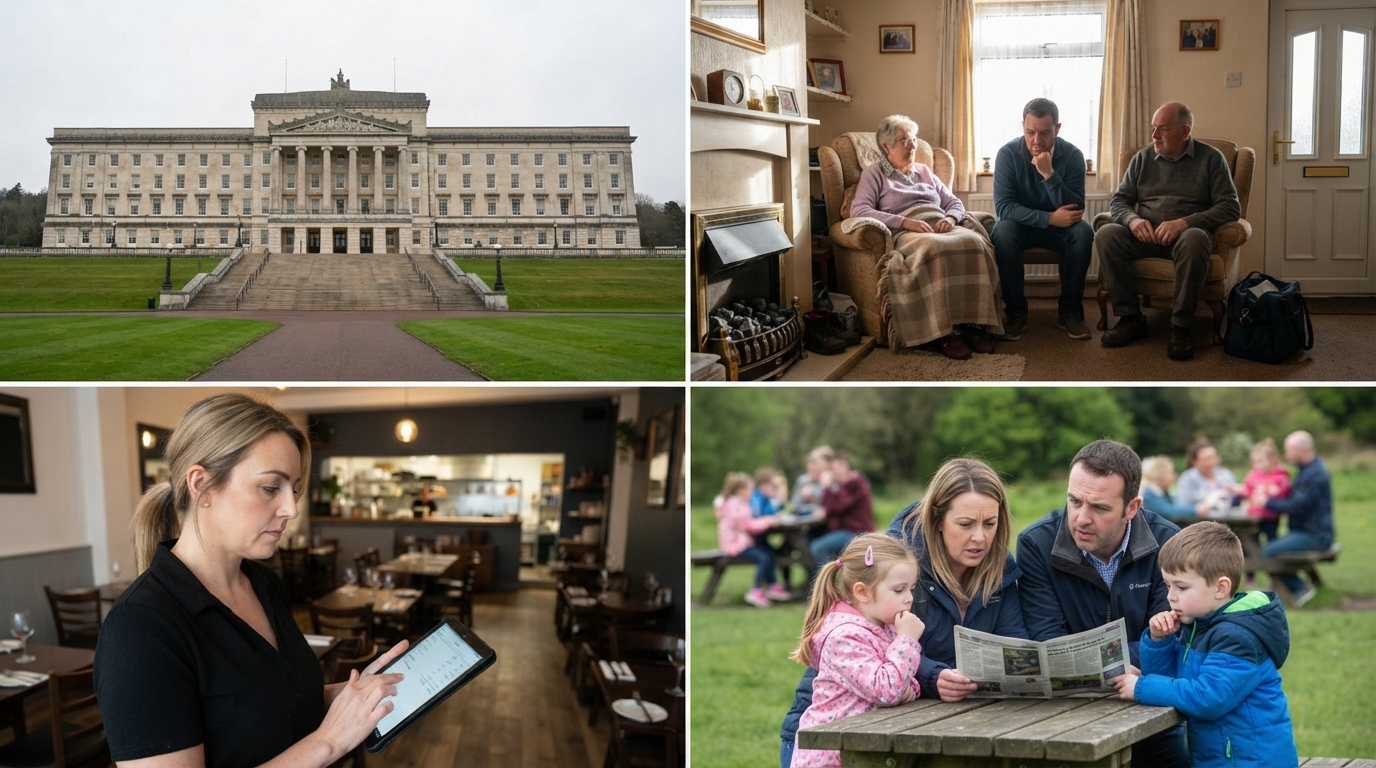
Stormont ministers are due to learn later how much extra funding they will receive following the Westminster Budget.
Additional money could help pave the way for an agreement on the Stormont budget, which remains unresolved seven months into the financial year.
Chancellor John Healey is not expected to provide everything Northern Ireland parties say they need.
The UK government has put forward an extra £525m this year, but the parties say around £1.5bn is needed to create a workable financial plan.
Last week, Democratic Unionist Party (DUP) leader Gavin Robinson said it "wouldn't be realistic" to expect the chancellor to close the gap completely, though it could be made "more manageable".
Government sources have downplayed the idea that the Budget will deliver a transformational sum of money.
Stormont receives a population-based share of extra spending handed to public services in England.
Traditionally, the chancellor sets out the headline figure in the Budget speech.
Later in the day, Stormont's Department of Finance will work out when the money can be used and what it can be spent on.
Stormont is already set to get a small amount of money for spending this year, following measures announced shortly after Andy Burnham became prime minister.
For instance, his move to freeze bus fares in England is expected to be worth about £10m to £15m to Stormont this financial year.
But most of what Healey announces on Wednesday is likely to be for next year.
Healey is expected to concentrate on "breathing space" measures aimed at helping households with the cost of living.
He said, however, that "breathing space today must go hand-in-hand with building for the future".
He said the Budget would offer targeted support for businesses and self-employed people, and "start the long-term action needed to get energy costs down for good".
He added that it would include support for businesses and entrepreneurs, investment in the technologies that drive future growth, and the building of more homes.
On Tuesday, it emerged that the Budget is expected to include a rise in the minimum wage, but 18-to-20 year-olds are set to receive smaller increases than in previous years.
The government also announced several measures, including scrapping import taxes on some food and ending the so-called cliff-edge for people receiving carer's allowance payments.
Any help Healey announces with energy bills is unlikely to apply directly in Northern Ireland because it has a separate energy market with different regulations from the rest of the UK.
Instead, Stormont would receive money to create its own support schemes.
Households in Northern Ireland have already received a £63 cut in electricity bills this month.
That is the local effect of two schemes that apply in Great Britain.
Christina Taylor said another rise in the minimum wage would mean higher prices for customers
Christina Taylor, who owns Shed Bistro in south Belfast and employs about 30 staff, said another increase in the minimum wage would lead to higher prices for customers.
"The raise last year meant that every guest would need to spend £4.50 more to cover that," she said.
"That's so much money and people can't afford that.
"Raising the minimum wage isn't the answer to the cost of living because it goes in a circle and no one is better off.
"Everyone is still struggling and it's not sustainable for anyone."
Taylor added that there "needs to be support for households or else eating out will be a thing of the past".
She said she had noticed people were not eating out as often, apart from special occasions.
"The cost of living affects us so much, more than Covid - eating out for people is now a luxury and it shouldn't be."
She backed calls from business groups such as Hospitality Ulster, which want a cut in VAT.
"We really need to see a VAT reduction," she said.
"Comparing ourselves to the South (Republic of Ireland) at 9% and Europe at 10% and we're sitting at 20%, it's not sustainable.
"Something needs to happen to change that."
Derek Moore from Greysteel would like to see help with heating costs and for carers in Northern Ireland
Derek Moore looks after his parents Margaret and Douglas in Greysteel, County Londonderry.
He would like to see help with heating costs and for carers in Northern Ireland.
Social security is devolved, so any changes announced in the Westminster Budget would not automatically apply in Northern Ireland, because legislation would need to pass through the Stormont assembly.
Moore said he could not get his parents "out and about" as much as he would like to "because the cost of living has made it much harder".
"You also have to look at shopping and what things you can save money on," he added.
"You also don't turn the heating on as much as you would like, you have to go down the coal route and make sure it's cosy and warm for them.
"You have to make sure that one room is really warm, and close doors."
His mother is registered blind and his father suffered a stroke and a heart attack earlier this year.
He works full-time and his parents have carers who visit four times a day.
"It puts a lot of pressure on you that affects things like your social life, being able to go out and enjoy meals," he said.
Before the Budget, BBC News NI also asked members of the public for their views at a family event in Slieve Gullion Forest Park, near Newry.
The Harrison family lives in Craigavon.
Leanne Harrison said grocery prices were "crazy" and she had her "fingers were crossed" for VAT cuts.
Tim Hanna said families were "feeling the pinch" and that tax breaks on hospitality and fuel duty would help.
"I know the hospitality sector is particularly hard hit, the price of a pint seems to keep going up and up, seems to deter people," he added.
Rozlyn Sheridan, of the Sheridan Stage School in Newry, was hoping for support for the arts sector.
"In my own business in the arts, we are paddling our own boats and trying to survive in an industry that sometimes isn't valued within our society, within our government" she said.
"The arts brings so much to a community and gives so much value to people's mental health."