

Some New Yorkers hail ban on horse-drawn carriages, but drivers fear for incomes
As councillors prepare to banish the vehicles, views in Central Park are divided over the 160-year-old tradition.
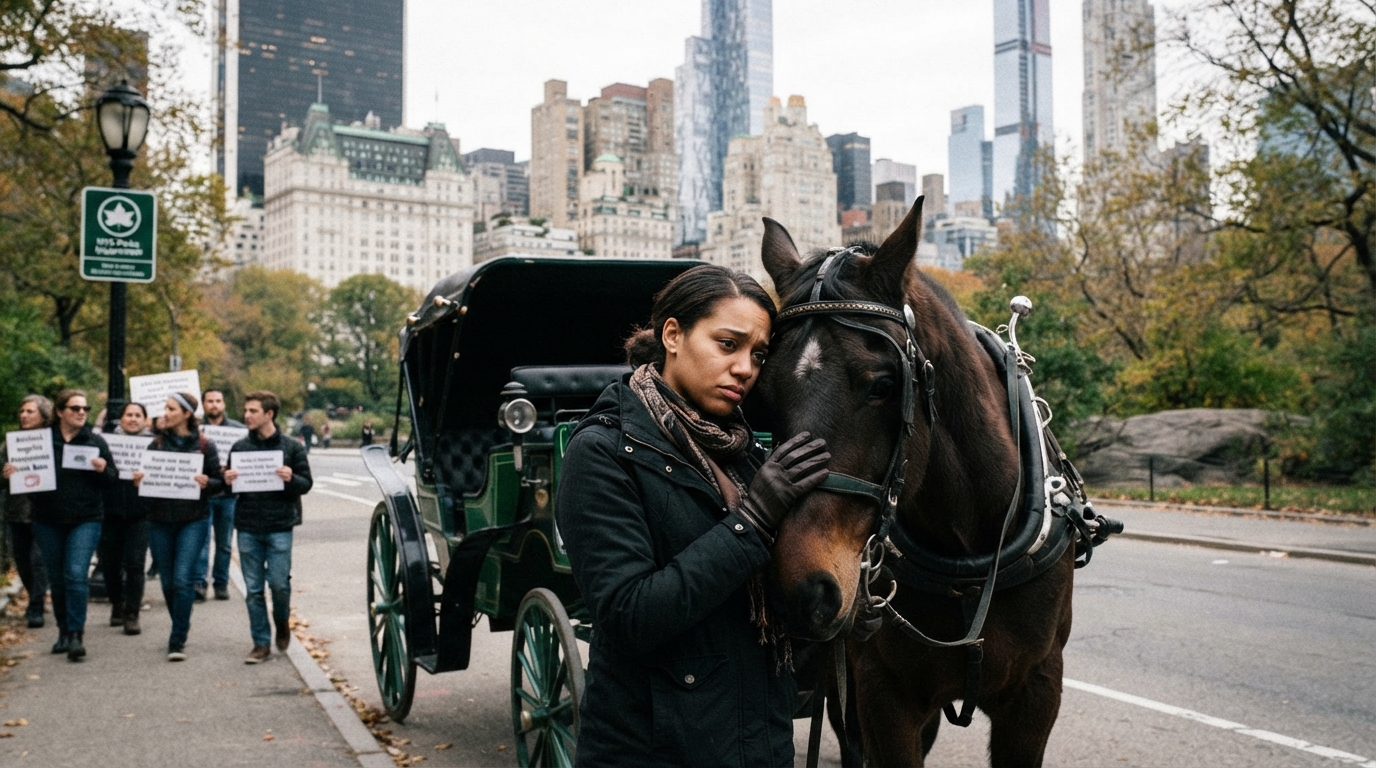
Some New Yorkers welcome horse-drawn carriage ban, while drivers worry about their livelihoods
Drivers of horse-drawn carriages in Central Park are anxious about what comes next, while animal activists view the ban as a win.
After petting a carriage horse in New York’s Central Park when she was five, Alexus Lawson was captivated.
For six years, she has driven a carriage in Manhattan’s best-known park, with her horse pulling it. But since Lawson learned of the city’s vote this week to prohibit the carriages over animal and public-safety concerns, she has been uneasy.
“What am I supposed to do with my horse?” asked the 28-year-old, who has been driving in the park for six years. “You’re going to tell me I can’t work with her anymore? How am I supposed to ensure her health?”
Lawson is among about 200 horse-drawn carriage drivers in Central Park. The carriages have been a sometimes contentious tradition for more than 160 years and have become a popular tourist attraction.
On Thursday, the New York City Council is expected to vote to approve a ban on the carriages that would take effect in June 2028. The measure is supported by Mayor Zohran Mamdani, who says he will help create a transition plan for workers in the industry.
But several drivers who spoke to the BBC said they did not want new jobs, and rejected accusations that their horses are mistreated, even as many New Yorkers and tourists embraced the ban.
“There were a few cases of horses dying in the middle of the park. You can clearly see that they’re not taken care of,” said New York resident Ron Tsur. “That’s not what they’re supposed to be doing.”
According to the Manhattan Borough President’s office, 40 horses working in Central Park have died since 1982, with causes including overheating and collisions.
New York officials had previously pushed for a ban under pressure from animal-rights activists, but met resistance from city council members and unions representing the workers.
The campaign for a ban gained fresh momentum this summer after a teenager died.
In June, Romanch Mahajan, a tourist visiting New York with his family from India, was riding in a carriage when the horse bolted, causing the 18-year-old to fall out and die. The proposed ban — called Romanch’s Law after the teen — also comes after the death this year of a carriage horse, Deniz, who ate a toxic plant in Central Park.
Several Central Park horse carriage drivers who spoke to the BBC said they were devoted to their horses and insisted the rides did not create a safety danger.
Lawson, who was nearby on the day Mahajan fell to his death, described the fatal incident as “extremely tragic”. But she said that if the city were truly concerned about the safety of horse-drawn carriages, it would ban them immediately — not in two years’ time.
The Central Park Conservancy, the non-profit organisation that manages Central Park and supports the carriage ban, said there had been seven “horse-related incidents” in the past 13 months alone. In May, a driver was taken to hospital after a startled horse struck another carriage, causing it to overturn. In January, another horse, named Destiny, ran into traffic near the park, triggering a multi-car collision.
Lawson, who owns six horses, said New York City carriages are the most heavily regulated in the country and argued that horses benefit from the work.
“They look at an animal in harness and they see a trap,” Lawson said of officials backing the ban. “They see a job as something that’s terrible. Horses are working animals.”
Lawson says she feels deeply attached to her horse — and to her business as a carriage driver.
Medet Fidan, who has been a carriage driver for 12 years, feels the same way about his horse and called claims of mistreatment a joke.
“I spend more time with my horses than my wife and my kids,” he said. “They’re telling me I’m abusing my horse? No way.”
Fidan said he was furious, and that officials were moving ahead with a ban without speaking face-to-face with drivers and others in the industry. “If you don’t listen to me, how can you come and kill my business, destroy my family’s, my livelihood?” he asked.
The city council held a hearing in July and invited community members, including horse-carriage drivers, to give their views.
The legislation to end horse-drawn carriages includes an “industry transition framework” with possible job placement, training, career counselling, and financial compensation for people in the business.
A spokesperson for Mamdani said his office was involved in planning to help these workers find new jobs — workers who, according to drivers who spoke at the city council hearing, earn about $60,000 (£ 44,000) to $70,000 a year.
But the Transport Workers Union, which represents the drivers, said the plan offered no guarantees — including compensation — and that the workers would be “economically wiped out”.
The union also voiced concern about a lack of funding for people and organisations that would eventually take in the horses. It said thousands end up at slaughter auctions each year.
The bill bans selling horses for slaughter or for similar work.
Chris Koenigs thinks the horses are “wonderful”, but too much of a danger to public safety.
Although carriage drivers say they are committed to their horses’ health, concerns about the animals’ welfare have been raised in the city for decades.
Animal-rights groups have long opposed the carriages, including one founded in response to New York’s industry. In 1866, after Henry Bergh saw the brutal beating of a carriage horse, he founded the American Society for the Prevention of Cruelty to Animals (ASPCA) to protest horses’ treatment and other forms of animal abuse.
People for the Ethical Treatment of Animals (Peta) and a coalition of organisations backing the horse-carriage ban also oppose the carriages.
Horses can work as many as nine hours a day. They are currently limited to certain entrances to the park, where they stand and wait with drivers to be hired. Customers pay $72.22 for a 20-minute ride, plus $28.89 for each additional ten minutes.
Vanessa Stolle, a German tourist, said she and her family have horses at home — and that they do not belong in a noisy park pulling passengers.
“To stand the whole day here – it’s loud for them and they can’t go to the countryside,” she said.
Another German tourist, Christian Bauers, disagreed. He said he remembered seeing the horses when he visited Central Park 20 years ago. “It’s part of the culture of New York,” he said. “Let them stay. It’s cute.”
Jeanne Collopy, an animal lover from Colorado, where horses run wild, said she worries about accidents in the park that have injured both people and horses.
“I know there’s a union and I hate to have people out of work,” she said, adding: “It’s a little bit confining for the horses.”
Her husband, Chris Koenigs, said the animals were “wonderful” to see. But he said the teenager’s death this summer was “sickening”, and too high a price to pay for the chance to enjoy the horses.
“The park is magnificent,” he added. “I can’t help but think, it would be a magnificent park with or without the carriages.”