

Six more golds in four days. Uzbekistan rose to fourth place at the Asian Games
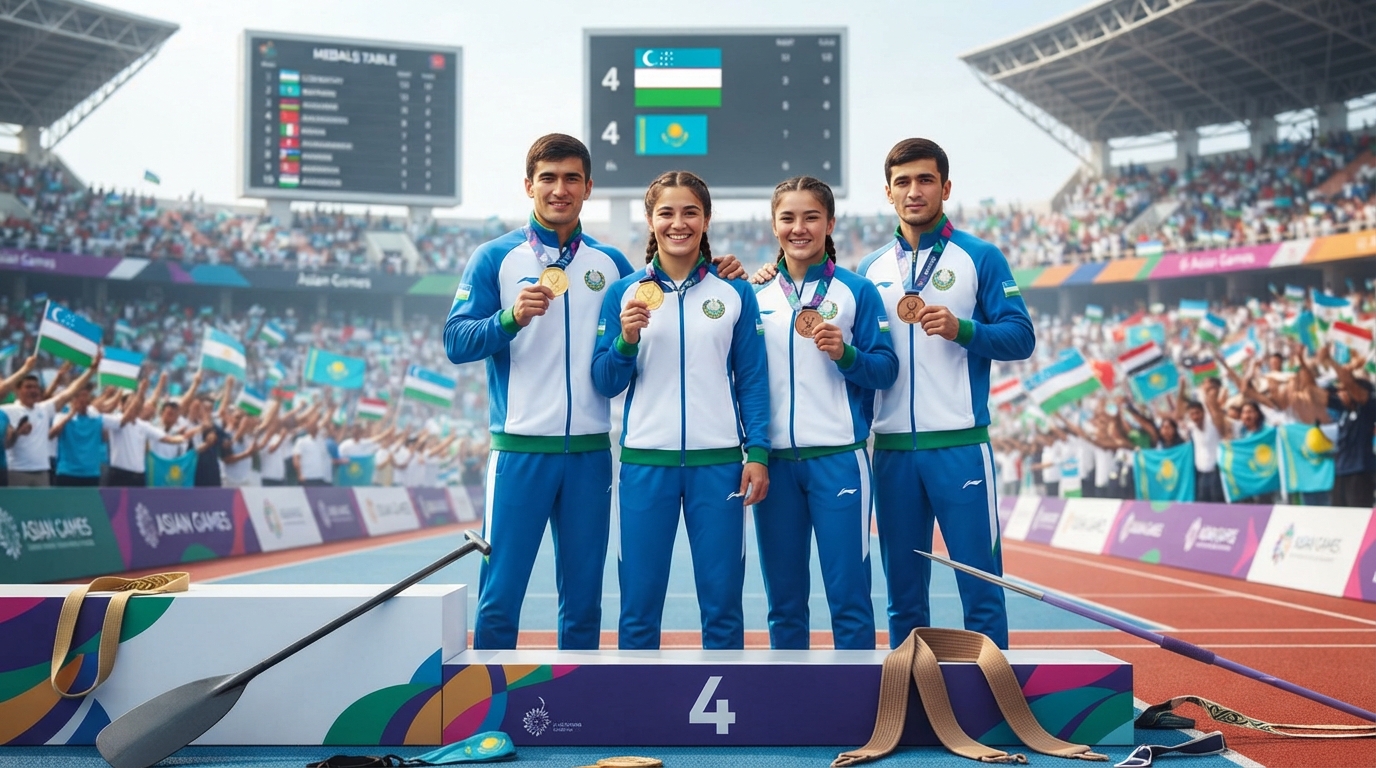
From September 25 to 28, the national team of Uzbekistan won 16 more medals at the Asian Games — 6 gold, 5 silver, and 5 bronze. The team brought its total tally to 42 awards and rose to the fourth place in the standings. The main sources of medals were kurash and rowing.
Six more golds in four days. Uzbekistan rises to fourth place at the Asiad
From September 25 to 28, the Uzbekistan national team added another 16 medals to its tally at the Aichi-Nagoya Asian Games — 6 gold, 5 silver, and 5 bronze. As of the end of September 28, the delegation already had 42 awards — 12 gold, 17 silver, and 13 bronze. Uzbekistan moved up to fourth place in the overall standings.
The main contributors of medals during these four days were canoeing and kayaking, as well as kurash — with six awards each.
On September 25–26, the paddlers took one gold and five silver medals, while the kurash wrestlers on September 27–28 claimed four golds and two bronzes. Track and field athletes added two more awards, while artistic gymnastics and fencing contributed one each.
The sixth competition day brought Uzbekistan five medals — one gold, three silvers, and one bronze. All three silver medals were won in canoeing and kayaking.
In the women's kayak four (K4) 500m, Ekaterina Shubina, Arina Tanatmisheva, Milana Dushev-Yanish, and Shakhrizoda Mavlonova finished second.
Another silver was won by Vladlen Denisov in the men's canoe single (C1) 500m. This was already his second award of the Games: a day earlier, together with Artur Guliev, he finished second in the canoe double (C2) at the same distance.
The third silver medal of the day was brought by Shokhsaanam Sherzodova and Nilufar Zakirova in the women's canoe double (C2) 500m. For Sherzodova, this was also her second award of the Asiad: earlier, she won gold in the canoe single (C1) 200m.
In artistic gymnastics, Rasuljon Abdurakhimov took bronze in the parallel bars event. He scored 14.433 points in the final.
The gold of the day was won by hammer thrower Sukhrob Khodjaev. His best result was 74.38 m. This is the athlete's first gold at the Asian Games: in Jakarta in 2018, he was third with a result of 74.06 m, and at the Asiad in Hangzhou in 2023, he again received bronze, throwing the hammer 70.79 m.
After September 25, Uzbekistan had 31 medals — 7 gold, 15 silver, and 9 bronze.
All three of Uzbekistan's medals on September 26 were brought by representatives of canoeing and kayaking — one gold and two silvers.
Shakhriyor Makhkamov became the Asian Games champion in the kayak single (K1) 500m. This is his first Asiad gold. Previously, Makhkamov won bronze at the 2018 Games and silver at the Hangzhou Asiad.
In the women's kayak single (K1) 500m race, Arina Tanatmisheva won silver. This award became her third at the Games: on September 24, she received bronze together with Ekaterina Shubina in the K2 500m, and on September 25 — silver as part of the kayak four.
Another silver was won by Vladlen Denisov and Nilufar Zakirova in the mixed canoe double (C2) 500m. Denisov, thus, stood on the podium three times in three days: he also received silver in the men's double and single at 500m.
In total, over three competition days — from September 24 to 26 — canoeing and kayaking brought Uzbekistan nine medals: two gold, six silver, and one bronze. By the end of September 26, the team's overall result reached 34 awards — 8 gold, 17 silver, and 9 bronze.
The seventh day was marked by a successful start to the kurash competitions. On September 27, representatives of this sport won two gold and one bronze medal. Another bronze was claimed by the women's sabre fencing team.
In the over 90 kg category, two representatives of Uzbekistan met in the semifinals. Shokhrukhkhon Bakhtiyorov defeated Bekmurod Oltiboev, who ultimately received the bronze medal. In the final, Bakhtiyorov proved stronger than the representative of Tajikistan, Shakarmamad Mirmamadov, and became the Asiad champion. His award became Uzbekistan's tenth gold at the Games.
Among women, gold in the under 57 kg weight category was won by Ibodatkhon Agojonova. In the final, she defeated an athlete from Chinese Taipei.
The bronze medal in the women's team sabre tournament was won by Zaynab Dayibekova, Fernanda Herrera, Gulistan Perdebaeva, and Samira Shokirova. In the semifinals, Uzbekistan lost to Japan — 33:45.
This result is also notable for the history of the rivalry between the two teams. At the previous Asiad in Hangzhou, it was Uzbekistan and Japan that met in the final. Back then, the Uzbekistani sabre fencers won 45:42, bringing the country its first-ever Asian Games gold in fencing.
Following the results of September 27, the national team had 38 medals — 10 gold, 17 silver, and 11 bronze.
The next day, kurash brought the team three more awards. In the women's under 78 kg category, two representatives of Uzbekistan met in the semifinals: Pokizakhon Kamoliddinova defeated Shokhista Nazarova. Nazarova received bronze, while Kamoliddinova advanced to the final, where she defeated a South Korean athlete to become the Asian Games champion.
Another gold was won by Akhror Ziyodullaev in the under 81 kg weight category. In the decisive bout, he defeated Iranian Ramin Ahmadzoda. This award became the 12th gold for the Uzbekistan national team.
Thus, in two days of kurash competitions, the Uzbeks took six medals — four gold and two bronze. Out of seven athletes included in the team's entry list for this sport, six stood on the podium.
The last medal for Uzbekistan on September 28 was the bronze won by track and field athlete Anvar Anvarov. In the long jump, he showed a result of 8.06 m and took third place.
By the end of the ninth competition day, Uzbekistan had 42 medals in its tally — 12 gold, 17 silver, and 13 bronze. With this result, the team was running fourth behind China, Japan, and South Korea. Kazakhstan had more awards in absolute terms — 45, but was in fifth position, as the medal standings first take into account the number of gold medals: 12 for Uzbekistan against 9 for Kazakhstan.