

Sick Judiciary Saga: Secondary victimization, or how courts penalize victims alongside their harassers
Tashkent Times is an English language online-newspaper that brings all latest Uzbekistan news
**Judicial Ruling in Namangan Draws Scrutiny for Penalizing Harassment Victim**
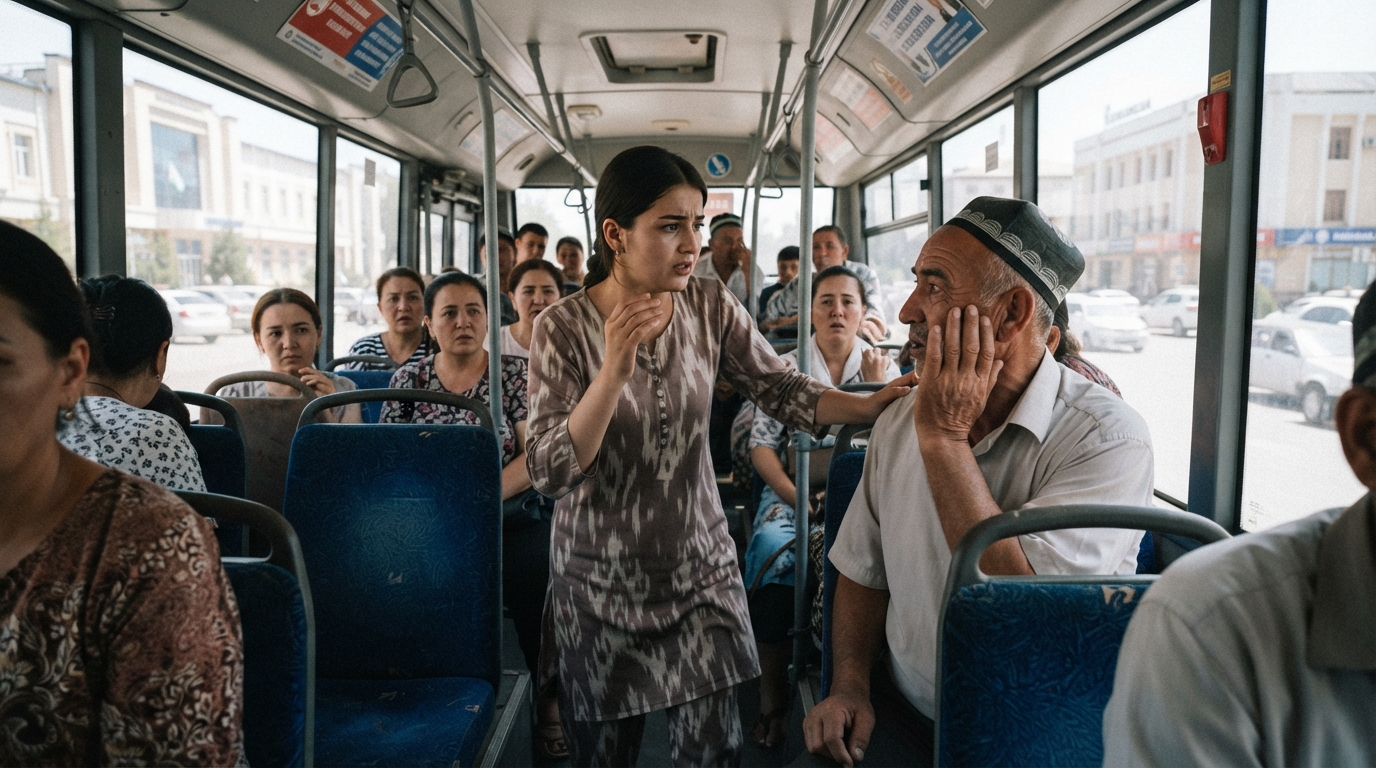
A recent administrative court decision in Namangan has sparked debate after an 18-year-old woman was fined for striking a 66-year-old man who had sexually harassed her on a city bus. The incident, which occurred on July 27, resulted in both individuals being found guilty of administrative offenses.
According to court documents, the man initiated the encounter by grabbing the woman's hip. In response, she struck him, causing minor bodily injury that was determined to have no lasting health impact.
The court found the woman guilty of inflicting minor bodily injury under Part 2 of Article 52 of the Code of Administrative Responsibility, imposing a fine of 0.5 times the base calculation value, equivalent to 206,000 som. The man, conversely, was found guilty of sexual harassment under Part 1 of Article 41-1 of the same code and received a fine of 2 times the base calculation value, or 824,000 som.
Critics argue that the court's decision to penalize the woman for her reaction fails to distinguish between an act of aggression and a reflexive response to unwanted physical contact. The case file describes the events as a continuous sequence: the man's grab immediately followed by the woman's strike. Despite this clear causal and temporal link, the court treated both actions as separate offenses.
Commentators highlight that a slap in immediate response to an unwanted touch should be considered a proportionate and involuntary act of self-preservation, not a distinct act of aggression. The injury sustained by the man was characterized by the court itself as minor and without lasting harm. In contrast, the man's conduct was classified as sexual harassment, a serious offense under the Code of Administrative Responsibility.
The ruling is seen by some as a failure to apply the principle of proportionality and self-defense, effectively isolating the woman's defensive action from the preceding act of harassment. This approach, they contend, not only assigns shared blame to the victim for a confrontation she did not initiate but also sends a concerning message to other potential victims. It suggests that reacting to harassment, even reflexively, could lead to legal repercussions, potentially deterring individuals from reporting incidents or defending themselves.
Uzbekistan's harassment statute, under which the man was convicted, acknowledges the harm caused by unwanted physical contact. Critics argue that a legal system committed to this principle should not simultaneously treat an instinctive defensive response as an equivalent offense. They warn that if courts continue to view such incidents as equally weighted violations, victims may conclude that self-defense comes with its own penalty.