

Scottish Highlands benefiting from 'coolcation' trend
Scotland and other northern European nations are seeing more tourists as people avoid the heat.
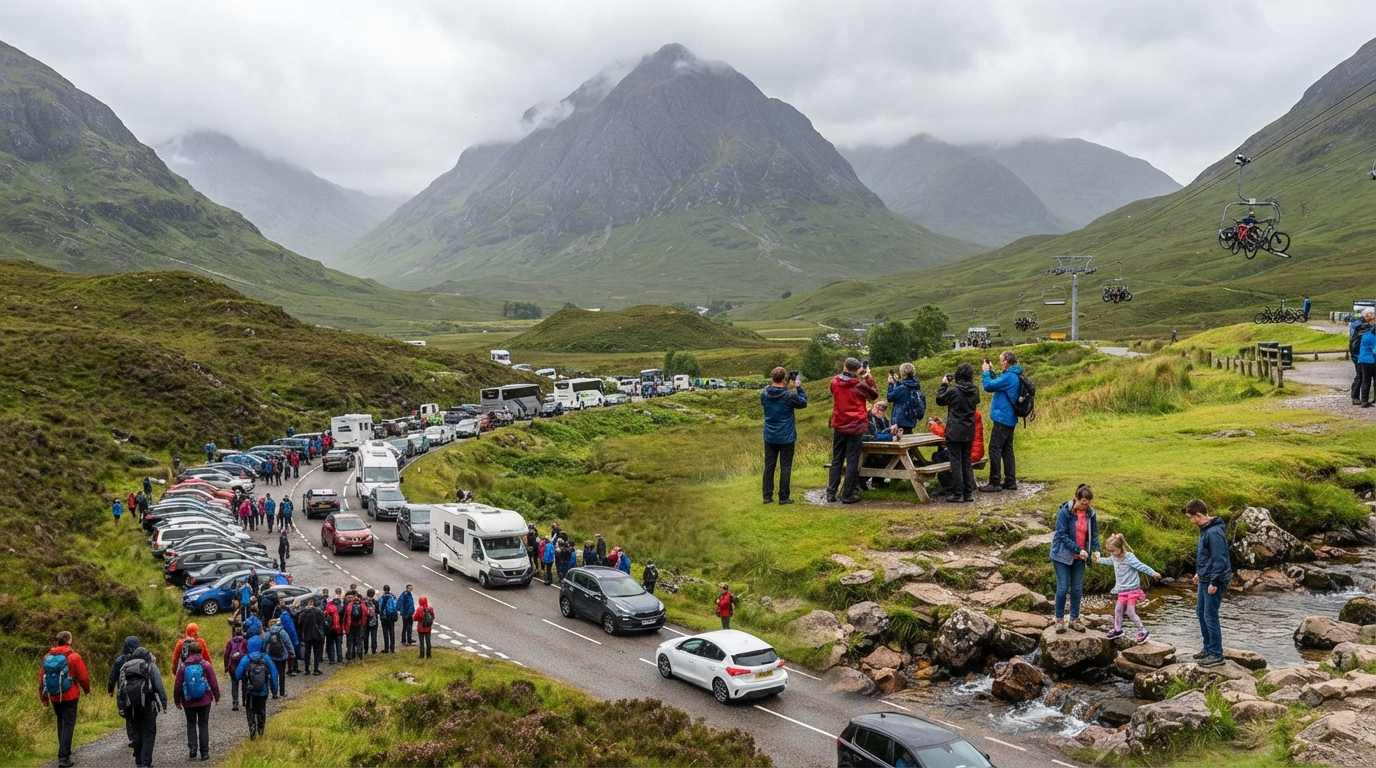
The Scottish Highlands are experiencing a surge in popularity due to the "coolcation" trend, offering stunning scenery without extreme heat. James MacLeod, concierge at Glencoe House Hotel, notes a significant shift in visitor attitudes. He observes that guests, once critical of the weather, now embrace it, even shrugging off midges and rain, simply grateful for cooler temperatures.
This change reflects a broader redrawing of Europe's summer tourism map. While southern Europe grapples with wildfires, droughts, and record heatwaves, northern European nations like Scotland are becoming attractive "coolcation" destinations. The European Travel Commission (ETC) reports that northern Europe, encompassing Denmark, Finland, Iceland, Ireland, Norway, Sweden, and the UK, has outperformed all other European subregions. Awaze, a European holiday-rental group, saw a threefold increase in "escape the heat" searches and a more than fourfold rise in "coolcation" searches over the past three months. Within the UK, Cottages.com's Scottish properties were the most viewed this summer.
Emily Bryce, operations manager at the National Trust for Scotland in Glencoe, confirms an 8% increase in visitor numbers this summer compared to last year. Visitors frequently comment on the refreshing coolness compared to destinations like the south of France and Spain, even on a drizzly 13-degree day. Chris Greenwood, a senior researcher at Glasgow Caledonian University's Moffat Centre for Travel and Tourism Business Development, highlights a "massive shift" in holiday choices among high-net-worth UK families, with many opting for the Scottish Highlands over places like Tuscany. He also points out Scotland's evolving promotional strategy, shifting from a "rugged" image to a "temperate" one since 2016.
This northward migration of holidaymakers is not exclusive to Scotland or the Nordics. The Hague, a Dutch coastal city, has also seen a boom, combining international institutions and urban culture with 10km of coastline, beaches, dunes, and cycle routes. However, this success brings challenges. Streets in Kijkduin, a popular coastal district of The Hague, have been temporarily closed to non-residents this summer due to severe traffic congestion from Belgian, German, and Dutch cars. Further up the coast, residents in Zandvoort resorted to putting up fake diversion signs to deter tourists.
Similar overcrowding issues are now evident in the Scottish Highlands. Nick, a visitor from the US, described Glencoe valley, a particularly scenic and popular area, as "busier than the carpark at my local mall," noting numerous full laybys. Greenwood adds that many of Scotland's other Instagram-famous locations, such as the Fairy Pools on the Isle of Skye and Edinburgh's Royal Mile, are becoming "victims of their own virality" due to the sheer volume of tourists.
To manage the impact of tourism, Edinburgh introduced a 5% tourist tax on hotel rooms last month, becoming the first UK city to do so. This is expected to generate up to £50 million annually. Edinburgh Council Leader Jane Meagher stated that this "small new contribution" will help improve services and public spaces, while better managing the effects of tourism. In Glencoe, the National Trust for Scotland has expanded parking, is investing in a 5km cycle route, and plans to introduce a park-and-ride system with shuttle buses between mountain ranges. Bryce emphasizes the need to provide alternatives to car travel for visitors who want to stop for a quick selfie.
Despite the "coolcation" trend, Scotland has not been immune to the effects of drier weather this summer. Wildfires affected both the Highlands' Cairngorms National Park and Edinburgh's Arthur's Seat in July. Furthermore, the Glencoe Mountain Resort skiing centre is adapting to unreliable winter snow, with its chairlift now transporting mountain bikes to the top of a downhill track, in addition to skiers.
The author recounts a personal experience in Glencoe, observing their 10-year-old daughter building boulder bridges and clinging to their brother amidst the Etive Mòr and Black Mount mountains. Thirty years prior, the author's father brought them there to ski and spot red deer outside the Kingshouse Hotel. This time, the stags were absent, replaced by tourists photographing themselves at sunlit picnic tables. The author concludes by questioning whether this newfound appreciation for the Scottish wilderness will leave enough of it intact for future generations.