

Scientists revealed the secret of an ancient Roman chalice that changes color
The 4th-century Lycurgus Cup has unique optical properties. It changes its color depending on how light falls upon it: in ordinary light, the vessel appears green, but when illuminated from behind, it glows with a red hue.
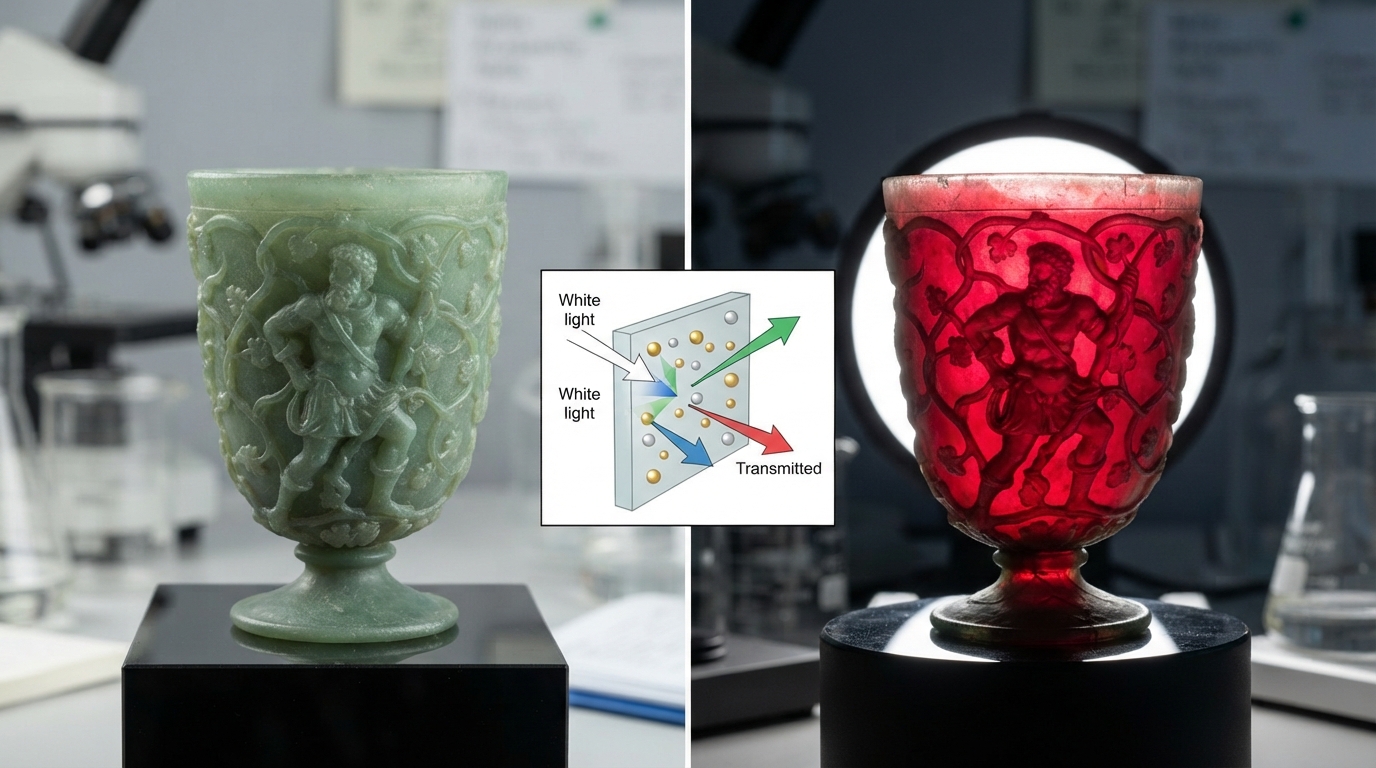
Scientists have unlocked the secret of ancient Rome's color-changing cup
Scientists at the University of Sheffield in Great Britain have managed to recreate ancient Roman glass that changes color, writes.
The British Museum houses the 4th-century Lycurgus Cup. Made of dichroic glass, it changes color depending on how the light falls: in normal light, the vessel is green, but when illuminated from behind, it glows red. It depicts King Lycurgus, described in Book Six of Homer's epic poem "Iliad". In 2022, the Lycurgus Cup was recognized as one of the seven glass wonders of the world.
According to researcher Lisa Hollands, gold and silver nanoparticles were added to the glass composition. A thick molten glass mass was created, and as it cooled, gold and silver nanocrystals began to grow around the particles within it.
"White light is composed of different colors. You can see this when a rainbow appears in the sky. The nanoparticles are much smaller than the wavelengths of light, and under certain conditions, because light affects the electrons in the atoms, they block certain colors," says Hollands.
According to her, when light is passed through the glass, "the gold and silver particles trap blue and green light, passing only red and orange light."
"If light reflects off the surface, these particles scatter the light, resulting in the green color we see," she said.
Ian Freestone, an emeritus professor at University College London, noted that attempts were made to recreate ancient Roman glass as far back as the 1960s.
"Color largely depended on the conditions in the furnace. If the glass was in a different part of the furnace, its color would also turn out differently. Such sensitivity of color to the position in the furnace indicates that it was extremely difficult for the Romans to control it. This leads to the idea that they might have simply gotten lucky when the Lycurgus Cup was made," the scientist said.