

Scientists proposed a method to obtain rocket fuel from Mars "air"
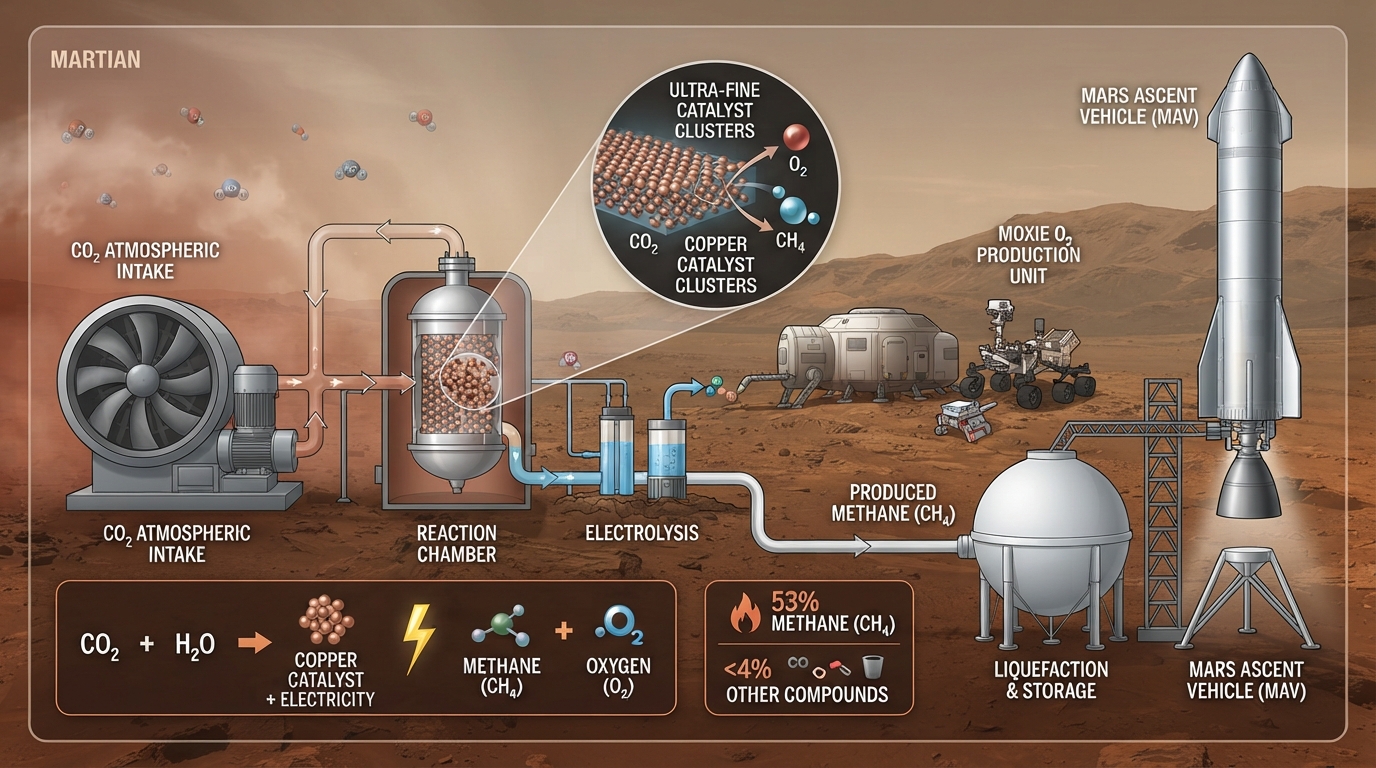
Scientists propose a method to obtain rocket fuel from Martian "air"
US scientists have created a new catalyst that converts carbon dioxide into methane, which can be used as rocket fuel. The results of the study were published in the scientific journal ACS Catalysis.
Developed by scientists from the University of Mississippi and Texas A&M University, this technology could be useful for producing rocket fuel on Mars in the future. Almost 96 percent of the Red Planet's atmosphere consists of carbon dioxide (CO₂). The technology uses electricity to convert CO₂ into methane.
A special copper catalyst is used in the process. The active copper clusters in it are extremely small — researchers described their size as approximately 100,000 times smaller than the thickness of a human hair.
The main advantage of the technology is that it reduces unwanted byproducts during the methane formation process. In existing methods, when CO₂ is converted into methane, other compounds are also formed, which then need to be separated.
On Earth, complex equipment can be used for such purification. On Mars, however, delivering this additional equipment complicates the task.
"On Earth, you can separate the desired and undesired products, but on Mars, the final product needs to be close to the purity required for rocket fuel," says Ahmad Badreldin, one of the study's authors.
In experiments, the most efficient catalyst achieved up to 53 percent of the electricity share spent on methane formation. At the same time, the total share of other carbon products formed from CO₂ was less than 4 percent. In particular, the share of carbon monoxide was 0.5 percent, and ethylene was 2.8 percent.
One of the challenges of sending humans to Mars is the fuel needed to return the crew to Earth. Carrying it from Earth significantly increases the mass of the spacecraft.
"You cannot bring everything you need from Earth. Every additional kilogram drastically increases launch costs and complexity. Therefore, scientists are looking for ways to produce fuel and other resources on the destination planet itself during long space missions," says Badreldin.
This concept is called in-situ resource utilization (ISRU). One of the advantages of methane is that it can be used as rocket fuel. The scientific paper also points to methane as a strategic fuel that can be obtained from local resources on planets like Mars.
However, the technology has not yet been tested on Mars. The study was conducted with CO₂ in a laboratory, and additional experiments are needed to adapt it to real Martian conditions. The scientists plan to work on increasing the catalyst's efficiency, the rate of methane formation, and its long-term durability. The next phase of the project is supported by a NASA EPSCoR grant.
This is not the first technology aimed at extracting resources from the Martian atmosphere for future expeditions.
In 2023, the MOXIE device installed on NASA's Perseverance rover successfully completed an experiment to produce oxygen from carbon dioxide in the Martian atmosphere. The device was launched 16 times, producing a total of 122 grams of oxygen. The peak performance was 12 grams per hour, and the purity of the obtained oxygen was at least 98 percent.
NASA stated at the time that larger versions of such technology could be used in the future to provide astronauts with oxygen for breathing, as well as to produce an oxidizer for rocket fuel.