

Scammers are deceiving citizens of Uzbekistan, Belarus, and Tajikistan under the guise of government payouts
F6, a developer of technologies for combating cybercrime, has discovered a new large-scale fraudulent scheme targeting residents of Uzbekistan, Belarus, and Tajikistan. The attackers are creating websites that mimic government social programs, offering citizens the chance to receive "entitled payouts" or "passive income." To participate in the program, users need to fill out a form with their contact details, after which they become victims of telephone or online scammers. Specialists [...]
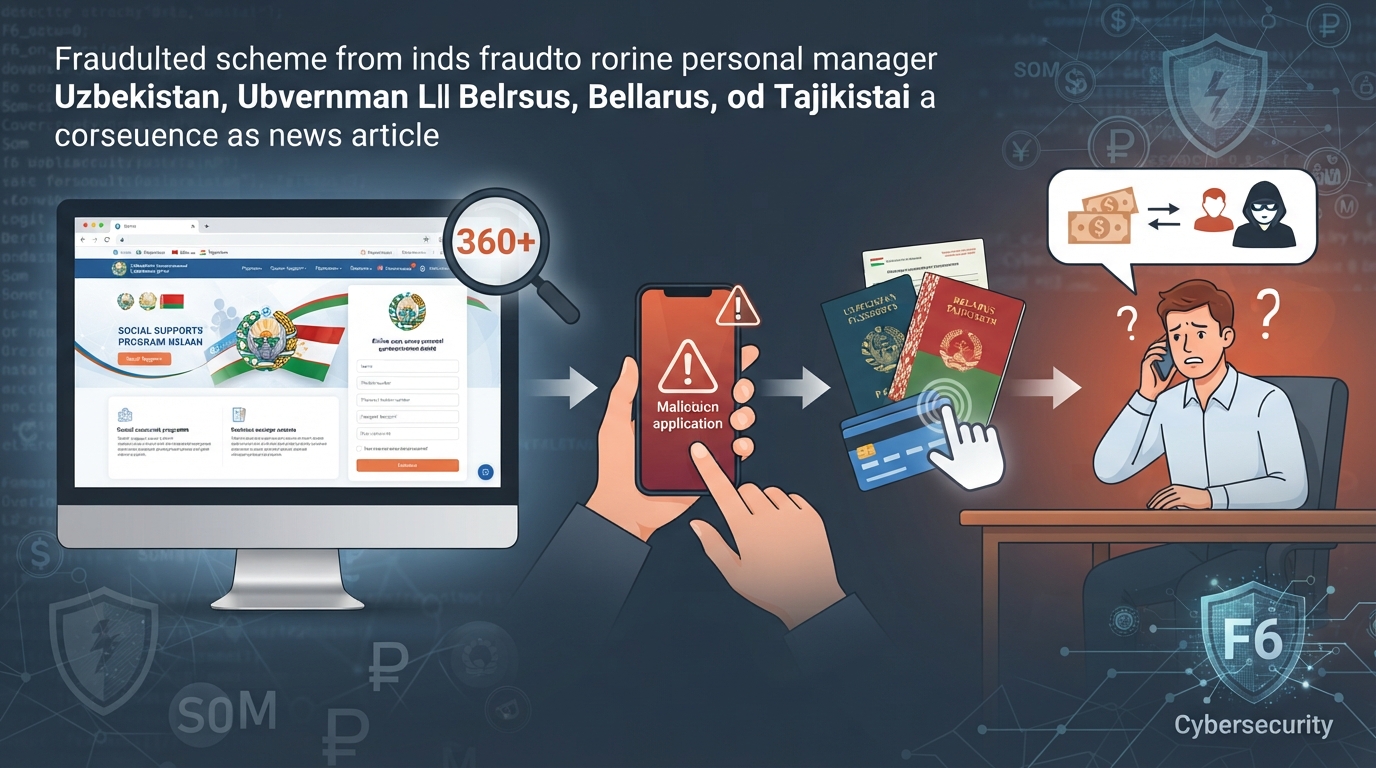
Scammers deceive citizens of Uzbekistan, Belarus, and Tajikistan by posing as government payouts
F6, a company that develops technologies to counter cybercrime, has identified a major new scam scheme targeting residents of Uzbekistan, Belarus, and Tajikistan.
The perpetrators launch websites that copy government social programs, promising citizens "entitled payouts" or "passive income." To allegedly participate in the program, users are asked to fill out a questionnaire with contact details, after which they become victims of phone or online scammers. F6 specialists have detected more than 360 fraudulent domains operating under this scheme.
Analysts from the Digital Risk Protection department studied the campaign, in which scammers exploit citizens' trust in government social initiatives. Instead of the usual promises of quick earnings, they offer to register for payouts that are allegedly due to all residents of the country under a "people's social program," as well as to receive "passive income with the support of the Ministry."
The scammers created more than three hundred resources that outwardly resemble official information or news websites, which post information about an allegedly state-run program of financial support for citizens. The user is invited to take a survey and promised that every resident of the country can receive a cash payout. For instance, residents of Uzbekistan are promised weekly payouts of 15 million soums. To get this, it is enough to fill out a questionnaire with their full name and phone number.
This scheme operates under two scenarios. In the first case, the website is a simple one-pager with a short description of the promotion and a questionnaire. The user immediately sees the offer to receive a payout and fills out the form.
In the second scenario, the resource completely replicates the design of a regional media outlet, featuring an alleged journalistic article about the social program, with a questionnaire to fill out at the end.
After the victim leaves their details on such a website, a scammer posing as a personal manager contacts them by phone. The ultimate goal of the scammers may be not only the theft of money, which they demand to be transferred to an account under the pretext of paying a "commission" or "fee" for processing the payout, but also gaining control over the victim's device or personal data.
In some cases, for "registration in the system" or "identity verification," the user is asked to install a mobile application, which in reality turns out to be malicious and gains control over the device to withdraw money from all accounts.
In addition, under the pretext of identity verification to receive the payout, the user may be asked for a passport scan. If the person agrees, this personal data falls into the hands of the scammers and can be used for other fraudulent attacks — from taking out loans to phishing mailings.
"Scammers in such schemes exploit citizens' trust in government programs and social initiatives. The perpetrators carefully copy the visual style and language of government portals and media outlets to make the websites look as convincing as possible," emphasizes Anastasia Knyazeva, senior analyst at F6's Digital Risk Protection department.
Information about government programs can be found on the official websites of federal government authorities.
As a rule, scammers create fake websites a few days or weeks before launching a fraudulent scheme.
If an acquaintance sent you a link you did not ask for, you should not open it either — their account might have been hacked by scammers.
Do not enter this data on websites you are visiting for the first time.
· In any unclear situation, before taking any action, consult with those you trust.
F6 specialists will verify the information and forward it to regulators for blocking.