

Saudi Aramco Returns to Hormuz and Sends a Powerful Signal to Global Energy Markets
An Exclusive Interview with the Swedish Pracademic and International Business Strategist Mr. Alex Matrsson on Saudi Aramco’s Return to the Strait of Hormuz, Energy Resilience, and the Future of Global Energy Security A Calculated Return
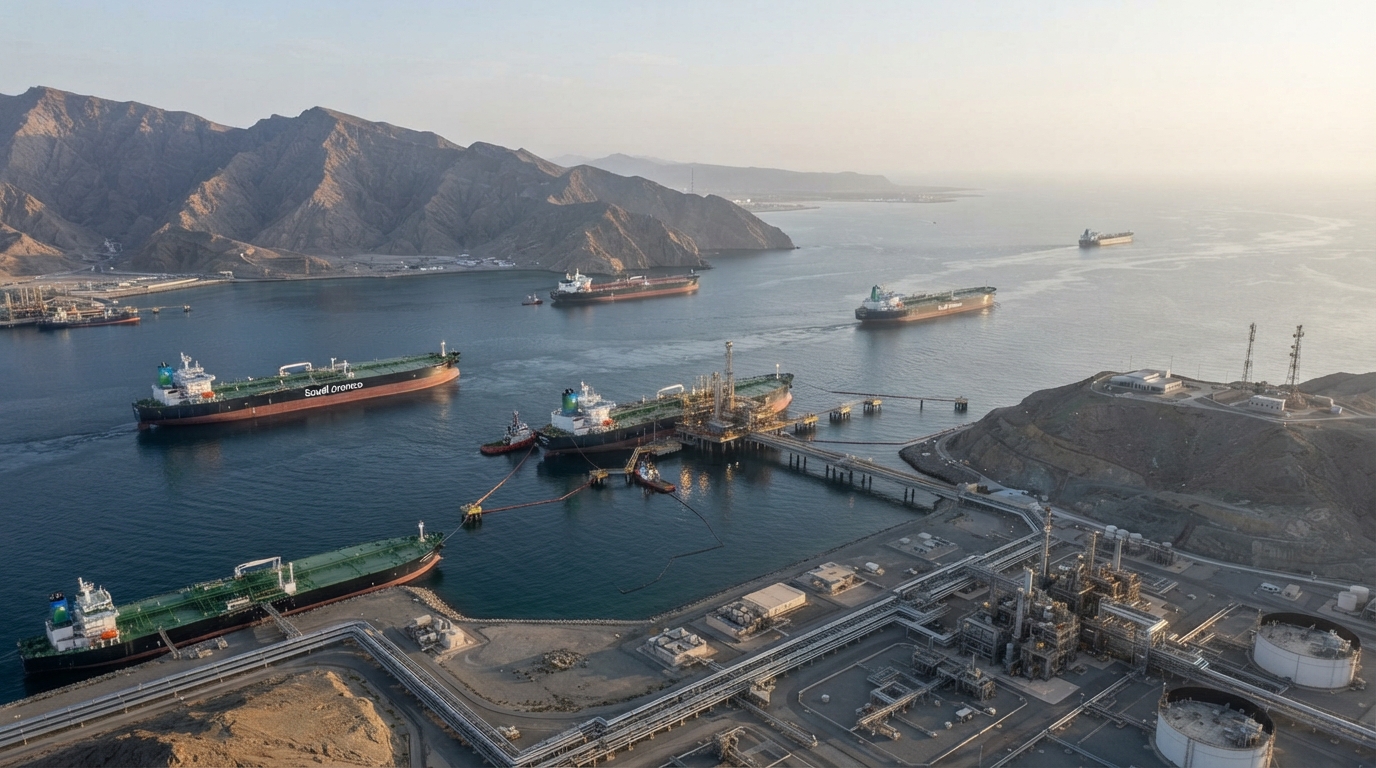
## Saudi Aramco's Return to Hormuz: A Signal of Resilience, Not Just Confidence
**An Exclusive Interview with Swedish Pracademic and International Business Strategist Mr. Alex Matrsson on Saudi Aramco’s Return to the Strait of Hormuz, Energy Resilience, and the Future of Global Energy Security**
### A Calculated Return
**Q: Saudi Aramco has resumed crude-oil loadings from inside the Strait of Hormuz after a period of disruption. Is that best understood as a sign that confidence in the waterway is returning?**
**Mr. Matrsson:** I would caution against using the word "confidence." The resumption of operations indicates that Saudi Aramco views the risk as sufficiently manageable to reinstate a crucial commercial function. This is significant, but it doesn't equate to declaring the security issue resolved.
The distinction is important. A sophisticated energy company doesn't require perfect security to operate; it needs a risk environment where the anticipated commercial benefits of operating outweigh the additional costs for security, insurance, logistics, and scheduling. Therefore, what we're observing is less a vote of confidence in absolute security and more a demonstration of confidence in operational risk management.
This is a key distinction for the market. Aramco is essentially communicating that Gulf export infrastructure remains commercially viable even under heightened geopolitical pressure. This reinforces the perception of Saudi Arabia as an energy supplier capable of adapting its operating model rather than simply waiting for ideal geopolitical conditions.
### Confidence or Risk Management?
**Q: Could the decision therefore be interpreted as resilience rather than reassurance?**
**Mr. Matrsson:** Precisely. Resilience is often mistakenly understood as the absence of vulnerability. In energy markets, resilience signifies the capacity to absorb vulnerability without allowing it to escalate into systemic failure.
Saudi Arabia's advantage isn't that its infrastructure exists outside the geography of the Gulf; it doesn't. The advantage lies in the kingdom's development of a network of infrastructure, logistics, and commercial relationships that provides flexibility when one part of that system faces constraints.
This flexibility alters the strategic calculation. A disruption at one point doesn't necessarily translate into a complete interruption of supply. Alternative export arrangements, pipeline connectivity, storage, tanker management, and various loading configurations can buy time and preserve commercial relationships. Aramco's recent actions should therefore be interpreted as much as evidence of institutional resilience as evidence of restored maritime confidence. Aramco itself has emphasized its continued use of the East-West Pipeline to secure flows across its network.
### The Gulf Supply Chain
**Q: What does this episode tell us about the resilience of the wider Gulf energy system?**
**Mr. Matrsson:** It tells us that resilience is becoming a competitive attribute in its own right.
For decades, energy security was primarily discussed in terms of reserves, production capacity, and long-term contracts. While these remain important, the modern energy system is also a logistics system. The question isn't simply whether crude exists underground; it's whether it can move from producer to customer when political, military, or commercial conditions deteriorate.
Saudi Arabia is particularly important because its energy infrastructure has been designed for scale and optionality. This doesn't eliminate exposure to the Strait of Hormuz, but it creates alternatives and provides the operator with more ways to sequence exports, reroute volumes, and adjust logistics.
This is also where the GCC gains strategic importance. Gulf producers are no longer competing solely on production economics. They are increasingly competing on reliability under stress. This represents a much more sophisticated form of energy security.
### The Asian Refining Market
**Q: What does the resumption of these cargoes tell us about Asian refiners and their willingness to continue relying on Gulf crude?**
**Mr. Matrsson:** It tells us that dependence should not be confused with complacency.
Asian refiners have strong commercial reasons to maintain access to Gulf crude because refinery configurations, crude quality requirements, established logistics, and long-standing commercial relationships create a powerful degree of structural dependence. However, this doesn't mean buyers will ignore maritime risk.
What changes during a disruption is the procurement architecture. Buyers become more attentive to optionality, voyage duration, freight exposure, insurance conditions, inventories, and the reliability of alternative routes. The objective isn't necessarily to abandon Gulf supply; it's to make Gulf supply more resilient within a broader portfolio.
This distinction is important. A buyer can remain deeply committed to Gulf crude while simultaneously demanding greater flexibility in delivery arrangements. In fact, that may become the preferred model: retaining the economic and quality advantages of Gulf supply while building more logistical insurance around it.
### Oil Markets Without Simplistic Forecasts
**Q: How should investors interpret the market implications without reducing the story to a question of whether crude prices rise or fall?**
**Mr. Matrsson:** The more interesting question is how risk is being transmitted through the physical market.
When shipping becomes less predictable, the initial consequence isn't necessarily a dramatic change in the underlying availability of crude. It can be a change in the cost and confidence associated with moving that crude. Freight becomes more significant. Insurance assumptions change. Tankers may become less willing to enter particular waters. Buyers may hold more inventory. Sellers may alter loading schedules. Refiners may pay more for logistical certainty.
These costs can accumulate before a physical supply deficit becomes apparent.
Conversely, when a major producer resumes loading operations, it can have a psychological and commercial effect beyond the individual cargoes involved. It signals that at least part of the supply chain remains functional. This can moderate some of the defensive behavior of buyers and traders.
However, I would resist interpreting this development as the disappearance of a geopolitical risk premium. Current vessel traffic remains highly constrained, indicating that the market has not returned to a normal operating environment.
### Security as an Economic Variable
**Q: Has maritime security effectively become a component of the price of energy itself?**
**Mr. Matrsson:** Absolutely. Security has always had an economic dimension, but the distinction is becoming impossible to ignore.
A tanker route is an economic asset. Its value depends on more than its physical existence. It depends on whether shipowners will use it, whether insurers will cover it, whether crews can operate safely, whether ports can function, and whether buyers believe deliveries will arrive as contracted.
This means geopolitical risk is increasingly embedded in commercial decision-making.
We are moving toward an energy system where uninterrupted flows may no longer be the baseline assumption. Companies are learning to price continuity itself. This could mean more strategic inventories, diversified routes, contractual flexibility, and greater tolerance for logistical redundancy.
The consequence is subtle but important: resilience has a cost, but so does fragility. The market is becoming more sophisticated at distinguishing between the two.
### Saudi Arabia's Strategic Resilience
**Q: Does this episode strengthen Saudi Arabia's position as a stabilizing force in global energy markets?**
**Mr. Matrsson:** I believe it does, provided we use the word "stabilizing" carefully.
Saudi Arabia cannot control the security environment surrounding the Gulf. What it can control is the sophistication of its response. This includes infrastructure, export flexibility, commercial relationships, logistics, and the credibility of its commitment to customers.
The strongest strategic argument for Saudi Arabia is therefore not that the kingdom is immune from disruption; it is that disruption does not automatically remove Saudi Arabia from the market.
That is a very different proposition.
The ability to continue supplying customers, adjust routes, use alternative infrastructure, and restore conventional loading operations when conditions permit gives Saudi Arabia an important form of strategic credibility. It also reinforces the broader GCC proposition: that Gulf energy infrastructure can remain commercially functional even when the surrounding geopolitical environment is under severe pressure.
### Beyond Hormuz
**Q: Is there a danger that international markets become too focused on the Strait itself and overlook the wider Saudi energy system?**
**Mr. Matrsson:** Yes, and that would be an analytical mistake.
Hormuz is strategically indispensable, but Saudi energy security cannot be reduced to a single waterway. The more meaningful question is how the entire system behaves when that waterway becomes unreliable.
Think of energy infrastructure as a network rather than a collection of individual terminals. Pipelines, ports, storage facilities, tankers, refineries, trading relationships, and customer contracts interact with one another. The strength of the system comes partly from those connections.
That is why Saudi Arabia's strategic position should be evaluated through optionality. Every credible alternative route or logistical arrangement reduces the probability that a localized disruption becomes a national export crisis.
For international buyers, that optionality has commercial value. For Saudi Arabia, it is strategic capital.
### A Northern European Perspective
**Q: What can energy-producing economies outside the Gulf learn from the way this crisis is being managed?**
**Mr. Matrsson:** They can learn that physical resources are only one part of energy power.
From a Northern European perspective, I would point to Norway as a useful comparison. Norway demonstrates how an energy producer can combine resource strength with institutional credibility, infrastructure, market integration, and long-term thinking. The lesson is not that the two systems are identical—they are not—but that energy influence increasingly depends on reliability across the entire value chain.
The Gulf is teaching the complementary lesson. Geographic exposure does not necessarily diminish strategic importance if a producer has the infrastructure and institutional capacity to manage that exposure.
For energy-producing economies everywhere, the strategic question is becoming: how many different ways can we remain reliable when circumstances stop being predictable?
### The Central Asian Dimension
**Q: Could these developments also change how energy producers farther east think about routes, infrastructure, and market access?**
**Mr. Matrsson:** Certainly. Kazakhstan is an instructive example because its strategic value is not simply a function of how much energy it produces. It is also a question of how effectively that energy can reach different markets through competing infrastructure systems.
The wider lesson is that diversification is not merely about finding another buyer. It is about developing multiple credible pathways between producer and consumer.
That means pipelines, ports, rail networks, maritime access, storage, and commercial partnerships become part of geopolitical strategy. When a major maritime chokepoint becomes uncertain, markets suddenly assign greater value to infrastructure that previously looked like redundancy.
This is why today's energy security debate is ultimately a debate about connectivity. Producers that can connect to several markets and consumers that can connect to several suppliers have greater strategic resilience.
### The Strategic Outlook
**Q: Looking beyond the immediate resumption of loadings, what should policymakers, energy companies, and investors watch most closely?**
**Mr. Matrsson:** They should watch behavior rather than headlines.
The important question is whether shipping companies, insurers, refiners, and producers gradually begin behaving as though Gulf routes are becoming dependable again. That will be visible in tanker movements, contracting decisions, inventory strategies, freight patterns, and the willingness of buyers to commit to conventional delivery structures.
If those behaviors normalize, the market will be signaling that it regards the security premium as manageable.
If they do not, then resumed Aramco loadings should be understood differently: as a demonstration that sophisticated operators can function inside a high-risk environment, rather than evidence that the environment itself has become safe.
That distinction captures the larger strategic story. The future of Gulf energy security will not be determined simply by whether ships can move through the Strait of Hormuz. It will be determined by whether the global energy system develops enough flexibility to remain commercially confident when geopolitical certainty disappears.
Saudi Arabia's significance in that environment is considerable. Its strength lies not in escaping geopolitical risk, but in possessing the infrastructure, relationships, and institutional capacity to operate through it. That is a much more durable form of energy power.
### About Mr. Alex Matrsson
Mr. Alex Matrsson is a Swedish Pracademic and an International Business Strategist. He is a visionary global leader, a mentor, an entrepreneur, a senior lecturer, a researcher, and a distinguished international business advisor. He is the number one International Business Strategy graduate in Sweden. He has extensive experience initiating, running, and managing businesses across the global value chain, as well as working internationally with investors, SMEs, MNCs, government agencies, universities, and multidisciplinary research institutes. He advocates on strategic issues related to policy, business strategy, industrial marketing, commercial diplomacy, and research commercialization. When it comes to higher education, Mr. Matrsson believes in serendipity, innovation, and the power of synergy-making. Therefore, these concepts jointly constitute the springboard for his knowledge dissemination endeavors. He implements a pragmatic approach that is rigorous in nature. He systematically ensures the successful delivery of core business concepts, while simultaneously developing the students' ability to become reflexive thinkers. He aims to enable the students to operationalize their "state-of-the-art" knowledge constructively—so that they can become an invaluable source of prosperity, driving forward the "social" and "economic" well-being for their local communities, their regions, and the larger society, worldwide. His scientific endeavors consolidate around trade promotion, emerging markets, business resilience, and the network approach to internationalization. Mr. Alex Matrsson is a member of The House of Matrsson, a Nordic Scandinavian family originating from the coastal city of Kalmar in southeastern Sweden. Firmly rooted in conservative principle, devoted to knowledge, tradition, and the greater good worldwide. Finally, on a personal level, his wide-ranging interests include blue whales, Arabian horses, classical music, ethical capitalism, religion, culture, the Nordics, the GCC region, and Central Asia—particularly Kazakhstan.