

Rumours swirled after a Vietnamese teen was run over - then came a stunning admission
Confirmation of the circumstances around Do Ngoc Phuong Thuy's death have only spurred more questions.
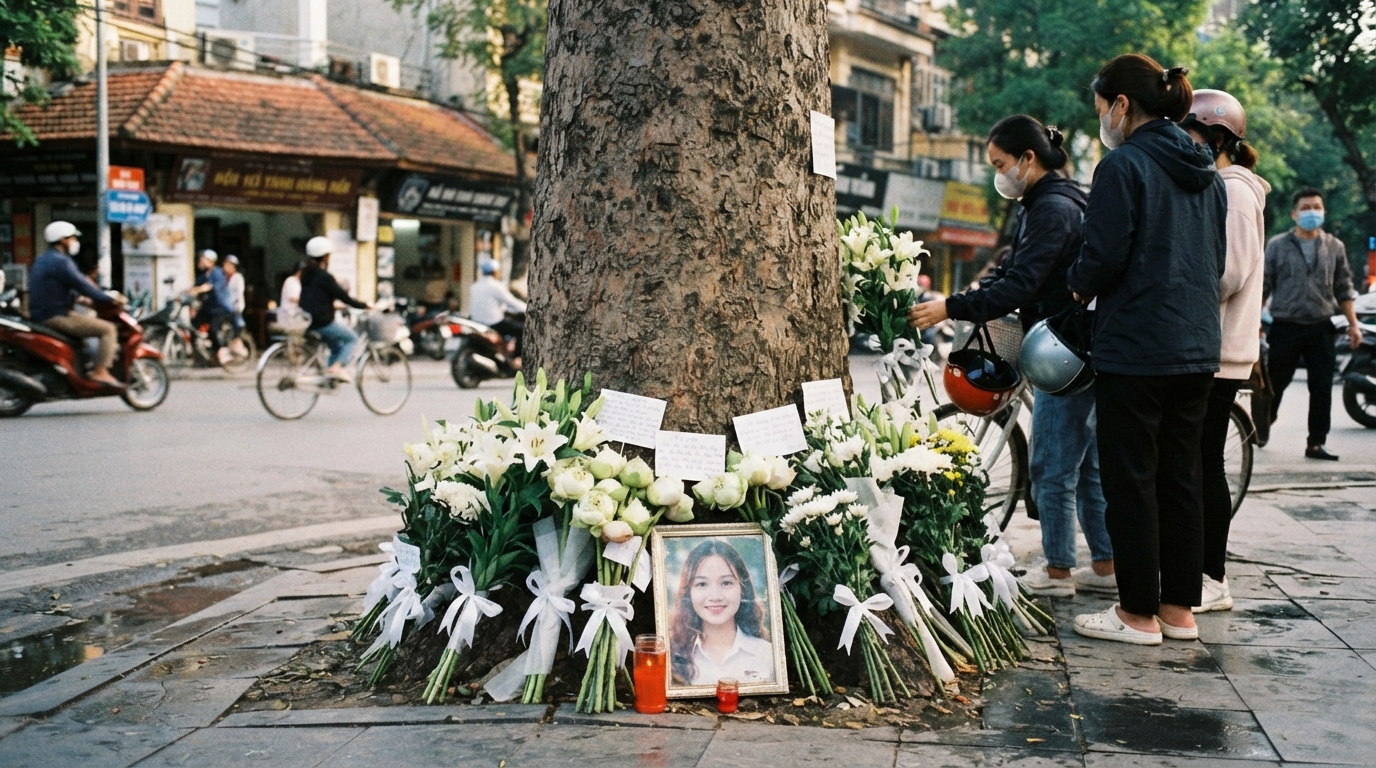
After a Vietnamese teenager was fatally struck by a car, rumors circulated, culminating in a surprising official admission.
For many on social media, the demand for accountability regarding a deadly traffic incident in Hanoi last May has been persistent.
What was once an ordinary "Justice Tree" in Hanoi, indistinguishable from countless others, began to accumulate bouquets, drawing significant attention. This site marks where former politician Nguyen Sy Cuong, driving his BMW in May of the previous year, veered into the opposing lane, colliding with a motorbike carrying a father and his teenage daughter.
The father, Do Viet Hung, survived with a broken leg. However, his 18-year-old daughter, Do Ngoc Phuong Thuy, succumbed to her injuries 10 days later in the hospital, having lost her right leg in the collision.
Fifteen months on, her death, and what many perceive as a suspicious lack of information surrounding it, has become a focal point for the dissatisfaction among Vietnam's youth.
In early August, a multitude of anonymous social media users initiated a campaign, publishing millions of posts with the hashtags #NguyenSyCuong and #BMW across platforms like Facebook, Instagram, Threads, and X. Identifying themselves as Gen Z, they called for accountability.
Initial discussions centered on whether the former politician was indeed responsible for the accident and why authorities had provided so little information.
Some users referenced reports indicating the BMW driver had the initials NSC and was born in 1961, fueling speculation that he was a former member of parliament. Others alleged that the incident had been suppressed due to the influence of powerful individuals. Many also reported that their posts were deleted by social media platforms at the Vietnamese government's request, providing screenshots as proof.
The expressions of outrage and demands for a thorough investigation intensified.
Concurrently, masked individuals began appearing at the accident site, placing bouquets at the base of the tree now known as the Justice Tree. Police quickly removed the flowers, prompting mourners to establish a virtual version of the tree online, where hundreds of thousands have since offered tributes and respects.
Under pressure from over a year of mounting suspicion and a surge of online attention, the matter became too prominent to disregard.
Then, last Monday, the government made an extraordinary disclosure.
State broadcaster Vietnam Television (VTV) aired an official statement from authorities, confirming the events of the incident. Former National Assembly deputy Nguyen Sy Cuong was indeed driving his car on Nguyen Huy Tu Street on May 30, 2025, when his vehicle suddenly swerved into an oncoming motorcycle.
Vietnamese authorities have confirmed that former politician Nguyen Sy Cuong was the driver involved in the crash that injured an 18-year-old and her father last year.
VTV cited police and prosecution sources, stating that because Nguyen Sy Cuong "sincerely confessed and actively and fully remedied the consequences of his actions," Do Ngoc Phuong Thuy's family had submitted a petition to exempt him from prosecution. The report did not detail the nature of this remedy, but Nguyen Sy Cuong was cleared of all criminal liability.
While such a decision is permissible under Vietnamese law, lawyers have raised questions about whether the criminal proceedings were conducted with due process, or even conducted at all. Social media users have highlighted that Nguyen Sy Cuong is married to a current government minister, suggesting potential influence in covering up the story. Some users have also cited other instances, including fatal traffic incidents, where the law appeared to be applied inconsistently.
Such online pressure has yielded results in the past.
In March of this year, a 66-year-old man driving under the influence of alcohol in Hanoi caused a chain-reaction crash involving seven cars and three motorcycles, resulting in one fatality and two serious injuries.
Following that incident, it was revealed that the driver, Nguyen Van Sau, was a retired police colonel who had previously served as deputy director of a department within the Ministry of Public Security. Fearing an official cover-up, the victim's family sought assistance. Social media users amplified the issue, and three months later, Nguyen Van Sau was charged with "violating regulations on participation in road traffic."
Many now believe that a similar public outcry may be the only path to justice for the teenager who died last year. However, their efforts have encountered resistance.
Do Viet Hung, the teenager's father, appeared on VTV's broadcast to thank internet users for their sympathy but stated that the family was satisfied with the investigation's findings and requested privacy. Notably, he also cautioned people "not to be drawn into the influence of reactionary elements."
A senior police official also featured in the broadcast, similarly suggesting that individuals were exploiting the incident to incite dissent.
The Ministry of Public Security had "uncovered highly dangerous plots and intentions by hostile forces, reactionaries and bad actors to incite unrest and cause disorder," the official stated.
"The ministry advises the public, especially young people, to remain fully alert and highly vigilant."
Similar condemnations have also emerged on social media, with some alleging that conspiratorial forces were manipulating young Vietnamese people to stir political discontent, sway online public opinion, and mobilize people in real life ahead of the country's national holiday on September 2.
Mourners have created a virtual equivalent of the Justice Tree online, where hundreds of thousands have paid their respects to Do Ngoc Phuong Thuy.
Others have accused Gen Z Vietnamese of orchestrating a "color revolution," a term referring to largely nonviolent protest movements that adopt specific colors or flowers as symbols.
This critique is familiar from Vietnamese authorities, who have previously dismissed public grievances or resentments as untrue, unreasonable, or fabricated by "anti-government" or "reactionary" organizations.
In this case, many have dismissed such accusations as baseless, asserting they are merely seeking justice for the victim of a fatal traffic accident. Nevertheless, the escalating outrage has become a flashpoint amidst broader, simmering grievances among Vietnam's youth.
Despite the Vietnamese government's increasing control over online freedom of expression—through tactics ranging from intimidation and fines to criminal prosecution—public opinion in some sectors has begun to diverge from the Communist Party line.
On platforms like Threads and Reddit, where anonymity is more common, many young people have voiced dissatisfaction with various social issues: from the expansion of police power and land reclamation projects to exam cheating scandals and stricter regulation of online communication.
These grievances mirror those expressed by other Gen Z-led movements across the wider Asia region.
Over the past 12 months, youth-led anti-government uprisings in countries such as Bangladesh, India, and Nepal have garnered immense support against issues like corruption, nepotism, economic inequality, and democratic backsliding. Unofficially dubbed "the Asian Spring," the growing influence of these movements has spread from Iran, Mongolia, and the Maldives to the Philippines and Timor-Leste.
However, protests in Vietnam have rarely, if ever, reached such intense levels. Vietnamese authorities have historically been effective at detecting and suppressing dissent before it escalates into action. Virtual mourning spaces, anonymous social media posts, and online protests appear to be the most assertive actions many civilians here can undertake.
Many are simply seeking justice for a teenager killed in a tragic accident and accountability for a former lawmaker who seemingly received special clemency.
Yet, even the mere suggestion that this incident could spark an uprising has caused alarm, accompanied by stark reminders of the long-standing status quo in Vietnam's one-party state.
"Are these Gen Z kids planning a color revolution using this accident?" reads one widely shared post. "Are they trying to emulate Bangladesh, India, and Nepal, and then create an Asian Spring? Remember, this is Vietnam! This is not Nepal, India, or Bangladesh!"