

Realtors have found a possible loophole in the new certification law.
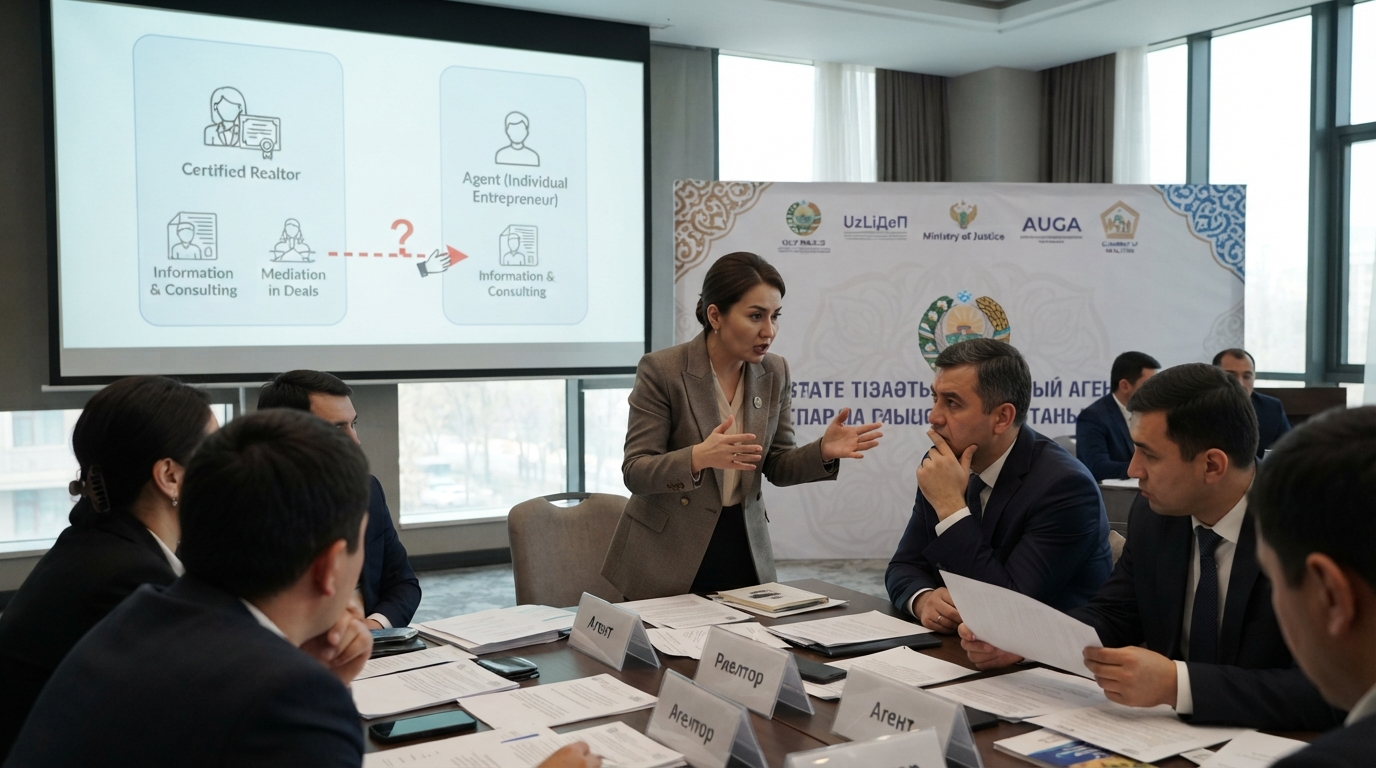
Realtors have discovered a potential loophole in the new certification law.
The new law "On Real Estate Activity" could create opportunities to circumvent certification requirements, as real estate market participants in Tashkent have indicated the possibility of framing intermediary services as information and consulting services. Representatives of the State Assets Management Agency (SAMA) acknowledged the problem but stated that a definitive delineation of the powers of realtors and agents will be possible after the development of new industry standards.
This issue was raised on August 21 at a meeting in Tashkent, where representatives of the Oliy Majlis, UzLiDeP, the Ministry of Justice, SAMA, and the Chamber of Realtors explained the provisions of the new law to market professionals.
The discussion was prompted by the difference in status between "realtor" and "real estate agent." According to the law, a realtor is an individual holding a qualification certificate, while an agent can be a sole proprietor or self-employed individual conducting real estate activities in accordance with the established procedure.
One of the meeting participants, the general director of a Tashkent-based real estate company, noted that this wording potentially allows for the exemption from taking the state exam and obtaining a qualification certificate, and instead, registering as an individual entrepreneur.
A representative of the AUGA disagreed with this interpretation, explaining that a real estate agent's capabilities are significantly limited: they are only permitted to provide information and consulting services, while intermediation, that is, direct participation in the transaction, is prohibited. According to him, this distinction is crucial. Many market participants, by inertia, believe that if the law defines a real estate agent, they can perform all types of real estate services. However, the new law does not provide for this. Previously, a realtor registered as an individual entrepreneur could indeed act as an intermediary, but these regulations have been amended.
Meeting participants also noted a practical problem with oversight. If an individual entrepreneur is effectively acting as an intermediary but formalizes the relationship with a client as an information and consulting services agreement, the question arises of how to distinguish legitimate activity from an attempt to circumvent legal requirements.
"How are we going to combat this?" asked a meeting participant.
An AUGA representative acknowledged the problem, but attributed it not so much to the law itself as to the fact that current industry standards for intermediary activity have not yet been harmonized with the new regulations. After the law is adopted, the standards must be reviewed and refined.
It is expected that a separate standard for intermediary activity will clearly define the rights and responsibilities of both realtors and real estate agents. This, in turn, should provide regulatory authorities with a formal basis for distinguishing between information and consulting services and intermediaries disguised as such activities.
The Chairman of the Chamber of Realtors of Uzbekistan urged industry representatives not to shift the responsibility for solving the problem solely to government agencies. He stated that emerging questions about oversight and the potential for circumvention reflect the real state of the market.
He noted that legislation may be imperfect, and therefore industry regulation should gradually transition to self-regulation by the professional community. He assessed the current disorder in the market as the shared responsibility of industry participants themselves, not just the regulator.
The Chairman of the Chamber also cited related decisions and decrees of the president, including those related to the development of cashless payments. He stated that mechanisms have already been established to allow tax authorities, in conjunction with representatives of the Ministry of Employment and Poverty Reduction, to verify whether an employee is actually on the official payroll of an organization.
In this regard, he stated, the practice of real estate companies employing real estate assistants under civil contracts to circumvent hiring requirements should no longer go unnoticed. Such contracts are also subject to reporting under the new Tax Code.
However, the issue of delineating the powers of a realtor and an agent remains unresolved. Market participants have yet to jointly develop national standards that will define the services each of these two statuses is authorized to provide.
The Chairman of the Chamber of Realtors believes that this work will require one to two or three months of intensive collaboration between the professional community and the government.
Thus, the potential loophole lies not in directly authorizing agents to act as intermediaries, but in the difficulty of proving that, under the guise of information and consulting services, they are actually providing illegal intermediaries. A package of industry standards that should close this gap in practice has yet to be developed.