

Rami Library in Istanbul has been named the world's best "Green Library"
And the Rami Library in Istanbul became the winner of this competition in the "Large-Scale Project" category. The library dates back to the 19th century
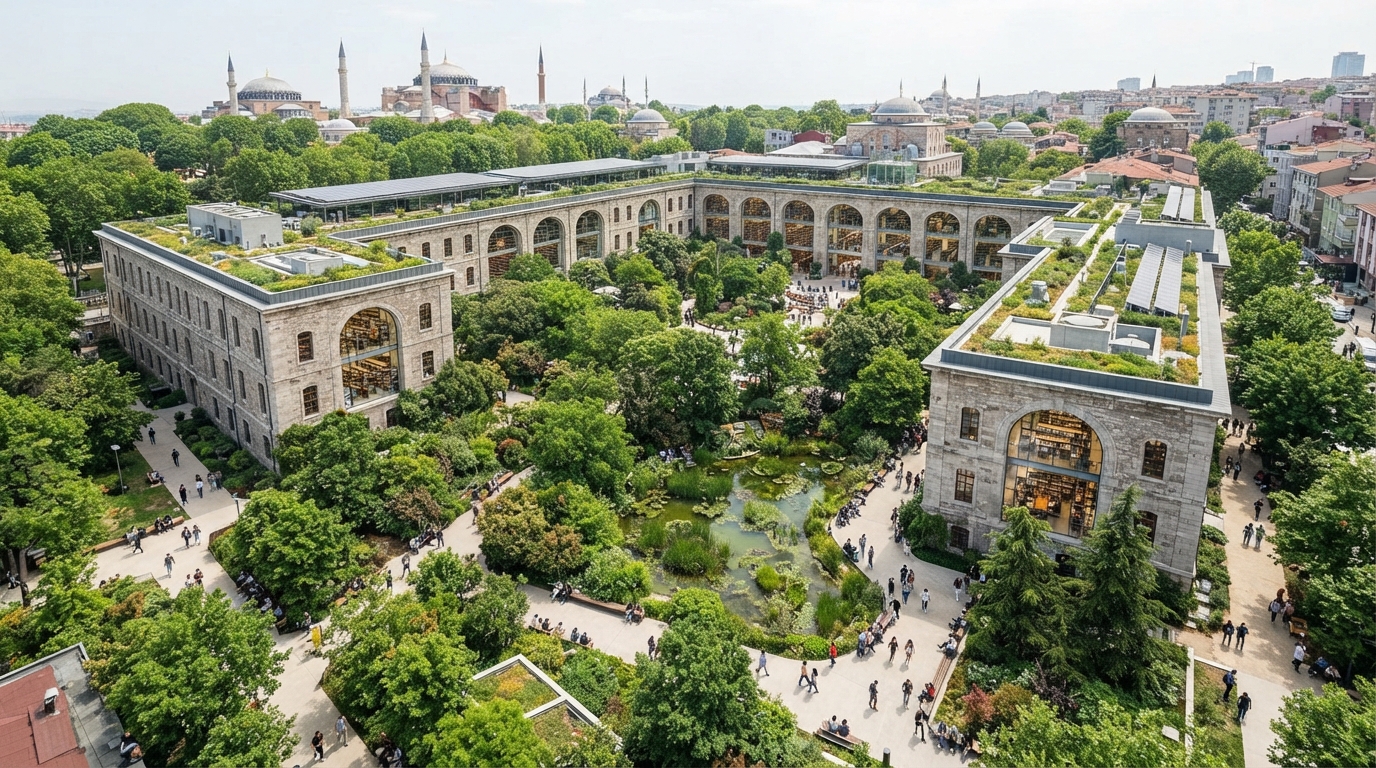
Rami Library in Istanbul Named the World's Best "Green Library"
The winners of the International Federation of Library Associations and Institutions (IFLA) 2026 "Green Library" award were announced during the World Library and Information Congress (WLIC 2026) held in Busan, South Korea. A total of 62 projects from 27 countries participated in the 11th edition of the competition.
The Rami Library in Istanbul won the competition in the "Large-Scale Project" category. The library was deemed worthy of the award for transforming 19th-century historical military barracks into a modern public space that is resilient to climate change and open to everyone.
Rami Library's first-place finish on a global scale demonstrates that preserving historical heritage, environmental sustainability, and modern library services can be harmonized within a single space. Along with enhancing the library's international prestige, this award showcases the significant attention being paid to climate and sustainability issues within the librarianship sector in Turkey.
Following the completion of restoration, renovation, and construction works on the barracks built between 1826 and 1828, the building reopened as a library in 2023. During the restoration process of the complex, its historical appearance and original building materials were preserved as much as possible.
With a closed area of 36,000 m² and a seating capacity of 4,200 people, Rami Library is one of Turkey's major information centers. The complex houses a digital library, a youth library, an adult library, and various specialized libraries.
Environmental sustainability also plays an important role in the modern design of the Rami Library. With its 51,000-square-meter green area, the building is considered the library with the "largest indoor landscape area" in Europe. It features nearly 700 trees, 99,000 shrubs, a biological pond, and reed beds. These serve to support urban biodiversity and improve the local microclimate.
Rainwater collected from the building's extensive roof surfaces is reused for watering the green areas and flushing toilets. To reduce energy consumption, low-energy equipment, LED lighting, sensor systems, and solar energy are utilized. Additionally, waste is sorted at the source, hazardous waste is managed separately, the use of single-use plastics is minimized, and internal workflows are digitized.
Through its cultural programs and public services open to all, Rami Library responds to the cultural, educational, and artistic needs of society, embodying the concept of a "living library."
This approach continues through initiatives aimed at developing climate literacy, including information services, training sessions, and practical workshops on environmental topics. The library's Special Resources Center further expands access to library services for users of various ages and needs. At the same time, rare manuscripts and printed materials are preserved and restored in the Shifahane (restoration department) section. In this way, the valuable heritage that has reached today's generation is preserved for future generations as well.
Rami Library also stands out for operating 24/7. Furthermore, during natural disasters, it serves as a safe assembly point. Therefore, the library has become an important public space not only for culture and education but also for community resilience.
As a result of these multifaceted initiatives focused on sustainability, the complex became the first library in Turkey to receive the "Biosphere Sustainable Museum Certificate," "Zero Waste Certificate," and "Green Energy Certificate."
Since its opening in 2023, Rami Library welcomed more than 8.2 million visitors by the end of 2025. Its international recognition as a "green library" once again shows that the future of libraries is connected not only with books but also with people, society, and the environment.