

Questions remain over Ebola patient who travelled across three nations undetected
Fresh details reveal how the 40-year-old businessman flew and crossed regional borders while seriously ill.
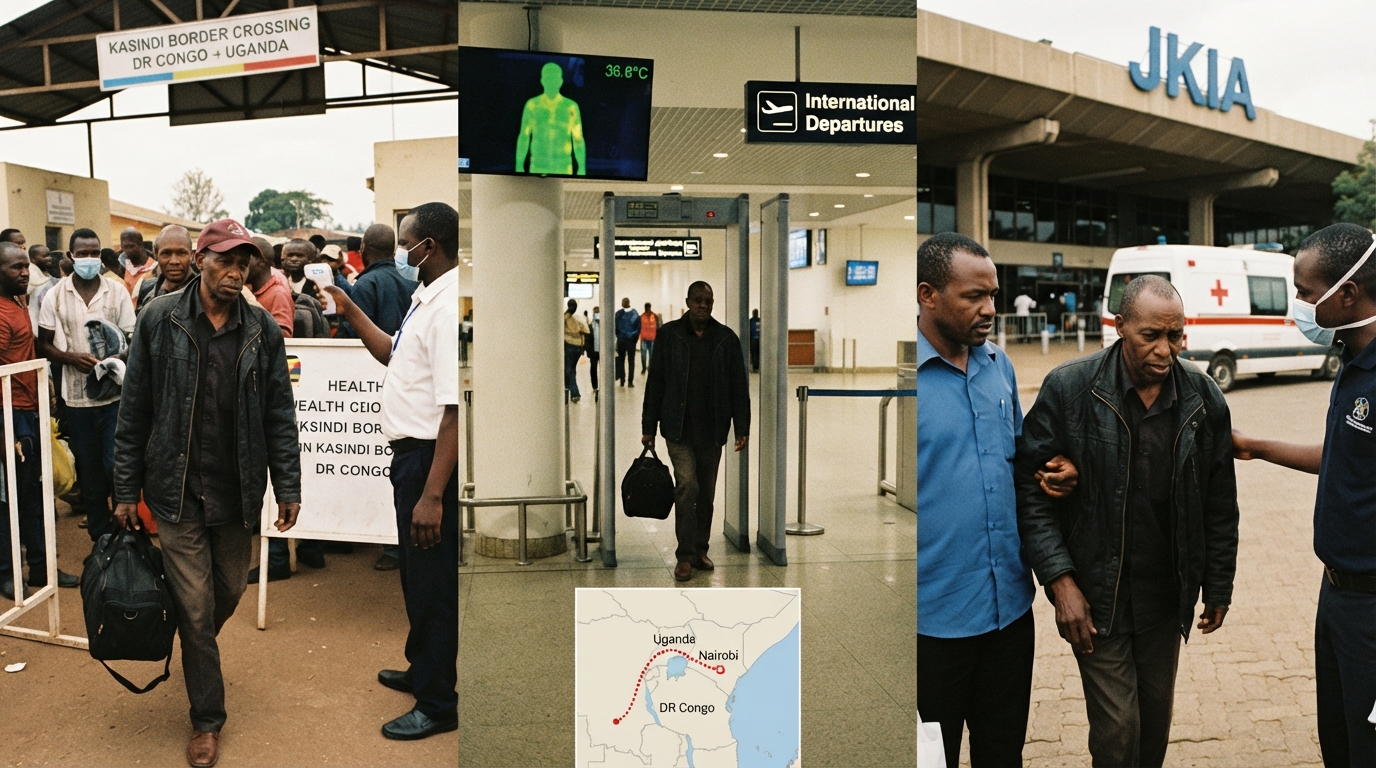
Questions remain about an Ebola patient who crossed three countries without being detected
Nearly 70 possible contacts have been quarantined in Nairobi
A Kenyan businessman was able to spend time in one of the regions hardest hit by Ebola, then travel through two more countries before his illness was identified.
The 40-year-old man — who was only diagnosed with the deadly infectious disease after arriving gravely ill at a hospital in Nairobi — became Kenya’s first confirmed case. He died two days later, on 5 October.
The fact that his infection was missed at several health facilities in the Democratic Republic of Congo, as well as at two airport health screenings in Uganda and Kenya, has raised serious concerns about biosecurity in these countries during a major outbreak.
More than 4,000 people have died from Ebola in DR Congo this year, in what is the second deadliest known outbreak on record.
Africa CDC, the continent’s leading public health agency, has now pieced together the Kenyan patient’s movements over nearly six weeks, exposing several missed chances to detect his infection and possibly stop dozens of people from being exposed to the deadly virus.
The account, given by the agency’s emergency director, Dr Wessam Mankoula, offers the clearest picture yet of how the businessman travelled thousands of kilometres while becoming progressively more unwell.
The man, whose identity has not been disclosed, had lived in DR Congo for seven years and had travelled through three of its provinces on business.
Exactly when or where he contracted Ebola is still unknown — but the virus was present in all three provinces he visited by early October, according to the World Health Organization (WHO).
He spent much of late August and early September in Bas-Uélé province, visiting towns including Buta, Aketi and Likati.
The WHO confirmed an Ebola case in Buta in August, before his visit, although there is no evidence that he caught the virus there.
His symptoms first appeared around 15 September. He was given antibiotics and sent home.
Two days later, he was admitted to Tongo Etandi Health Centre in Bondo, where he stayed until 19 September.
Although he had fever and a rash, he was diagnosed with a skin infection.
Because no Ebola test was taken at any stage during his travels, it is impossible to say exactly when he became infected. Those symptoms fit the early phase of the disease, but they also match other infections common in the region, such as malaria.
On 20 September, he flew to Kisangani, a city of about 1.5 million people on the Congo River, where he spent more than 10 days seeking medical care.
It is not known which hospitals or clinics treated him there, or what medicines he was given. Kisangani is the capital of Tshopo province, which has recorded only 51 Ebola cases.
Then, on 1 October, more than two weeks after he first fell ill, the businessman took another domestic flight to Beni before continuing on to Kasindi, a busy border town.
Both Beni and Kasindi are in North Kivu, which has recorded 1,755 Ebola infections and more than 1,000 deaths, making it one of the Congolese provinces worst affected by the disease.
He did not remain there long, however, and crossed into Uganda later that day.
Uganda introduced restrictions on movement across its border with DR Congo soon after the outbreak began in May.
The country has experience in containing several Ebola outbreaks, including through surveillance, contact tracing and isolating suspected cases. It has had some cases this year — mostly among people travelling from DR Congo — but was declared free of the disease in August.
However, the border between the two countries runs for hundreds of kilometres through remote terrain, making it difficult to monitor.
It is still unclear whether the businessman passed through an official health checkpoint when he crossed the border.
The man’s funeral was held under strict safety protocols
After crossing, he travelled by road to the capital, Kampala, and then to Entebbe International Airport, where he boarded a flight to Nairobi on 3 October.
Ugandan officials said his temperature was normal when he went through airport screening. Health experts say his case shows the limits of relying on temperature checks and self-reporting.
Mankoula said investigators were looking into whether the man’s medication may have suppressed his temperature. He may also simply not have had a fever when he passed through the checks.
Likewise, he was not identified as a suspected Ebola patient when he arrived at Nairobi’s Jomo Kenyatta International Airport, where a relative picked him up and drove him straight to Nairobi Hospital, a private medical facility in the Kenyan capital.
By then, he was experiencing fever, chills, muscle pain, a sore throat and bleeding.
Laboratory tests confirmed that he had contracted the Bundibugyo species of Ebola — the same strain responsible for the outbreak in DR Congo.
He was isolated as his condition worsened. He died on 5 October and was buried the next day under strict infection-control measures.
The Kenyan government says it has now identified 66 people who may have been in contact with him after his arrival. The WHO says that number is likely to increase as contact tracing continues in Uganda and DR Congo.
The quarantine arrangements have also caused concern among some healthcare workers, amid questions about how the patient was managed at Nairobi Hospital.
Kenya’s health ministry says more than 652,000 travellers have been screened and nearly 5,000 healthcare workers trained to deal with Ebola, with five facilities designated to handle cases.
Ebola spreads through direct contact with the bodily fluids of an infected person who has developed symptoms, or through contaminated materials.
Its incubation period ranges from two to 21 days, meaning someone exposed to the virus may not become ill until several weeks later.
Mankoula urged travellers who experience Ebola symptoms to report them, saying early medical attention could improve their chances of survival.
“When you reveal any Ebola-related symptoms early, you’re not only preventing the virus spreading to other countries but you’re also protecting yourself first,” he said.
The WHO has warned that stigma around Ebola could stop people from reporting symptoms or seeking medical care, potentially allowing the virus to spread unnoticed.
The agency says it is intensifying efforts to encourage this by reducing fear and misinformation about the disease — a major problem in DR Congo, where some health workers have been attacked by people who say Ebola does not exist.