

Pyramids, wars, and a golden mask: Five famous rulers of Ancient Egypt
Narmer has gone down in history with the formation of a unified Egyptian state, Khufu with the Great Pyramid of Giza, and Tutankhamun with his tomb discovered thousands of years later. While Ramesses II demonstrated his power through huge temples and military campaigns, Cleopatra attempted to preserve Egypt's independence during the period of Rome's growing strength.
Pyramids, wars, and a golden mask: Five famous rulers of Ancient Egypt
Throughout the nearly three-thousand-year history of Ancient Egypt, numerous rulers succeeded one another. Some of them altered the political trajectory of the state, while the monuments left behind by others became crucial sources for studying this civilization.
**Narmer — the formation of a unified state**
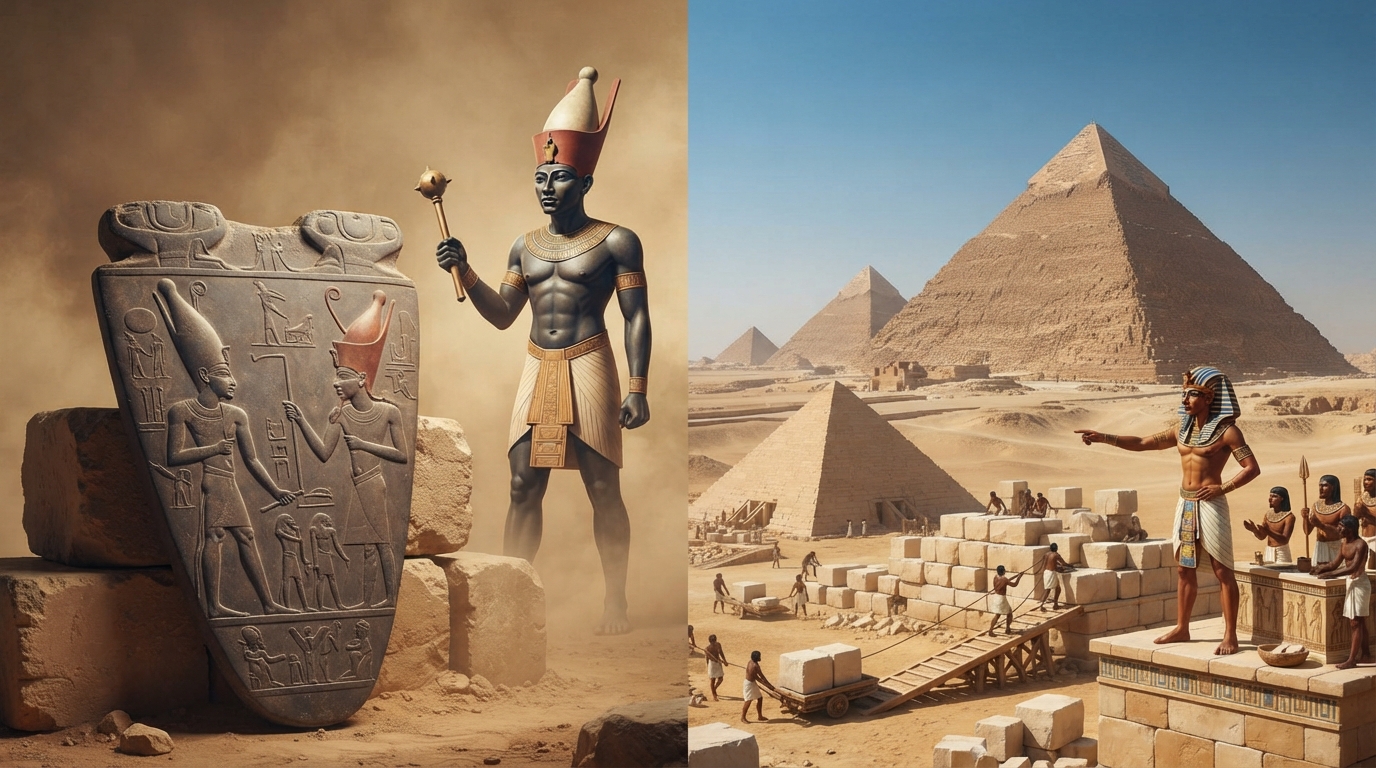
In the 4th millennium BC, political centers of Upper and Lower Egypt were formed in the Nile Valley. Narmer, who ruled around 3100 BC, is considered one of the key historical figures associated with the unification of these two territories.
The most significant archaeological evidence of his reign is the Narmer Palette, a stone slab engraved with images. On one side, the ruler is depicted wearing the white crown of Upper Egypt while defeating an enemy, and on the other side, he is shown in the red crown of Lower Egypt.
This indicates that Narmer ruled over both regions. However, it remains unclear whether the unification was achieved through war, diplomacy, or a combination of both methods.
The formation of a unified state paved the way for centralizing tasks such as tax collection, controlling agriculture and trade, and supplying the army. The perception of the pharaoh's power as sacred also played an important role in maintaining the country's unity.
**Khufu — builder of the Great Pyramid**
The most recognizable symbol of Ancient Egypt is the pyramids. While the first step pyramid was built during the reign of Djoser, the Great Pyramid at Giza is associated with the name of Khufu.
Khufu, who ruled approximately between 2589 and 2566 BC, oversaw the construction of this massive structure. Later, his son Khafre and grandson Menkaure also built their own pyramids on the Giza Plateau.
These structures were part of complexes intended for the burial of pharaohs. Constructing them required large-scale coordination of labor, food, stone, and transportation.