

Putin ordered the capture of Donbas by the end of the year. Is this possible?
Putin ordered the capture of Donbas by the end of the year. Is it possible?
Russian President Vladimir Putin is demanding Donbas as one of the main conditions for stopping the war in Ukraine. More precisely, he says that Kyiv must withdraw its troops from its administrative borders. This same position was put forward again during a recent meeting in Moscow with Donald Trump's special envoys, Bloomberg reported, citing its sources.
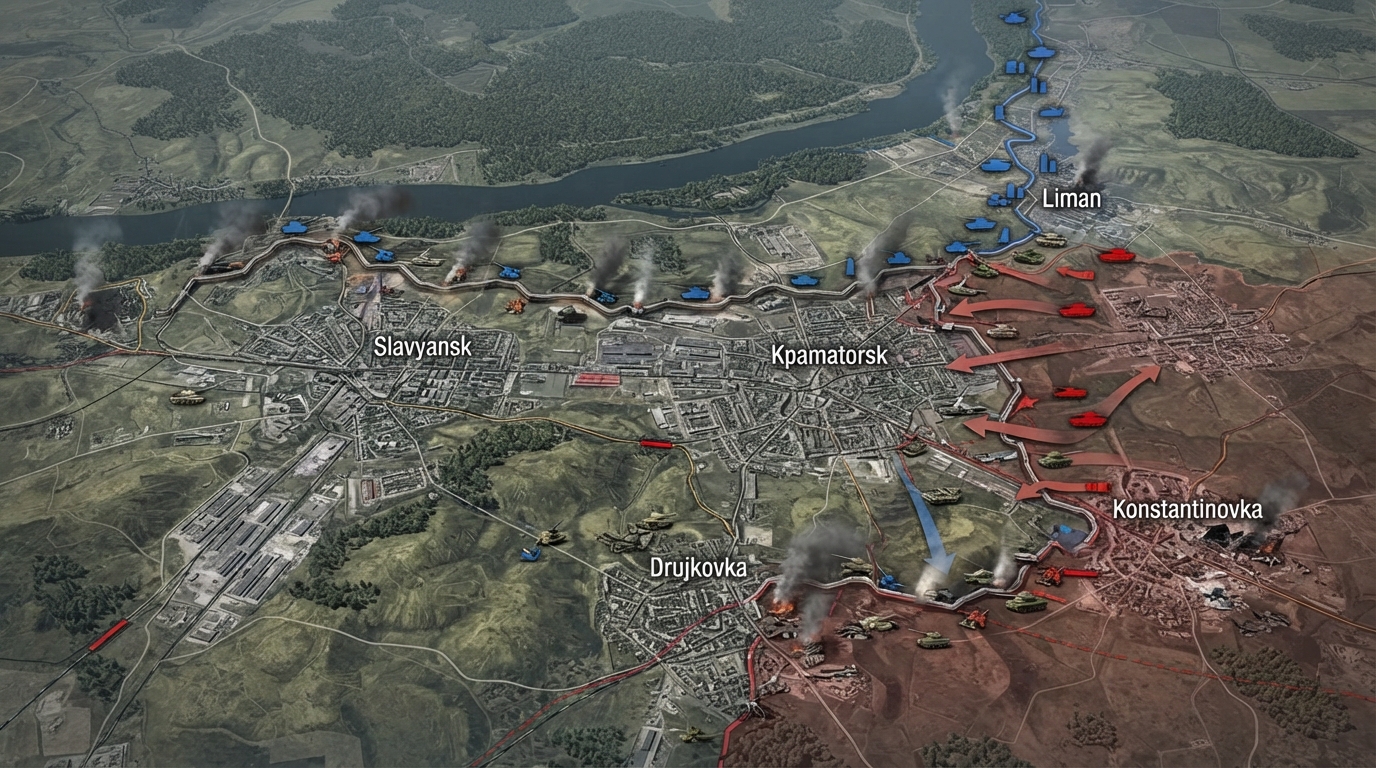
The Ukrainian side, however, has expressed readiness to freeze the conflict along the current line, but stated it will not give up territories that the Russian army has not yet captured and when it might capture them remains unknown. Ukrainians are strengthening defenses in the remaining parts of the region under their control. In this regard, 4 large areas, known as the "belt of fortress cities," are of particular importance.
The reason is that they are located close to each other, forming a strong defensive chain. However, a few months ago, Russia captured an important city within this belt — Kostiantynivka. According to Western analysts, this does not mean the Russian army fully controls the area. Some pockets of resistance may remain in the city. However, from an operational point of view, Kostiantynivka is considered lost.
"Belt of fortress cities."
Nevertheless, the Ukrainian army is actively defending other key cities in this chain — Sloviansk, Kramatorsk, and Druzhkivka. The office of Volodymyr Zelenskyy notes that Putin has instructed the Russian army to fully capture the Donetsk region by the end of the year. The military, however, is asking to extend this deadline until March 31, 2027.
A source close to the Kremlin told Reuters that Putin believes the Russian army will capture Donbas by the end of the year. But military experts are somewhat skeptical about the feasibility of this plan. This conclusion is based on the fact that the conflict has already entered a positional phase and Ukraine is gradually shifting the initiative to its side on the battlefield.
According to observers, the Russian army is approaching the cities of Sloviansk and Kramatorsk from the east. A September 3 report by analysts from the Conflict Intelligence Team (CIT), which works with open sources, stated that Russian servicemen had entered the small town of Mykolaivka. From this area, the distance to the nearest outskirts of Sloviansk is about 3 kilometers, and to the city center is nearly 11 kilometers. However, experts do not yet consider the ongoing process in Mykolaivka as a full-scale battle for the city.
"For now, the phase of active breakthrough is underway. It is too early to talk about battles for the city. Battles for the territory will begin after a sufficient number of assault troops gather in the city," CIT experts noted.
Meanwhile, battles in the area closest to Kramatorsk continue in the village of Nikanorivka. It is located approximately 5 kilometers from the northeastern outskirts of the city. The situation in the area remains complex. A Ukrainian serviceman with the call sign "Muchnoy" wrote on September 9 that Russian soldiers had begun entering the village from the eastern direction. He also added that the Russian army is trying to break through to the village of Vasylivska Pustosh, west of Nikanorivka.
Russian troops are also increasing pressure in the direction of Druzhkivka. Battles continue about 7 km from the center of the area. It is worth noting that there are many residential buildings and industrial facilities in this direction. This factor makes the advance of the Russian army difficult and increases casualties.
The cities of Sloviansk, Kramatorsk, and Druzhkivka are being subjected to regular bombardment. One of the goals of such attacks is to disrupt the logistics system of the Ukrainian armed forces. In particular, in recent weeks, the Russian side has destroyed or damaged several bridges in Kramatorsk and Sloviansk.
According to the conclusion of Jenny Olmsted, an analyst at the US-based Institute for the Study of War (ISW), the Russian army is currently advancing slowly toward Sloviansk and Kramatorsk. She ruled out the possibility of sharp changes in this direction, but noted that the situation is changing in Russia's favor.
According to the analyst, as Russian armed forces approach Sloviansk and Kramatorsk from the east, battles may begin within the city itself. This will be not only a military operation but also a political signal: through this, the Russians will show that the final phase of the battles for Donbas has begun. However, the expert doubts that such an attack will succeed in the short term.
"We have witnessed many times that the Russian army has been unable to capture large cities without bypassing them from the flanks and cutting off their logistics," she says.
The analyst cites Pokrovsk and Kostiantynivka as examples. Ukrainian forces were able to defend these cities for months even after the Russians invaded the territory.
For the Ukrainians, the situation deteriorated sharply after several factors occurred simultaneously. In particular, the Russian side began regularly striking the supply routes of the Ukrainian army, and also opened corridors for partial encirclement and penetration of the city.
The situation in the north is complex — for the Russians
From a military point of view, the cities of Sloviansk, Kramatorsk, and Druzhkivka form a single defensive area over 30 kilometers long. For this reason, completely encircling such a complex of fortifications would require far more forces and resources than those deployed in the Pokrovsk direction. To avoid precisely this scenario, the Russian army is trying to reach the rear of these cities through the south and north. But for now, there is no threat of encirclement.
Looking north of the belt of fortress cities, the situation of the Russian troops appears even more complex. OSINT analysts report that the Ukrainian armed forces conducted a successful operation near Lyman.
According to unconfirmed reports, as a result of counterattacks that began in May, Ukrainians liberated about 200 square kilometers of territory and pushed Russian troops to the eastern bank of the Zherebets River. OSINT analyst Clément Molin described the progress of the operation in the greatest detail. His data was confirmed to one degree or another by other experts as well.
The difficult situation in which Russian troops found themselves near Lyman was also acknowledged by the Russian Telegram channels "Rybar" and "Dva Mayora". Success in this direction is important for Ukraine in two ways. First, it protected Sloviansk from a potential attack from a new direction in the north.
Second, Russian troops were deprived of the opportunity to bypass the city and cut off the road leading from Izium to Sloviansk. This is one of the most important supply routes for the Ukrainian army.
The Ukrainian side has not yet officially commented on the operation near Lyman. However, a "silence regime" was also observed in previous similar operations. For example, when the Armed Forces of Ukraine liberated 26 villages located in the Donetsk, Dnipropetrovsk, as well as Zaporizhzhia regions, officials were in no hurry to make statements.
At that time, the counteroffensive operation began in January and ended in August. Only after that did the Commander-in-Chief of the Armed Forces of Ukraine, Mykhailo Drapatiy, openly report the results of the operation to President Zelenskyy.
What is behind Ukraine's successful counterattacks?
According to military expert Kyrylo Mykhailov, there are complex reasons behind the fact that the counterattacks of the Ukrainian army are leading to practical results. The operational-tactical coordination of infantry, armored vehicles, and drones is one of them.
"This allows conducting even limited mechanized operations, because Russia's ability to partially isolate the battlefield using drones is limited," the expert says.
A CIT analyst notes that the Ukrainian armed forces have been conducting counteroffensive operations at low intensity but regularly for the past year and a half. First, the enemy's firing assets, including drones and their operators, are identified. Then, such targets are struck. As a result, relatively safe conditions are created for the infantry to advance.
After that, the captured position is consolidated, and the entire process is repeated in other areas. In the operation near Lyman, choosing a tactically favorable direction also played an important role. Ukrainian forces cut off a relatively isolated bridgehead of Russia, which was separated from its main troops by the river.
However, according to some experts, Ukraine is mainly able to carry out such operations in directions that are of relatively secondary importance to Russia and where Moscow is not ready to deploy large amounts of resources. In this regard, it will not be easy to organize successful counterattacks in the Sloviansk — Kramatorsk — Druzhkivka direction. Because the Russian army has deployed large resources to this area.
"The main task here is simply to stop Russia's advance. For now, there are no resources for an operation larger than that," says the CIT analyst.
When can Russia capture the belt of fortress cities?
Experts have put forward various predictions as to when Russia might capture Sloviansk, Kramatorsk, and Druzhkivka. However, most of them consider the probability of this happening by the end of 2026 to be very low.
"The Russians will attack Sloviansk and Kramatorsk directly, but at the same time they will try to break through from the south. To do this, they will first need to capture Kostiantynivka and Druzhkivka," said Kyrylo Mykhailov.
Given that the pace of advance of the Russian armed forces slowed down significantly in 2026, capturing Sloviansk and Kramatorsk next year remains a big question. The CIT analyst also drew attention to this aspect, noting that this is impossible within the next six months.
The Russian army is gradually, albeit slowly, increasing pressure in the directions of Sloviansk, Kramatorsk, and Druzhkivka. In particular, the breakthroughs into the areas of Mykolaivka and Nikanorivka, the advance in the south through Kostiantynivka toward Druzhkivka, and the fierce battles around Dobropillia testify to this.
However, completely encircling and capturing the "belt of fortress cities" stretching over more than 30 kilometers is a complex task. This requires an unprecedented level of additional forces and resources. On top of that, the Ukrainians conducted a successful operation near Lyman, seriously undermining the Russians' plan to bypass Sloviansk and cut off its main supply routes.
For this reason, almost all military experts come to a common conclusion: Russia is unlikely to fully capture the Donbas region in the coming months. What will change on the battlefield next year depends on very many factors.