

Protesters call off 26-day agitation over exam irregularities in Indian state
Protesters have warned the agitation had only been suspended and could resume if the government failed to act.
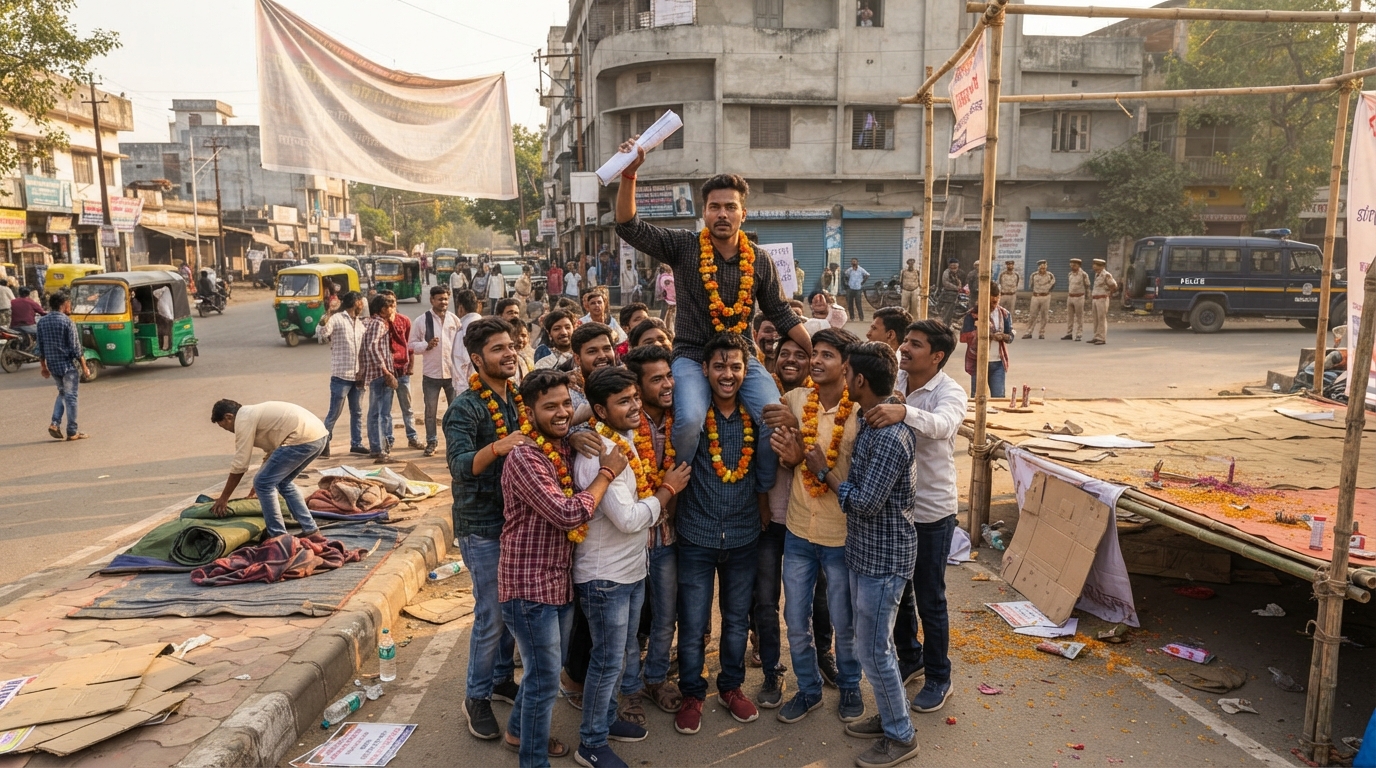
Protesters in Jharkhand, an eastern Indian state, have concluded a 26-day demonstration against alleged irregularities in government examinations, following the state's agreement to several of their demands. The agitation, which sought education reforms, saw thousands of students and job seekers advocating for an overhaul of the state's recruitment system, with some engaging in hunger strikes.
The resolution came after the government nullified 22 of the contested exams and initiated investigations into several others. On Wednesday, student leaders announced a two-month deadline for the government to fulfill its remaining commitments. The protest site in Ranchi, the state capital, which had been occupied by hundreds since late July, has since been cleared.
Before dispersing, protesters celebrated their perceived victory with garlands and firecrackers. Student activist Ravindra Paswan informed news agency ANI, "This marks a major victory in the struggle that Jharkhand's students have endured." However, protest leaders emphasized that the agitation was merely suspended and could resume if the government failed to act.
A key point of contention that prolonged the standoff was the students' demand for an investigation by the Central Bureau of Investigation (CBI), India's federal investigative agency. The state government initially resisted this, opting instead for its Criminal Investigation Department (CID) to probe the alleged irregularities. This investigation has led to several arrests, including the head of the Jharkhand Public Service Commission (JPSC), which administers many of these exams.
After weeks of stalemate, protest leaders confirmed on Wednesday their acceptance of a government proposal for a judicial inquiry, rather than an immediate CBI investigation. Paswan stated, "If this is not done within two months, we will once again vigorously demand a CBI investigation."
However, the government's concessions have sparked a new controversy. The decision to cancel some exams has prompted protests from successful candidates who had already cleared them and secured government positions. The fate of their appointments remains uncertain if the investigations uncover irregularities. Some of these individuals have petitioned the Jharkhand High Court, arguing that meritorious candidates should not lose their jobs due to alleged irregularities involving others.
Government jobs in India are highly coveted for their stability and security, with millions of candidates annually preparing for and taking recruitment exams. Despite this, the system has been repeatedly plagued by allegations of paper leaks, cheating, and other irregularities. The recruitment process itself can also be protracted, leaving even successful candidates in prolonged uncertainty.
In Jharkhand, the protests began last month following the preliminary civil service exam results. Some candidates alleged that answer sheets shared online indicated successful applicants had answered fewer questions than expected, fueling suspicions of manipulation. This occurred shortly after a larger protest in Delhi, the Indian capital, which led to the resignation of the federal education minister, thereby increasing pressure on Chief Minister Hemant Soren's government.
The protests had put the ruling alliance—comprising Soren's Jharkhand Mukti Morcha, the Congress, and other parties—on the defensive. The Bharatiya Janata Party (BJP) of Prime Minister Narendra Modi, which is in opposition in the state, had been supporting the protesters. Earlier this week, Soren revealed that "many shocking facts are emerging" from the CID investigation. He also announced the cancellation of exams conducted by private agency TSR Data Processing Private Limited (TDPL) and a review of all recruitment exams held since 2014.