

Protesters blame 'vulture funds' for Spain's housing crisis
Hundreds have pitched their tents in central Madrid, while the Spanish prime minister has called a snap election.
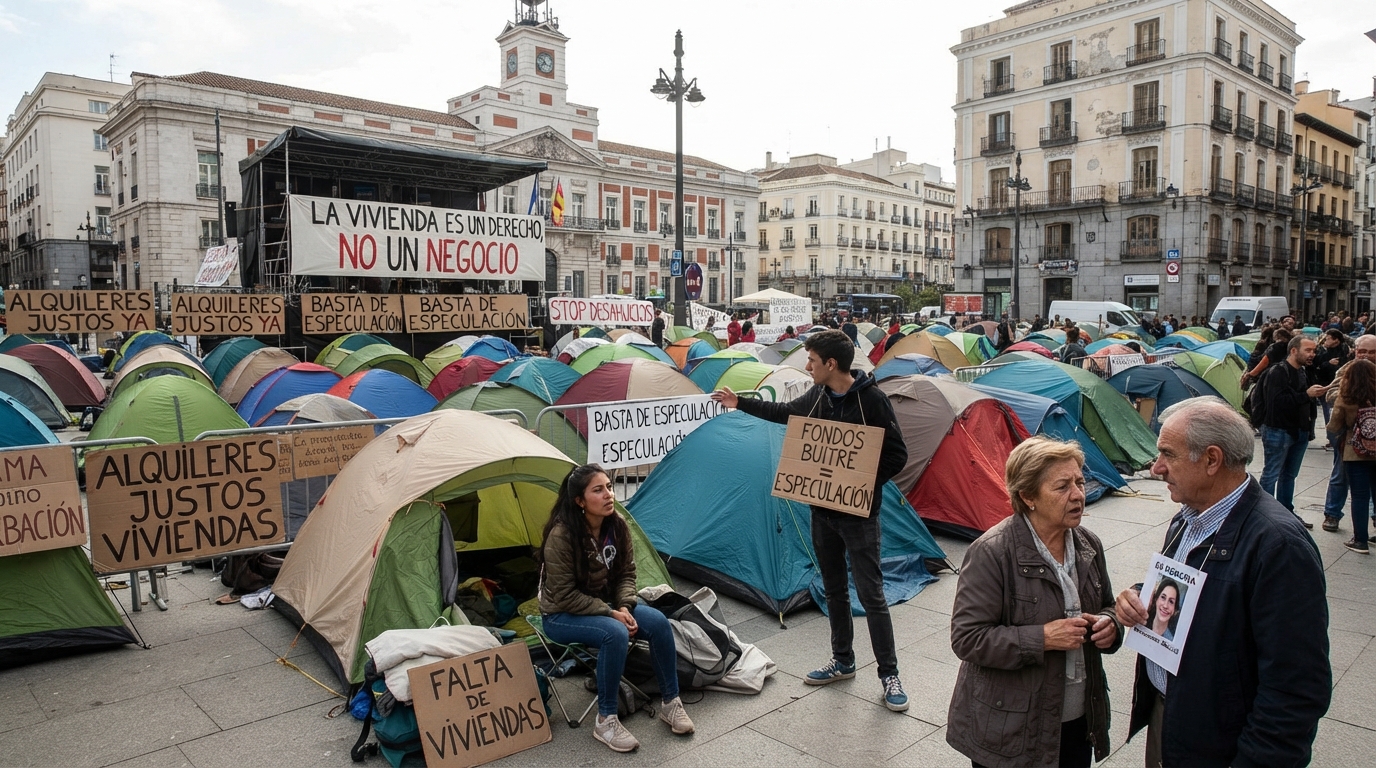
Protesters blame 'vulture funds' for Spain's housing crisis
Jorge Moreno (left) says "vulture funds" are driving rents higher, while Pierina Nicuray says there is "a lack of homes" in Spain
Pierina Nicuray, a 21-year-old university graduate, has spent the past week living in a tent in Madrid's Puerta del Sol square.
Like many of the hundreds of others who have set up camp there to protest Spain's housing crisis, she has no hesitation about what is causing it.
"It's the same problem as always," she says. "A lack of homes."
She adds: "Landlords are taking advantage of the situation to raise rentals, and then there's also Airbnb."
Jorge Moreno, a 19-year-old film-dubbing student who has also been staying in a tent in central Madrid for the last few days, agrees.
"There are so many homes standing empty because they have been bought by vulture funds and investment funds which hike up the rent of people living in properties until they get rid of them," says Jorge, who lives with his mother and fears it will be a long time before he can afford a home of his own.
"They've been making a business of housing for a long time," he adds. "But it's an abusive business which stops Spaniards from being able to live in a decent home."
Their explanations are echoed often by fellow protesters, ordinary Spaniards and even the Spanish government.
When presenting a recent package of emergency measures to address the housing problem, Socialist Prime Minister Pedro Sánchez said he was legislating "against those who consider housing just another object on the market with which to speculate".
Those reforms were rejected by Congress, leading Sánchez to call a snap election next month.
Nicuray and Moreno point to the single case that triggered the current Spanish housing protest movement as evidence that profit-led practices lie at the centre of the crisis: the 87-year-old Maricarmen Abascal was evicted from her home after the investment firm that had bought it tried to persuade her to leave, then sharply raised her rent, which she could not afford.
Although the public backlash that followed led the company to invite Abascal back to her former home, she never returned, dying in hospital on Wednesday.
Protesters at Pueta del Sol have been paying tributes to Maricarmen Abascal
Many others have their own accounts of struggling with a rental market that has soared.
Carmen Pérez is a retired widow from Ecuador who has lived in Spain for 17 years.
When she first arrived, housing was relatively cheap and easy to find, but as prices have climbed she has been forced to move in with her daughter and son-in-law while searching for somewhere affordable to rent.
"When a property is listed to rent, there's always a long waiting list," she says. "And the rent is always too high for me. All of this has affected my health - I've got depression, I don't have any stability or security."
Spain has recorded an average rise in rental costs of 84% over the past 10 years, according to property outlet Idealista.
In the centre of the southern city of Málaga, the increase has been 113 %, and in Marbella, just under 150%.
Figures like these have made housing Spaniards' biggest concern.
A recent study by the Centre for Sociological Research (CIS) showed that the wider Spanish public, like the protesters, wants action against those seen as powerful players in the housing market.
Some 72% wanted higher taxes for those with 10 or more properties; 76% wanted limits on short-term tourist accommodation; and 40% backed the expropriation of empty homes.
However, Jorge Galindo, director at the Esade centre for economic policy, says the available data makes it hard to know exactly how many Spanish properties are owned by so-called "vulture funds" and used for speculation.
He points to Bank of Spain figures from 2024 showing that only 8% of properties for rent are owned by companies.
Galindo says that, based on the data available, he does not see a significant concentration of rental property in the hands of a small number of owners in Spain.
"When it comes to explaining the rise in rentals, that is not the big cause," he says. "What explains it is the shortage of supply compared to demand over recent years."
The Bank of Spain appears to agree, estimating that the country has a housing shortfall of around 750,000 homes.
The institution's deputy governor, Soledad Núñez, warned in September that by 2028 that figure could reach one million.
There are 3.8 million empty properties in Spain, according to the National Statistics Institute (INE), but many of them are in depopulated rural areas and therefore have little bearing on the current crisis, which is most severe in urban centres.
Other reasons for the high number include homes awaiting renovation, or legal disputes between family members who have inherited them.
Demographic change has played a major role in the mismatch between supply and demand.
Between 2021 and 2025, around 1.2 million new households were created in Spain, driven largely by the arrival of migrants who have played a major role in the country's recent economic growth.
However, house building has not kept pace, with fewer than half a million new homes built during that period.
That was partly because Spain's construction industry had shrunk after the Eurozone crisis, while material costs rose sharply after Covid, and a lack of political consensus created legal barriers to building.
"It was not a priority for us to build new houses," Galindo says. "But, once the demographic boom came, we realised how costly it was for us."
He adds that short-term tourist accommodation, such as Airbnb, which has been identified by both the Spanish government and many activists as a culprit, is likely to have had a more localised impact, pushing up prices in particular urban areas rather than affecting the market overall.
Meanwhile, the crisis has been worsened by wages failing to keep up.
A study by El País found that, in real terms, the average Spaniard had 5% less spending power than a decade ago, because of taxes, social security and inflation. The average monthly salary in the Madrid region is €1,550 (£1,314; $1,738).
"No worker should have to spend 75% or 80% of their salary on rent, because what are they supposed to eat?" says Francisco Pardo, an 81-year-old retired taxi driver who sympathises with the protesters during a visit to the tent city in Madrid.
"Many workers don't even earn €2,000 [per month]."
Maricarmen's case has suddenly turned the housing crisis into an urgent subject of debate, not only in Madrid's Puerta del Sol but across Spain.
The question now is whether a consensus can be reached on how to solve it.