

Police deployed during stand-off over control of Poland's top court
It comes after the government suspended two senior justices and moved to bring criminal charges against them.
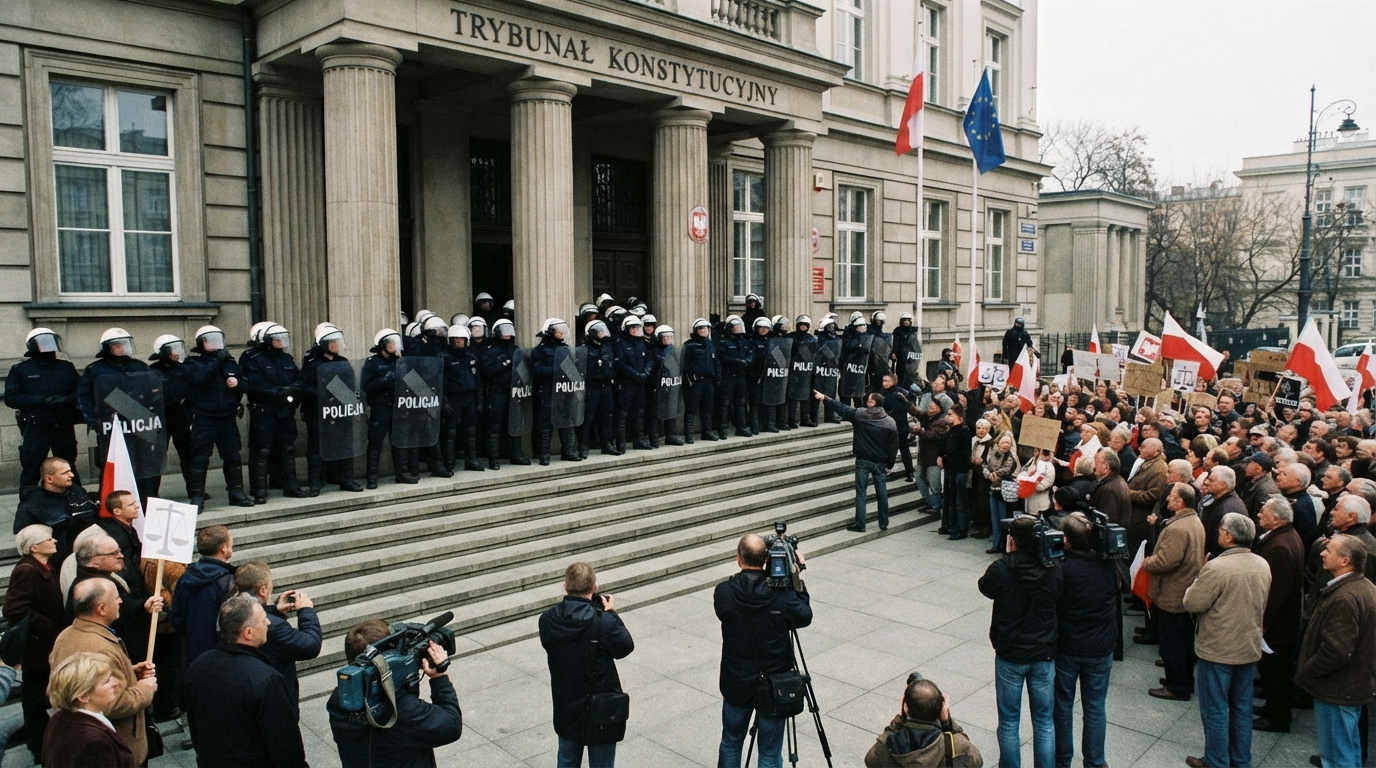
Police deployed amid standoff over control of Poland’s top court
A political confrontation over Poland’s top court, the Constitutional Tribunal, has erupted after the government suspended its two most senior justices and moved to pursue criminal charges against them.
Polish Justice Minister Waldemar Żurek said he had asked for the immunity of the court’s President Bogdan Święczkowski and Vice-President Bartłomiej Sochański to be lifted so criminal charges could be brought against them.
Right-wing politicians from the opposition Law and Justice (PiS) party assembled outside the court in Warsaw to protest the decision.
Riot police were sent in to stop any demonstrators from entering the court building.
In a social media post, the Constitutional Tribunal said the two men remained the court’s legally appointed senior justices.
“All persons participating in these actions are committing the crime of a coup d'etat,” it said.
Prime Minister Donald Tusk said his government was working to restore the rule of law.
In a social media post, Tusk wrote: “Restoring the rule of law is our duty. After years of Law and Justice's lawlessness, this is a difficult, sometimes painful process that requires decisive action. There is no other way.”
President Karol Nawrocki, who is backed by PiS, ordered his plane to be turned back to Warsaw while he was on his way to Senegal to attend the Summer Youth Olympic Games.
The Constitutional Tribunal was the trigger for Poland’s long-running rule of law dispute after the PiS-led government came to power in 2015.
The PiS majority in parliament quickly sought to appoint judges to the court in order to secure a majority there, since the tribunal has the authority to rule on the legality of legislation.
Leading European courts — the European Court of Human Rights and the Court of Justice of the European Union — later ruled that the PiS majority had improperly elected three of the judges because they duplicated positions that had already been validly filled by the previous parliament.
Those courts said Poland’s Constitutional Tribunal was no longer an “independent and impartial tribunal”, and Tusk’s government has relied on those rulings to stop publishing the tribunal’s decisions.
After taking office in 2023, Tusk promised to depoliticise the judiciary, but he has not been able to reverse the PiS-era changes, partly because Nawrocki and his PiS-backed predecessor Andrzej Duda used presidential vetoes to block his efforts.
Nawrocki has also refused to swear in five Constitutional Tribunal judges elected by parliament since March, citing alleged defects in the selection process.
One of those judges, Anna Korwin-Piotrowska, has now been put in temporary charge of the court.
Earlier this month, the Council of Europe’s advisory body on constitutional matters, the Venice Commission, said Nawrocki should swear in the judges so they can sit on the court’s bench.
Żurek said Święczkowski and his vice-president should face criminal charges for preventing the judges from ruling.
Some of Tusk’s supporters have accused him of not acting decisively enough to roll back the PiS-era reforms.
Parliamentary elections are due next year, and some view his move as an effort to improve Tusk’s standing with those voters.
But the move has also drawn criticism. In September, Tusk put forward Maciej Berek, a politician and lawyer who served as a minister in his cabinet, as a judge candidate for the court.
Lawyer Marcin Matczak, a critic of the PiS-era judicial reforms who has said he regards Święczkowski as the court’s worst president, said the suspension had no legal basis “for a million reasons”.
“Today's action at the Constitutional Tribunal, in my opinion, buries this body and the issue of the rule of law for two decades,” Prof Matczak wrote on social media.
“Images of armed police and legal interpretations according to which the minister of justice can remove the president of the Constitutional Tribunal by decree will have a powerful, anti-rule of law backlash for years to come,” he added.