

"People Should Not Fear the Court": Guzal Abduakhatova, First Uzbek to Join Chicago Bar Foundation
**"People Should Not Fear the Court": Gozal Abduakhatova, First Uzbek at Chicago Bar Foundation**
A notable aspect of Gozal Abduakhatova's academic career in America is that she became the first Uzbek student to intern at the Chicago Bar Foundation (CBF). CBF is a charitable organization of the Chicago legal community that provides free legal assistance to people in difficult situations. It is worth noting that Gozal's experience in providing free legal assistance to people began long ago, in Uzbekistan.
During the interview, she spoke about the process of providing legal assistance to Americans and Uzbeks, as well as her innovative proposals for the legal system in Uzbekistan.
**Starting point**
"Since childhood, my family has always supported my choices and interests. They allowed me to freely choose my field and extracurricular activities. Learning was always encouraged, and even the smallest achievements were celebrated. I think this freedom of choice that my parents gave me played an important role in finding my way in life," says Gozal.
She remembers her school days mainly with science Olympiads. It was the Olympiads that formed her ambition and fighting spirit. She reached the city stage and always took second place. This was not a bad result, but she wanted to win first place. She still remembers how she cried when she returned home after the Olympiad. This situation repeated itself for three years, and finally, in the 9th grade, on the fourth attempt, she won first place at the city stage and gained the right to enter a lyceum/college on a preferential basis. It was the result of three years of defeat, a firm goal, and steely discipline to achieve this goal.
After consulting with his family, he chose a law lyceum. His interest in the field of law began there, and now he has embodied in his imagination a future lawyer or diplomat of international standing. These sweet dreams led him to Tashkent State Law University three years later. "You know, when I was a student, I thought, 'That's it, I've achieved my highest goal, I've entered the university of my dreams.'" While actively participating in university life and getting to know the ups and downs of the industry, I realized that this was just the beginning of a long journey," says Gozal.
**First experience**
At the university, most of his time outside of class was spent in the library. But he didn't want to just be a "good student." He needed practice, more practice. Because memorizing laws is one thing, but applying them in practice and benefiting people is another.
In this sense, participating in two projects at the university was a very valuable experience for her. The first was the "Street Law" project, the concept of which was to explain to schoolchildren everyday legal concepts such as human rights, constitutional norms, the fight against corruption, consumer rights and gender equality in a simple and understandable language.
The second project was the TSYU Legal Clinic, where students provided free legal assistance to citizens, helped them prepare their applications and legal documents under the supervision of professors. "It was during this process that I realized that I get satisfaction from helping people, from easing their difficulties. If I can make a positive change in someone's life, even if it is small, this is the best motivation for me," says Gozal.
It was during this period — when he worked with those who could not afford a lawyer, did not know how to fill out their documents, and were stranded on the threshold of the courthouse — that he wondered: why should the path to justice be so complicated and arduous for an ordinary citizen? In search of an answer to this question, he came across the ocean — to America.
**The First Uzbek**
In January 2025, he was accepted into the master's program at the Faculty of Law of the University of Urbana-Champaign in Illinois. Being a scholarship holder of the "El-Yurt Umidi" Foundation, he was exempt from tuition fees. Already in the first months of his studies, advertisements for summer internship programs for students began to appear. Among dozens of options, the Chicago Bar Foundation (CBF) Summer 2025 LLM Externship program attracted the most attention. Because this program was an American alternative to the work that I had been passionately engaged in for several years at home - helping citizens who were having difficulty defending themselves in court.
The competition was very strong, among the candidates there were both US citizens and experienced law students from different countries of the world. At first, I was a little hesitant about my capabilities. But the desire to learn the US experience in facilitating citizens' appeal to the courts prompted me to take a risk. And the three-year pro bono (free legal assistance) experience accumulated in Uzbekistan spoke for itself - I won the competition and became the first Uzbek participant in this program.
The internship, which lasted from June to August 2025, took place in two main directions. In the first direction, I conducted extensive legal and political research on court transcription and translation practices in US states; They compared artificial intelligence transcription systems in more than 50 states and, based on the conclusions, prepared practical proposals for the implementation of AI transcription in Cook County courts.
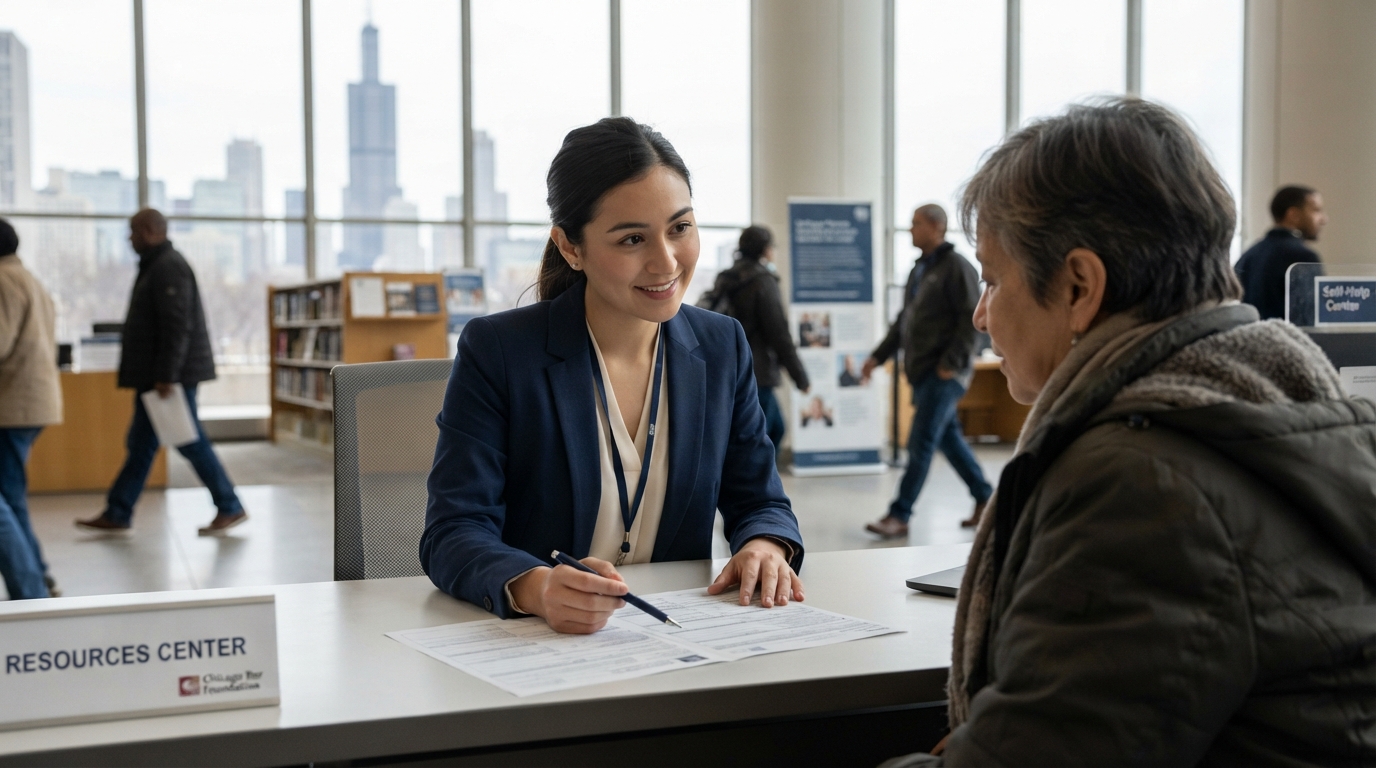
The second area was direct communication with people. Two days a week, the Richard J. Daley Center worked at the Resource Center for Unrepresented Citizens at the Cook County Courthouse. Here, citizens who could not afford to hire a lawyer directly assisted in filling out court documents in complex family and civil cases, such as eviction, divorce, child custody, and termination of parental rights.
"This practice made one thing very clear to me: when a person comes to court, he is often afraid and confused because he does not understand the complex system. The task of a specialist is not just to fill out a form, but to give the citizen confidence that 'you can overcome this problem,'" says Gozal.
At the same time, conversations with Cook County judges, the president of the Chicago Bar Association, and other influential lawyers provided a holistic and in-depth understanding of the ecosystem of access to justice in the United States.
The research and the lively dialogue at the Daley Center complemented each other. On the one hand, he saw the texts of the law and comparative studies of interstates, and on the other, the real-life reflection of the same laws - a mother fighting for custody of her child or a person struggling with their rights in housing disputes. The combination of theory and practice reminded him every day that the field of law is not only about papers and documents, but also about the fate of people.
After successfully completing his internship at CBF, he returned to Urbana-Champaign. On the eve of the fall semester, he saw an advertisement for the internship program of the Student Legal Services at the university. This organization works directly with the Champaign County courts to provide free legal assistance to university students on leases, housing issues, and traffic violations. The experience she gained at the Daley Center came in handy when she was accepted into this program. As a result, she became the first Uzbek to study the judicial system of two large counties in Illinois - Cook and Champaign.
During her participation in this program, she participated in court proceedings as a direct observer, conducted initial interviews with clients under the supervision of assigned lawyers, and thoroughly studied the practical aspects of the attorney-client relationship in the United States.
**Initial conclusions**
She currently works as a paralegal at the law firm of Hurst, Kay, Allen & Stambler in Chicago. At the same time, he is also preparing for the New York State Bar Exam. He has two options for his future specialization: either to study bankruptcy law thoroughly and choose a corporate specialty, or to stay in the family law field, where he has acquired sufficient skills. Regardless of which specialty he chooses, he plans to continue his research on pro bono — providing free legal assistance to citizens, and facilitating the court appeal system.
"I was 22 years old when I moved to Chicago. It was a huge, unfamiliar city, a completely different legal system, and I didn't know anyone. For many young professionals, this can be the most difficult period mentally and professionally, and I remember this stage with special gratitude. Because my professors and mentors were always there for me, diligently answering every question I had, and teaching me to approach work responsibly and professionally," says Gozal.
Participation in two prestigious programs gave him practical experience that cannot be found in university classrooms, as well as the most effective mechanisms of the US legal system. It was these observations that gave rise to a new idea for improving the legislation of Uzbekistan. Currently, an important scientific and practical proposal is being developed - based on the experience of standardized court forms in Cook County, the courts of Uzbekistan and the network of 149 regional advisory bureaus of the non-governmental non-profit organization "Madad" are working on the introduction of a simplified and standardized system of applications for family disputes.
"I have drawn such an important conclusion from practice in the United States: the more understandable, simple and convenient the system is for a citizen defending himself in court, the easier it is to achieve justice. As a lawyer, my ultimate goal is to contribute to creating the opportunity for every citizen to receive quality legal assistance through modern technologies and standardized solutions. If one practical reform, one convenient procedure that simplifies the appeal to the court, can at least slightly reduce people's fear of the judicial system and increase their confidence in justice, then our efforts will not have been in vain," concluded Gozal Abduakhatova.
Interviewed by Saodat Abdurakhmonova.