

Palestinians and US journalist injured by Israeli settlers in West Bank harvest attack
The BBC sees masked settlers attack Palestinians trying to harvest olives, amid a surge in similar incidents.
Palestinians and US journalist injured by Israeli settlers in West Bank harvest attack
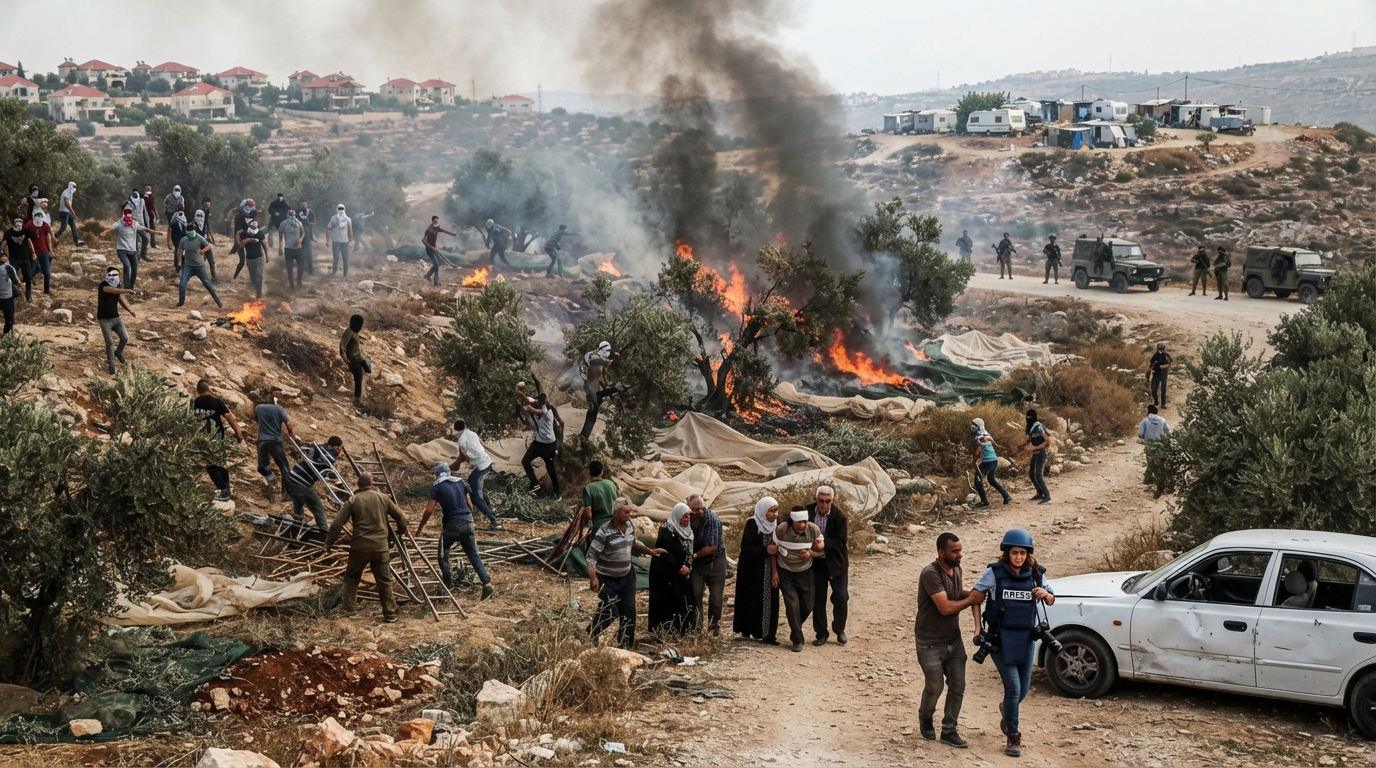
Dozens of masked settlers attacked Palestinians and torched cars and olive trees during the annual olive harvest in the occupied West Bank.
A BBC crew saw one of several assaults in farmland near the Palestinian village of Abu Falah. A local official said 12 Palestinians were injured in the attacks, among them four dual Palestinian American citizens. A foreign journalist was also hurt.
Majdi Fheed’s bloodied face could be seen from the back seat of one car.
"We were getting our olive trees and almost 15 Jewish guys … started attacking us with guns, with rocks, with special weapons. They hit me on my head [and] my neck – look, I am bleeding!"
Yaser AlKam, a council member from the neighbouring village of Turmus Aya, told me that Majdi - an American citizen - had been attacked by settlers using nail-studded sticks and needed treatment for deep wounds to his head. His elderly mother was also injured.
Another man, who was taking the injured to hospital, told us settlers had beaten them with sticks while they were picking olives, and had set fire to three cars – including one of his own.
"As soon as we got to the land and put our things on the ground, they started to come, so we ran away" said a woman beside him.
When asked about the violence, a US State Department spokesperson said they were aware of the reports.
"We condemn criminal violence by any party in the West Bank and call for investigations, arrests, and convictions, of those responsible," the spokesperson said.
As she watched vehicles pass by, 73-year-old Imm Khaldoun told me firmly that whatever happened, she would always come back to her land. "This is my land. It's my right [to be here]" she said.
The UN says the last two weeks have already seen more attacks by violent Israeli settlers than during the whole harvest season last year.
Picking olives in the West Bank has become a race against time, with trees stripped of fruit quickly after sunrise before violent Israeli settlers attack.
At another nearby olive grove, we saw dozens of farmers using power-tools to strip the trees as quickly as possible, keeping one eye on the ridge above us, where a group of settlers at a new illegal outpost had already gathered and were watching the olive harvest below.
Standing on ladders, the Palestinian farmers worked fast, sending streams of olives onto the plastic sheets spread beneath the trees. Amin Khalil, the landowner, told me that three villages had joined together to harvest these olives as protection against attack. He said his land was now surrounded by seven Jewish settlements and outposts.
All Israeli settlements are illegal under international law. Outposts – small encampments on hilltops – are also illegal under Israeli law, though many still receive state support.
"This is a hotspot – there are seven settlements around here," Amin Khalil told me. "This year, all the people came together because when there are just a few people working alone at the edge of the village, the settlers attack. So all the families are working together today."
But that tactic does not work today. As we watch, dozens of settlers dressed in black start moving down the hill toward us, setting fire to several clusters of olive trees.
There are cries of panic from the Palestinian farmers, shouting for children to leave the field. Some quickly begin packing up the olives to go.
But with large numbers on both sides, the confrontation settles into an uneasy stalemate. We see settlers with slingshots throwing stones toward us, and young Palestinian men running to throw stones back.
As Israeli forces arrive, the standoff erupts. Settlers begin running down toward us as the farmers quickly pull back. Some Palestinians fire fireworks in an attempt to drive the settlers away.
The UN says settler attacks this year have so far killed one Palestinian and injured more than 120 others.
American journalist Heidi Levine of the Washington Post was injured in the attack. She said dozens of settlers ambushed her while she was reporting at the scene.
"I got jumped," she said. "I was on the ground and they were kicking me and I was trying to hold onto my camera and my bag. I had my helmet and flak jacket on which protected me. They made me stand up and they kicked me again, and this went on for at least 10 minutes."
In a statement, Washington Post executive editor Matt Murray said Levine was clearly identifiable as a journalist.
"We are outraged by this unwarranted attack on a journalist doing her job and urge a thorough investigation and follow-through from authorities," he said.
The Israel Defense Forces (IDF) said troops had been sent to the area "following a report of a violent confrontation". It said a female journalist had been injured during the confrontation, and that "all circumstances" surrounding the incident would be examined.
As the farmers withdrew, the sound of live ammunition cracked across the fields. It was not clear whether settlers or Israeli forces were firing.
Minutes later, Israeli forces began firing tear gas into the Palestinian fields to end the confrontation – a familiar Israeli pattern for handling these clashes.
The UN says settler attacks on the olive harvest this year have so far killed one Palestinian and injured more than 120 others across the West Bank.
Illegal Jewish outposts have spread rapidly here over the past few years, clustering ever closer around Palestinian olive groves.
What we saw was part of a pattern repeated day after day, as settler outposts here grow.
The annual olive harvest has become a measure of how the policies of Israel's fiercely pro-settlement government are affecting Palestinians here, by overseeing rising violence by extremist settlers and strengthening Jewish claims to the land.