

Open the gates, and the people will come
A bridge of meanings: the EAEU can no longer rely on economics alone
Open the gates, and people will follow
For a long time, the Eurasian Economic Union (EAEU) was associated by most citizens primarily with strictly practical matters: customs duties, trade regulations, cargo transportation volumes, and labor market integration. But the economy is merely the "skeleton" of any union. Without a shared cultural and humanitarian space, trust, and human contact, such a structure remains vulnerable to external crises.
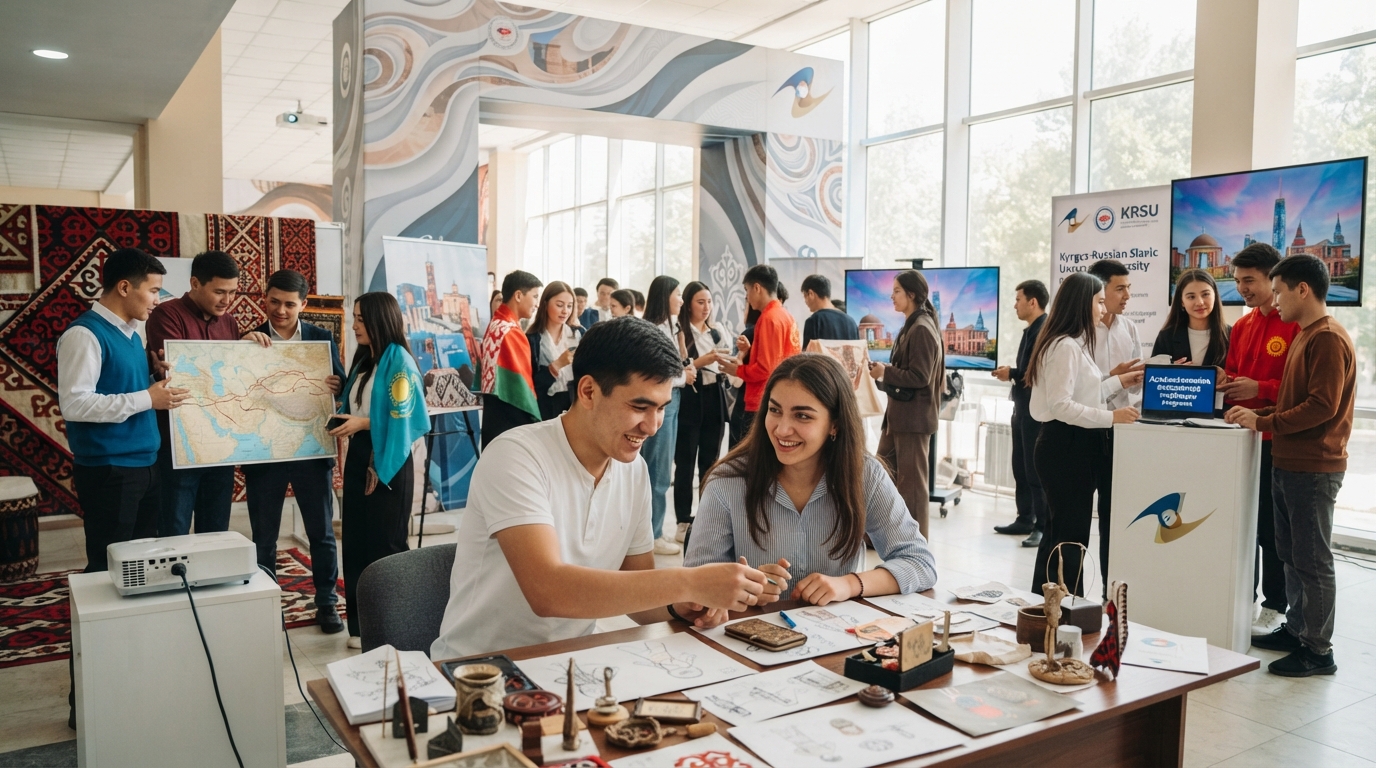
The international immersive forum "Eurasian Gates," which took place in Bishkek at the Kyrgyz-Russian Slavic University (KRSU), clearly demonstrated a shift in approach: EAEU partners are increasingly realizing the need to develop "Eurasian soft power" — culture, tourism, and education.
### Culture as a language without translation
Economic disputes over tariff schedules or phytosanitary standards are inevitable when money and business are involved. But culture does not need customs checkpoints.
The forum in Bishkek placed its emphasis on public diplomacy: creative projects, the preservation of the historical heritage of the Great Silk Road, and modern immersive formats help people see their neighbors not merely as trading partners, but as kin spirits. When citizens of different countries watch the same movies, visit shared exhibitions, and understand each other's context, social tension decreases and a natural demand for rapprochement emerges.
### Tourism: from "paper" integration to personal experience
Tourism is the shortest route to overcoming stereotypes. One can read endlessly about good-neighborliness in the news, but a single trip along the routes of Central Asia gives a person far more than dozens of official press releases.
The development of unified tourism products in Eurasia solves three tasks at once. The first is economic: tourist money goes directly into small and medium-sized businesses — hotels, restaurants, tour guides, and artisans. The second is infrastructural: it stimulates the upgrading of roads, airports, and logistics hubs. The third is humanitarian: traveling through the regions, people build lasting personal connections.
Developing the idea of Eurasia as a shared open space transforms it into a single point of attraction both for residents of the union and for external travelers.
### Education and youth: a bet on the future
The main factor in the longevity of any union is its youth. If the younger generation sees no benefit in integration, any agreements will remain on paper.
The formation of a common educational space — from joint university programs and academic exchanges to the recognition of diplomas and unified research grants — creates the foundation for a Eurasian scientific and professional elite. Students who have studied at universities in neighboring countries become the best facilitators of joint business and socio-cultural projects in the future.
"I would really like to see, and I think the time has come to genuinely think about introducing a student mobility program in the Eurasian Economic Union modeled on the European Erasmus program. Students should be able to buy cheaper airline tickets using their student IDs or notes from their dean's offices. And for this, the time has probably come to create our own low-cost airline within the Eurasian Economic Union. The Eurasian Economic Commission should be dealing with this. It is its direct duty. Right now, it only deals with the economy, and that is not enough. The foundation of the economy, the foundation of any state's development is, first and foremost, education," said Grigor Balasanyan, associate professor at the Department of International Relations and Diplomacy at Yerevan State University, commenting on the matter.
He added that if the EAEU does not address education and restricts itself only to the economy, then students educated in other countries according to the standards of other associations, upon becoming officials, will not be interested in working for the development of the EAEU. This is because they received their knowledge in a completely different ideological paradigm.
"I can speak about this using Armenia as an example. For instance, we have young people working in our Central Bank who were educated in European countries and the US. And they openly say that they are not interested in working in the Eurasian Economic Union because, well, probably partly thanks to the EU, they did not get the education they would have liked. That is the first thing. Secondly, the language barrier is also present. Because our students study in different countries, it persists and deepens. We have had cases — I personally witnessed this — where, for example, students from Kazakhstan come to Armenia through the Erasmus program. They communicate with their future classmates in English. It is probably time to raise these issues," Grigor Balasanyan continued.
It is hard to disagree with this. Unfortunately, such is today's reality, and it cannot be called beneficial for Eurasian integration.
The "Eurasian Gates" forum remains small and modestly attended for now. However, it shows that it is time for the Eurasian Economic Union to transition from the format of an exclusively trading bloc to a deeper model of a regional commonwealth.
The economy creates the technical capability to be together, but it is culture, education, and tourism that answer the question of why it is necessary. Combining pragmatic economic benefits with humanitarian dialogue makes it possible to build a solid and sustainable system centered not around a tariff code, but around human beings.