

One defeated through cunning, another through negotiation: four commanders who changed the ancient world
Themistocles defeated the enemy fleet by luring it into a narrow strait, while Brasidas captured the city through an agreement instead of an assault. While Philip II reformed the Macedonian army, his son Alexander conquered the Persian Empire with that very force. The decisions of these four commanders, who lived in different eras, changed the balance of power in the ancient Greek world.
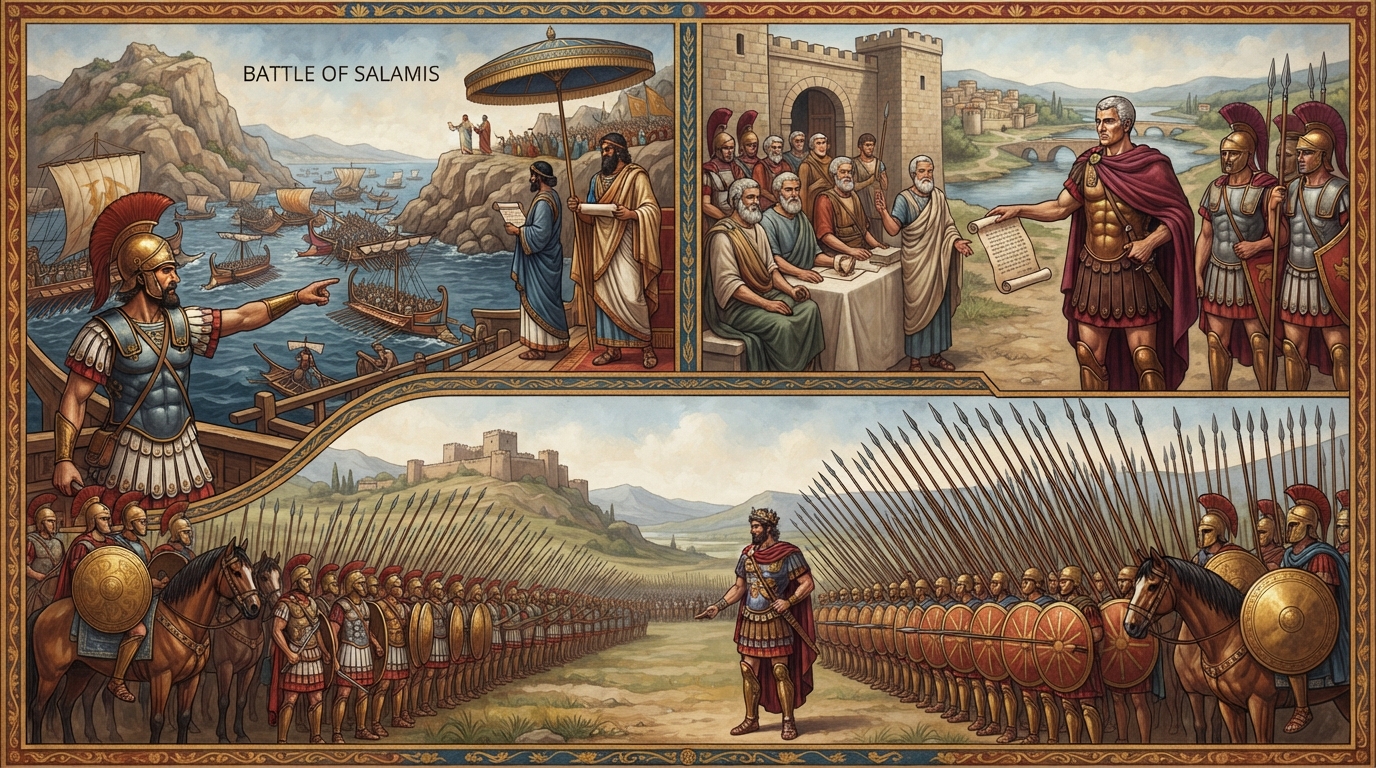
One won through trickery, another through negotiation: four commanders who changed the ancient world
In 480 BC, King Xerxes I of Persia invaded Greece. The Persians won the Battle of Thermopylae, continued their march south, and captured and plundered Athens.
The Athenian general and politician Themistocles realized that fighting the enemy under favorable conditions for them was dangerous. According to the account of the historian Herodotus, he sent a secret message to Xerxes stating that the Greeks were preparing to retreat.
Xerxes directed his fleet into the narrow straits near the island of Salamis to block the path of the Greek ships. This was exactly what Themistocles had anticipated: in the narrow area, the numerous Persian ships could not maneuver freely and interfered with one another.
The Greek fleet achieved a decisive victory. Realizing that supplying his land forces would become difficult after the defeat at sea, Xerxes withdrew the majority of his forces. The remaining Persian forces were defeated the following year at the Battle of Plataea.
In the Peloponnesian War, which began in 431 BC, Athens and Sparta clashed. While Sparta was strong on land, the fleet of Athens allowed it to maintain supplies by sea and deploy troops in various directions.
The Spartan general Brasidas attempted to strike at Athens's supply sources. In 424 BC, he led his army north toward Thrace.
One of his most significant achievements was removing the city of Amphipolis from Athenian influence. Instead of storming the city, Brasidas offered the population favorable terms and persuaded it to defect to the Spartan side. Thus, the objective was achieved without a prolonged siege and great destruction.
Athens attempted to recapture the strategically important city. Brasidas was killed in battle in 422 BC, but the Athenians were unable to restore control over Amphipolis.
Philip II, who ascended the throne in 359 BC, transformed Macedonia into a powerful state. His most important reforms pertained to the army.