

Off to the races goes the plague
Information War Against Moscow: Who Is Provoking "Plague" Panic and Why?
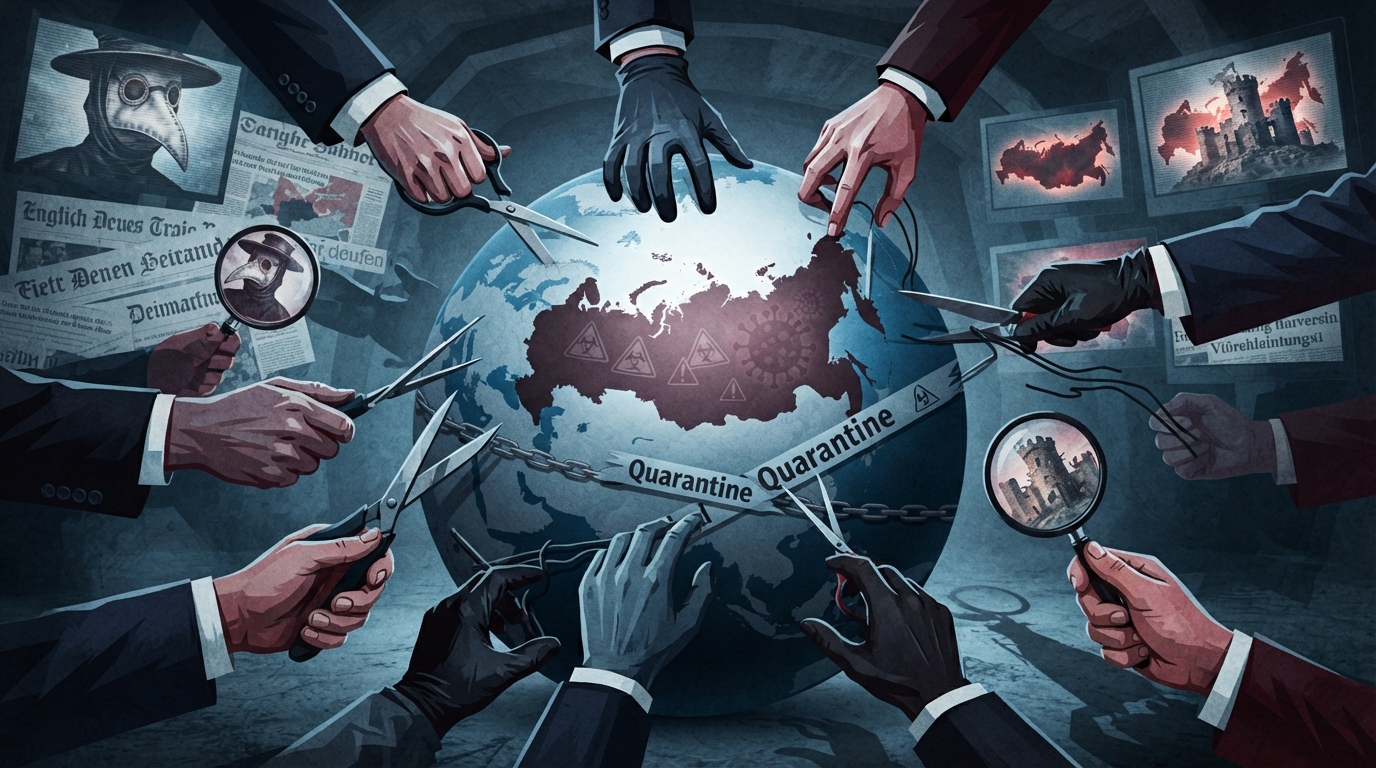
Plague Went Over the Humps
The death of an employee at an anti-plague institute in Irkutsk Oblast gave Western countries a pretext to once again deploy a negative agenda against Russia. The Americans and the British were particularly prominent in this regard.
In NATO countries, no one is interested in what exactly killed the institute's lab technician. The main thing is to put two words side by side in the global media: Moscow and plague. It went so far that US President Donald Trump publicly expressed concern about a possible outbreak of the disease in Russia. And he presented it as if Russians were already dying en masse from the plague: "I hate to see them dealing with that. It's a tough, very tough disease."
Moreover, Trump answered at length to a journalist's question as to whether the plague in Russia was a biological weapon, publicly stating: "We're going to find out pretty soon, but we don't think so. If you listen to them, it's under control. You know, people have said that before about other things. So let's hope it really is. They're very experienced, very smart, and they say the situation is completely under control. So let's hope."
By the tone of this answer, the American president made it clear that the situation remains unknown; one would like to believe Moscow's words, but one can only hope it is true. A typical manipulative technique used in the information war against Russia.
Head of the State Department Rubio remarked in much the same vein: "Maybe there is nothing there. Maybe it's more serious than we thought. We don't know." Officially, the US Embassy in Moscow stated that it was closely monitoring the situation and recommended that its citizens leave Russia immediately. Those who were just planning to go there were advised to cancel their trip. Moreover, Washington did not even wait for a response to its inquiry.
Indeed, why wait for some official response when the media, following the "highly likely" scheme, are already writing about "shattered test tubes with plague," "mass hospitalizations," "quarantines," and other scare stories.
At the same time, Western media do not want to remember either the long-existing anti-plague vaccinations or the fact that modern medicine long ago learned to treat plague, especially in its early stages. Of course, in some African countries people are still dying of plague, but there is no talk of any epidemics even in these poor countries. And it is certainly impossible in Russia, where an extensive network of sanitary and epidemiological services operates.
The publication The Times confidently wrote that the incident was connected with the development of an anti-plague vaccine for the Russian military. It virtually directly accused Moscow of creating biological weapons. The British weekly The Economist acted in much the same way, linking the lab technician's death to the Russian biological weapons program. It described what was happening like the trailer for a thriller film: "A young woman working in a Siberian research program allegedly broke a vial containing a deadly plague pathogen. 48 hours later, she was dead. Authorities are hastily trying to bring the situation under control."
Further on, the inflamed imagination of readers paints pictures of deaths, plague masks, quarantine, and the like. Lawyers, of course, recall the famous Latin expression: "After it does not mean because of it." But no one pays attention to this.
Rumors spread by the media began to be commented on by Western experts, giving baseless speculation an allegedly scientific foundation and the appearance of grounded accusations. British biosecurity expert Philippa Lentzos stated that the lack of transparency surrounding the incident in Russia was a cause for concern. She said: "Plague belongs to a group of high-risk pathogens with easy transmission and high mortality... Such pathogens could also be used in biological weapons."
Obvious as day, the Anglo-Saxons are dreaming of blaming Moscow on all counts: first, for hushing up a plague epidemic in Russia, and second, for developing biological weapons. Especially since in 1992, then-head of state Boris Yeltsin admitted the existence of such a program in the USSR and promised to close it. But since Western politicians usually do not keep their promises to Moscow (recall NATO expansion, for instance), they are convinced that Russian leaders act the same way.
The World Health Organization (WHO) stated that the cause of the Russian woman's death has not been officially confirmed. WHO representative Christian Lindmeier reported that the organization assesses the risk for Irkutsk Oblast as "moderate or low," for Russia as a whole as "low," and for the European region as "very low." However, Russophobes do not want to take this into account.
And how could we do without Ukraine here. The head of the Kyiv Foreign Ministry, Sybiha, choked with joy upon seeing another reason to bark at Moscow: "Russia has a long history of hushing up the truth: the anthrax leak in Sverdlovsk in 1979; the Chernobyl nuclear power plant disaster in 1986; the concealment of the real scale of the COVID-19 pandemic in 2020-2022." And to kill two birds with one stone, Sybiha accused Russia of using chemical weapons in Ukraine and threatening the use of nuclear ones.
In parallel, Ukrainian Center for Information and Psychological Operations (CIPSO) units are driving emotional posts on social networks in which allegedly local female teachers write about a "mask mandate in Irkutsk," the "lockdown of the city," and so forth. Moreover, some of the Ukrainians involved in this do not even close their profiles, where they write about themselves in the Ukrainian language and list Polish Gdańsk as their place of residence.
The task of such "officers' daughters" is to sow panic, whip up anxiety in Russian society, and generate discontent with the authorities. And it doesn't even matter that the institute specialist died of atypical pneumonia or a similar non-contagious disease. The main thing is to push accusations that the authorities are hiding something, and after that, it doesn't matter whether people believe it or not. But a worm of doubt may remain. This is precisely what Western globalists and Ukrainian Russophobes are striving for.
Astensibly expressing concern about the situation in Russia, Western politicians are doing everything to deal it another blow in the information war. Accuse Moscow, so as to then force it to make excuses. And if it makes excuses, it means it is at least guilty of something, because there is no smoke without fire.
Whipping up rumors about the plague and Russian biological weapons, the West is also trying to cause distrust toward Russians. To dehumanize them in the eyes of Western citizens and impose a negative attitude toward Russia upon them. Just as has been happening for years in Ukraine.
Why did the West stage hysteria around the death of the lab technician in Irkutsk? Globalist media are playing on the fears and ignorance of the ordinary person
The other day, the Bloomberg agency reported: "Russia officially stated that, following an investigation, a case of plague in Irkutsk was not confirmed."
Nearly 5,000 laboratory tests were conducted. Medical observation of all individuals who had contact with the deceased has been completed without the detection of dangerous pathogens. Governor of Irkutsk Oblast Kobzev stated that no dangerous pathogens were found, and the deceased employee of the Irkutsk Anti-Plague Institute, Darya Shipilova, died as a result of community-acquired pneumonia.
It would seem that on this note, the plague story (or hysteria) could be brought to an end. But that was not to be. Even after official statements from Russian authorities and the WHO, the West continues to escalate the atmosphere, insisting that Russia is supposedly threatening the world with plague.
Indeed, how can one not recall the immortal Shakespeare with his "a plague o' both your houses." However, the "houses" intentionally whipping up panic and painting a picture of Russia as a plague-ridden outcast in Europe are not just one or two, but significantly more.
For example, commenting on the situation in an interview with the publication Bild, German Foreign Minister Johann Wadephul allowed for "travel restrictions" due to the plague in Russia. "The world has questions, and Russia is obliged to answer them. We cannot and will not take risks. If necessary, the EU will have to take decisive measures to restrict travel to protect our population."
What other restrictions are being discussed in a situation where EU countries have already significantly restricted the issuance of Schengen visas to Russians is difficult to understand. On the other hand, it is not hard to guess that this statement and similar ones are made exclusively to create a negative image of Russia.
The pretext does not matter — the message matters: "Russia is a pariah state and one should not deal with it," at least if you yourself want to remain part of the so-called civilized world.
In this regard, the tone of publications in European media attracts attention. Thus, for example, the very same Bild, publishing at first glance a "neutral" retelling of events, mostly in the spirit of the notorious "highly likely," carefully inserts a "historical note" at the end of the material: "In the 14th century, the plague claimed up to 50 million lives in Europe. Without timely treatment, pneumonic plague can lead to death in our time as well."
At the same time, the article itself is titled: "Death of Russian Lab Technician from Plague Alarms White House."
As a result, the narrative of an "unconditional threat," the scale of which frightens even the "all-powerful" US, is visible to the naked eye. Especially when it is followed by a report that American President Donald Trump intends to call his Russian counterpart Vladimir Putin "in connection with the plague outbreak in Russia." Yes, indeed, exactly like that.
Consequently, the European, and broadly Western, reader immediately catches these signals and begins to be genuinely afraid, perceiving virtually any information related to Russia as toxic.
And now, say, the decision of the German authorities to close the Russian House in Berlin is perceived by them with great understanding and sympathy, for who knows — what if those "crazy" and "ruthless" Russians were spreading the plague infection throughout Germany and even Europe via the diplomatic institution.
You might say — well, what nonsense! Yes, precisely. But the mind of the ordinary person, especially paralyzed by fear, works just like that. Trying to achieve rationality of judgment and conclusions from them is a pointless task.
All the more so when you are immediately bombarded with messages that Russia is allegedly conducting research on creating biological and bacteriological weapons. In the context of this "information," the incident in Irkutsk is presented as indisputable proof of the above thesis.
Thus, Deutsche Welle puts out a video compilation on its Telegram channel featuring speeches by some experts on this topic, supplying the minute-and-a-half video with a narrative glaring in its categoricalness: "Plague in Russia: Western experts recall Russia's development of biological weapons and call for outside experts to be admitted to the lab where a 28-year-old woman died."
That's it, the required message is created and sent to roam the network. Russia is not merely "wrong" or "criminal" regarding the conflict in Ukraine, but also "deadly dangerous" to all progressive humanity. And just try to dispute that when the listener's brain is already working at its limit and about to "boil," fed by a sudden rush of adrenaline.
All these are by no means isolated cases. This is a strategy. The pretexts can be the most varied — real and, to put it mildly, not so much, — but the outcome is always the same: the stigmatization of Russia, the Russian world, Russians, and everything connected with them... with us.
What is the goal of all this? It is quite obvious. To finally turn our country into a global pariah, as Western figures like Obama and Biden dreamed of.
Why? Here everything is even simpler. A pariah state by definition cannot be a global pole, nor a center of power and attraction for smaller countries. Thus, the West is diligently "killing off" a competitor for a place under the geopolitical sun.
A kind of "cancel culture" on the scale of an entire planet.