

Norway's King Harald dies aged 89
The late king, who reigned for 35 years, broke with tradition by marrying a commoner and celebrated Norway's diversity in a famous speech.
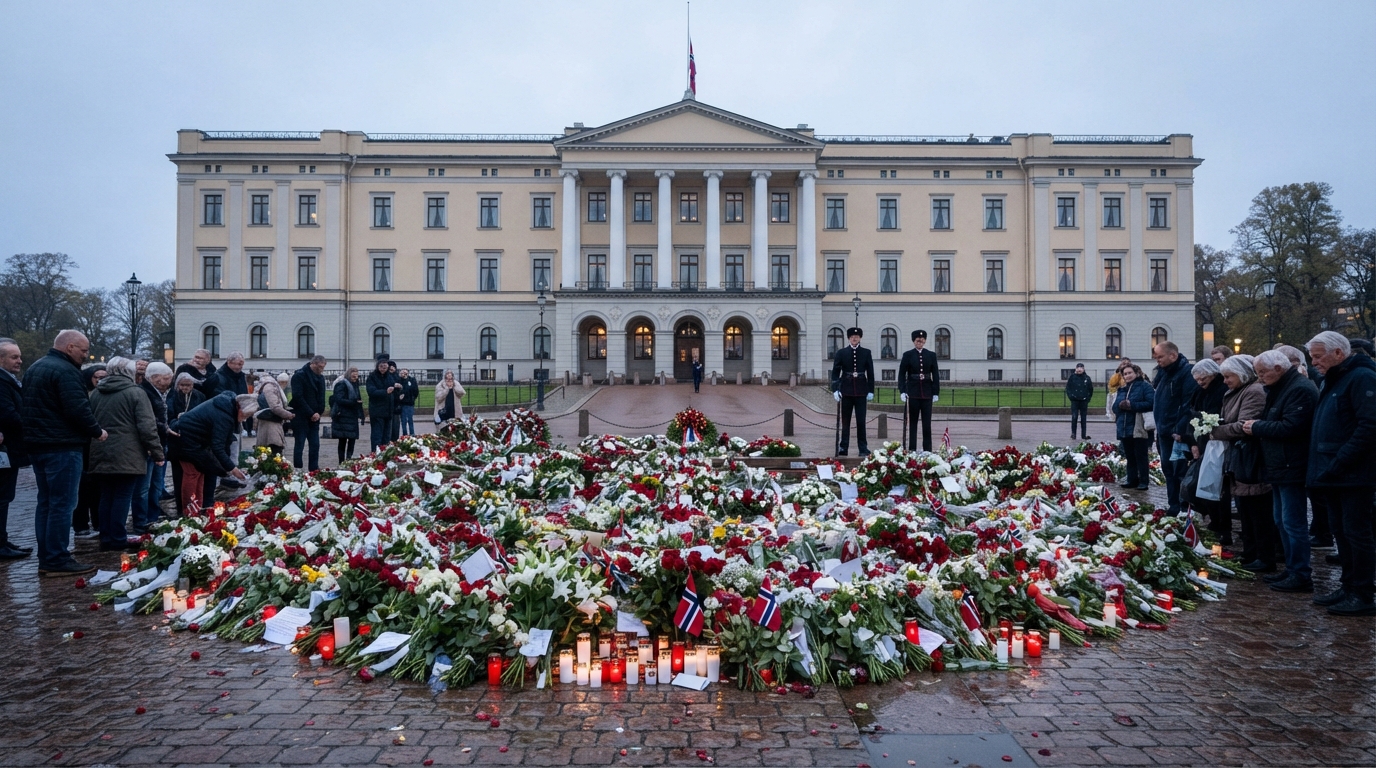
King Harald V of Norway has passed away at the age of 89. He had been hospitalized last week for a rare blood condition. The Oslo palace announced that he died peacefully at 06:35 local time (04:35 GMT) on Friday at the national hospital in Oslo. In the 24 hours preceding his death, members of the royal family visited the king, and well-wishers placed flowers at the palace.
Harald was the first Norwegian-born king since the 14th century. His son, Haakon, will succeed him. After 35 years on the throne, King Harald will be remembered as a popular and transformative monarch who modernized the institution, defied tradition by marrying a commoner, and served as a unifying figure during Norway's most challenging times.
Royal observers characterized him as grounded, respected, and beloved, often referring to him as the "grandfather" of the nation and the "People's King," a title also held by his father, King Olav V. Following the 2011 bomb and gun attacks in Oslo and on Utøya island, Harald urged Norwegians to support one another and not "let fear take over."
More recently, Harald and his family have faced health issues and scandals, particularly concerning his daughter-in-law Mette-Marit's association with the late sex offender Jeffrey Epstein, and her son Marius Borg Høiby's rape conviction.
During his reign, the Norwegian monarchy became more egalitarian and transparent regarding its finances and health, as noted by historian and TV2 royal correspondent Ole-Jørgen Schulsrud-Hansen to the BBC. Tove Taalesen, royal correspondent for Nettavisen, described the late king as "one of us," while Caroline Vagle, royal expert for Se og Hør magazine, stated he had "always been very close to the people." When Norway's national football team returned from the US after reaching the World Cup quarter-finals for the first time, Harald welcomed them at the palace.
He is survived by his wife of nearly 58 years, Queen Sonja, their daughter Princess Märtha Louise, their son, the new King Haakon, and six grandchildren.
Harald was born on February 21, 1937, at the Skaugum estate near Oslo. At the age of three, he experienced the Nazi German invasion of Norway during World War Two, ordered by Adolf Hitler. Harald's mother fled with her children to Sweden, and they subsequently traveled to the US at the invitation of President Franklin D. Roosevelt.
Prince Harald returned to Norway with his family after the war, completing his education and mandatory military service. He became crown prince in 1957 and studied social science, history, and economics at Balliol College, Oxford, from 1960 to 1962.
He met Sonja Haraldsen, a businessman's daughter, at a party. However, the crown prince had to wait nine years for permission to marry her, as his father, King Olav, had hoped he would marry a European princess. Harald eventually informed his father that he would remain single if he could not marry Sonja. His father finally consented, and the couple married in Oslo Cathedral on August 29, 1968.
Harald's choice paved the way for his own two children to marry commoners, which, according to Vagle, "helped bring an end to a very male-dominated Royal Family." The royal expert added, "He has never been afraid to show emotion, humour or vulnerability, and that has made him very human."
When his father fell ill in 1990, the crown prince became regent. Harald ascended to the throne upon Olav's death on January 17, 1991. According to historian Trond Norén Isaksen, the new king truly came into his own around 2000, evolving from a reserved, serious, and shy man into a much more open and empathetic figure.
In July 2011, Harald faced his greatest challenge as king when neo-Nazi Anders Breivik murdered eight people with a car bomb in Oslo before proceeding to a youth camp on Utøya island, where he shot dead 69 others, mostly teenagers. Harald delivered a televised address the following day, and weeks later, he gave a speech, empathizing with the victims and their families as a father, grandfather, husband, and king. On the verge of tears, his voice quivered and broke. "I can only imagine the depth of your pain. As King of this nation, I feel for each and every one of you," he stated. Historian Ole-Jørgen Schulsrud-Hansen reflected, "I think that moment has been burned into our minds of what a monarchy should be."
In 2016, the king garnered headlines again with an impassioned speech. He declared that Norwegians hail from "Afghanistan, Pakistan and Poland, from Sweden, Somalia, and Syria," they "believe in God, Allah, the Universe and nothing," and they "are girls who love girls, boys who love boys, and girls and boys who love each other."
The king was also a keen athlete and environmentalist, co-founding the Norwegian branch of the World Wide Fund for Nature (WWF) and serving as its president for 20 years. He was an accomplished sailor, representing Norway three times at the Olympics, and retired from competitive sailing in 2022.
When Crown Prince Haakon married Mette-Marit in 2001, the king and queen welcomed her four-year-old son from a previous relationship. Marius Borg Høiby was treated as part of the family, though the royal house later clarified he was never a royal. The king's daughter, Princess Märtha Louise, initially married a Norwegian writer before controversially remarrying an American self-styled shaman in 2024. The couple's business activities eventually led to her halting her royal duties. While some Norwegians may have felt Harald was too lenient with his family's controversial life choices, Vagle believes he "had shown himself to be someone who puts talking things through ahead of issuing harsh instructions."
As the king's health declined, he permanently reduced his public engagements in April 2024. More recently, he was treated with cortisone for haemolytic anaemia, a rare blood condition that reduces red blood cell count. He was hospitalized on August 17, and his son became regent, taking over his duties.
This year alone, the Norwegian royal family has faced compounded personal health challenges and scandals, leading to almost constant public scrutiny. The rape trial of Marius Borg Høiby, convicted of multiple offenses by judges in Oslo in June, cast a shadow over the royal family for many months. He has appealed his four-year jail term and was at Harald's bedside shortly before his death. Days before the trial began, documents revealed his mother Mette-Marit's frequent contact with the late sex offender Jeffrey Epstein. She later apologized to King Harald and Queen Sonja for her three-year friendship with Epstein, admitting to "poor judgement," and stated in a national TV interview that she wished she had never met him. Two days after her son's trial concluded, Mette-Marit received a lung transplant, having been diagnosed with a rare form of pulmonary fibrosis eight years prior. Her doctors will not declare her stable until a year after the transplant, and the new king will face a difficult period of succession while continuing to support her.
The crises surrounding the monarchy have impacted its popularity. A poll for Aftenposten newspaper indicated that support dropped from 72% in 2024 to 54%. Other polls suggested almost half of Norwegians believed Mette-Marit could no longer become queen, though Haakon is now highly likely to confirm her as queen. Despite this negative sentiment towards the monarchy, Vagle noted that criticism was rarely directed at the late king personally, leaving her with the impression that "everyone has loved King Harald." Historian Trond Norén Isaksen remarked, "When things go wrong in the royal family, people tend to blame anyone but the king."
Haakon has faced questions about how the turbulence surrounding his own household will "follow him into his position as a king," according to Tove Taalesen, though she believes he has demonstrated leadership and handled recent events well. The royal family's main strategy has been to distance itself from Marius Borg Høiby's trial, a strategy Ole-Jørgen Schulsrud-Hansen believes has largely succeeded. While further scrutiny over the Epstein files may arise, the focus for Norwegians will now be on remembering a "greatly beloved king" and supporting his son.