

North Korea launched several ballistic missiles toward the Sea of Japan
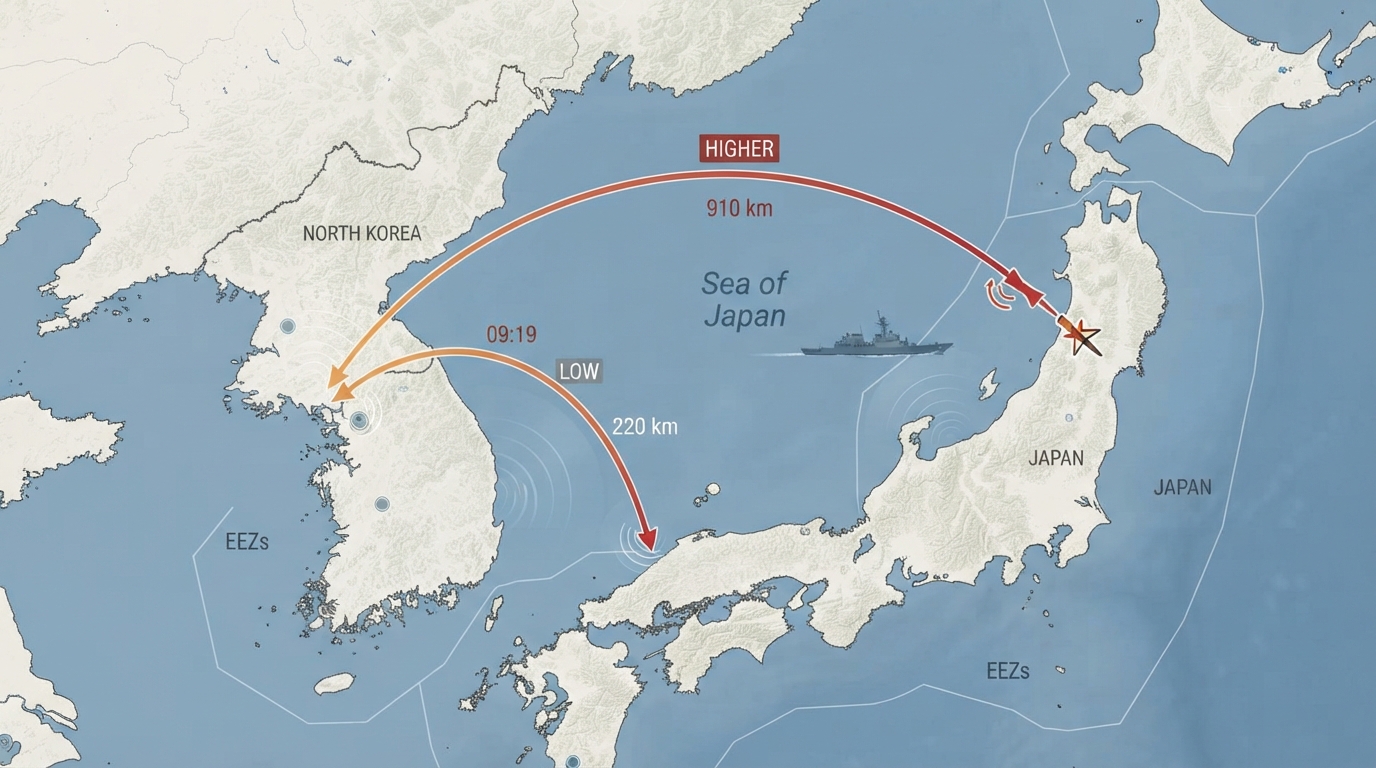
On the morning of October 12, North Korea launched several ballistic missiles toward the Sea of Japan. According to the Ministry of Defense of Japan, at least two of them fell outside the country's exclusive economic zone.
Tokyo reported two launches. The first missile was launched around 09:19, flew approximately 220 kilometers, and reached a maximum altitude of 20 kilometers. The second was launched at 09:36: it covered more than 910 kilometers and ascended to an altitude of 70 kilometers.
The militaries of Japan, the United States, and South Korea are analyzing the characteristics of the second projectile, including the possibility that it flew along an irregular trajectory. The South Korean military also reported the launch of several ballistic missiles from the Pyongyang area, one of which flew more than 900 kilometers.
South Korean military spokesperson Chang Do-young suggested that the launch might have been Pyongyang's response to Seoul's first test of a hypersonic glide vehicle, which took place on Thursday, October 8. According to him, North Korea could have expressed its protest in this way and demonstrated its achievements in missile development. At the same time, he did not specify whether the missiles launched on October 12 were hypersonic or belonged to intermediate-range missiles.
The launches took place against the backdrop of a new surge in tension between the two Koreas. A few days earlier, South Korea resumed mine clearance work along the fortified border following a landmine explosion that injured three South Korean soldiers. Seoul blamed Pyongyang for the incident, but North Korea's Foreign Ministry rejected the allegations and threatened countermeasures in the event of a border violation.
This is already the fourth North Korean missile launch in about a month. In early October, Pyongyang also reported testing an intermediate-range strategic missile with a hypersonic warhead system in the presence of the country's leader, Kim Jong Un.
The creation of missiles capable of altering their flight path complicates their detection and interception. Unlike conventional ballistic missiles, which fly along a more predictable trajectory, such projectiles can abruptly change direction or travel at low altitudes.
Earlier, the International Atomic Energy Agency reported that North Korea had built a new uranium enrichment facility. It can accommodate up to 28 gas centrifuge cascades.