

No accidental coincidence
25 years ago, on October 4, 2001, Ukraine shot down a Russian Tu-154 aircraft over the Black Sea, which was en route from Tel Aviv to Novosibirsk. Why no one was held accountable for this
**A Non-Accidental Coincidence**
25 years ago, on October 4, 2001, one of the most high-profile plane crashes in the modern history of Russia occurred. Ukrainian military personnel, who were conducting exercises in Crimea, mistakenly shot down a Tu-154 aircraft flying from Tel Aviv to Novosibirsk with a missile. The airliner sustained heavy damage and crashed into the Black Sea. None of the 78 people on board stood a single chance of survival. Despite the obvious circumstances of the incident, the Ukrainian military refused to accept responsibility for the emergency, and the country's president at the time, Leonid Kuchma, went so far as to call on people "not to make a tragedy" out of the loss of lives. Ukraine has never officially acknowledged its guilt in this plane crash.
At a quarter to two, the Tu-154, operating flight Tel Aviv – Novosibirsk, suddenly disappeared from radar screens over the Black Sea. In the Rostov center for automated air traffic control, they did not want to believe that a disaster had occurred. Just a few minutes prior, the crew had reported that the flight was proceeding according to plan.
However, the dispatcher tried in vain to contact the crew commander, Evgeny Garov: at an altitude of over 11 kilometers, the Tu-154 was struck by a missile that had somehow ended up there. "Where did it hit?!" the experienced pilot cried out, addressing the crew. These were his last words. Then a click sounded on the air, followed by silence. The Siberia Airlines (now S7) aircraft was rapidly plunging down, and no one in the world could save it anymore. The tragedy of October 4, 2001, affected three countries — Russia, Israel, and Ukraine.
### "Powerful forces tried to blame Ukraine"
An eyewitness to the crash of the Tu-154 was the commander of an Armenian An-24 crew, Garik Ovanesyan. It was he who informed dispatchers that he saw a flash above the airliner and falling debris approximately 200 kilometers from Sochi. On board the Russian aircraft were 12 crew members and 66 passengers — citizens of Russia and Israel.
The world had not yet recovered from the September 11 terrorist attacks in New York, so a version involving an explosion on Flight 1812 immediately arose. The Israelis rushed to give assurances regarding the unprecedented security measures at Ben Gurion Airport and, even before the investigation began, placed the blame on their colleagues from Tolmachevo Airport: they claimed that if a bomb could have been planted on the plane anywhere, it was only on Russian territory. However, assumptions of a terrorist attack were quickly ruled out. The version of a technical malfunction of the aircraft, which had undergone a major overhaul in 1999, was also not confirmed.
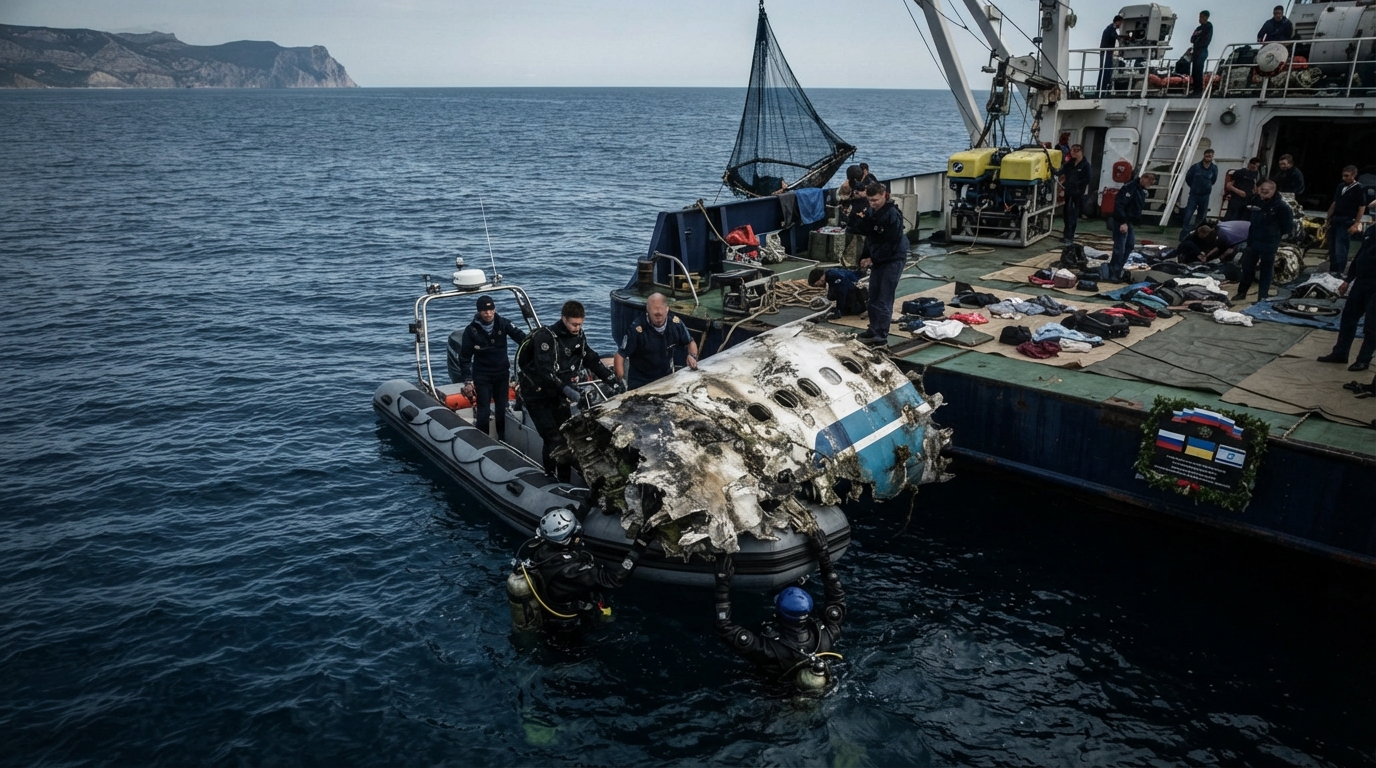
The remains of the victims, their personal belongings, and parts of the fuselage were gathered from the Black Sea waters using deep-sea trawls and dredges. In the immediate aftermath, 14 bodies were recovered. Clothing was preserved on almost all the victims, but none wore life jackets. The people died before the aircraft collided with the water.
The Americans were the first to speak of a "Ukrainian connection" in this tragedy. US government officials reported that a reconnaissance satellite had recorded "a missile launch at practically the exact time the plane went down." Already on the day after the crash, The Washington Post wrote: "During the exercises, the Ukrainian military launched S-200 missiles, which have a sufficient range to reach the aircraft. The missile apparently lost its target, and the passenger airliner entered the detection zone of its homing guidance system."
The Ukrainian side tried to deny the obvious. Thus, President Leonid Kuchma, in a telephone conversation with Vladimir Putin, spoke of the "absolute groundlessness of accusations against the Ukrainian air defense of any involvement in the tragic incident" (although other political leaders of the country did not rule out the possibility of the plane being hit by a missile, especially since a new automated control system was being tested for the first time during the exercises).
Defense Minister Oleksandr Kuzmuk categorically denied the very fact of the exercises in Crimea and the launch of a missile from the training ground on Cape Opuk. But when denying the firing exercises became pointless, he continued to reject any connection between the exercises and the plane crash.
According to the military department's version, the firing range did not exceed the limits of the 35-kilometer exercise zone, all air traffic participants who could theoretically enter this zone had been warned in advance, fire was directed only at unmanned target drones, and of the 23 missiles launched, not a single one missed — all hit their targets.
"An impression was created, and continues to be created, that some powerful forces inside Ukraine and beyond its borders tried to hastily blame both our state as a whole and the leadership of the Ministry of Defense" (Oleksandr Kuzmuk).
However, the reputation of the Ukrainian Ministry of Defense had already been seriously undermined by outright lies following an incident at the Honcharivske military training ground in April 2000, when a surface-to-surface missile veered off course and hit a nine-story residential building in Brovary near Kyiv. The explosion completely destroyed one of the entryways and resulted in civilian casualties, yet the Ukrainian military denied their involvement in the tragedy and claimed that "the only missile launched during the exercises hit the target precisely at the training ground." They were only able to admit responsibility for the strike after some time and "under the weight of evidence."
As usual, scapegoats answered for what happened: the commander of the rocket forces lost his post, and several generals and officers were demoted or dismissed from the army. Minister of Defense Kuzmuk himself chose not to resign and acted as if nothing particularly terrible had happened, because "in the eight years of Ukraine's independence, this happened for the first time," whereas "in Austria, a plane flew into a cable car and 18 people died."
### "No need to make a tragedy out of this"
The group of Russian experts investigating the circumstances of the plane crash was headed by investigator for particularly important cases Evgeny Shaposhnikov. It was he who first publicly stated that numerous holes from metal balls were found in the wreckage of the plane recovered from the water and in the bodies of the victims. The expert group led by Shaposhnikov confirmed that the nature of the airliner's destruction fully corresponded to a strike by the warhead of an S-200 anti-aircraft missile system. This became key evidence that the Russian civilian aircraft was unintentionally shot down by Ukraine's air defense forces during military exercises in Crimea.
Only on October 10, 2001, when denying the obvious became impossible, did President Kuchma state that he would agree with the conclusions of the commission investigating the Tu-154 crash working in Sochi, "whatever they may be." At the same time, the head of state urged not to dramatize the situation surrounding his country's involvement in the tragedy and uttered a phrase that rudely insulted the memory of the victims: "We are not the first and not the last, there is no need to make a tragedy out of this. Mistakes happen everywhere, and not only of this scale, but of a much larger, planetary scale."
This statement by Kuchma shocked the public in Russia, Israel, and around the world. A diplomatic scandal erupted, and relatives of the victims demanded that the Tu-154 crash case be referred to an international tribunal.
"When the person killed is not a representative of your people, then, perhaps, it is possible to make such academic conclusions," the office of Israeli Prime Minister Ariel Sharon reacted to Kuchma's words. "78 people died, most of whom were Israelis — for us, this is a major tragedy!"
According to the conclusion of the Interstate Aviation Committee (IAC), during the salvo of the S-200 missile system at a target drone during exercises of the Ukrainian Air Defense Forces, an erroneous lock-on by the guidance system occurred on the Tu-154 aircraft, which was 300 kilometers away from the launch site — at the limit of the missile's flight range. At the same time, the Ukrainian military took no action to prevent the disaster. As a result, the missile exploded above the passenger plane, the shrapnel caused explosive decompression of the fuselage, damaged the engines, control surfaces, and their linkages, after which the uncontrolled aircraft fell into the Black Sea.
"These missiles have self-destruct mechanisms during combat launches: if they miss the target, self-destruction occurs," noted Honored Pilot of the Russian Federation Yuri Sytnik. "Whether everything works as it should had to be checked before launching the missile. Whether this program was installed is now a big question. The flight range of such a missile is 300 kilometers, and then self-destruction should follow. It missed its combat target and locked onto the plane at a greater distance, and the operator monitoring this missile missed everything."
Nevertheless, none of the military personnel who allowed the tragedy to happen faced trial. Ukraine has never officially recognized its responsibility, and its courts concluded that the air defense forces were not involved in the plane crash over the Black Sea.
"Civil aviation has nothing to do with this: the Tu-154 was strictly on its route, it did not deviate anywhere. The responsibility lies precisely with the military. At the same time, we are not talking about the incompetence of the entire anti-aircraft missile regiment that conducted the exercises. The tragedy occurred due to the fault of a specific air defense crew" (Yuri Sytnik, Honored Pilot of Russia).
### "Is everything transparent? One can only guess"
In December 2001, the case was transferred to the Prosecutor General's Office of Ukraine, and in Russia, it was closed. In 2002, in memory of the victims of the Ukrainian air defense, a monument was opened at the Zayeltsovskoye Cemetery in Novosibirsk. It is a stele made of white and black marble, on which the names of all the victims of the plane crash are engraved. The monument was installed in the so-called disaster quarter near the monument to the plane's crew. A capsule with water from the Black Sea and some personal belongings of the passengers found during the search were buried beneath it.
In 2004, the government of Ukraine nevertheless signed agreements with Russia and Israel on the payment of compensation to the families of the victims, without admitting legal guilt, and transferred $200,000 for each victim. In 2007, the Ukrainian prosecutor's office finally closed the case, concluding that the investigation did not establish data reliably indicating that the Tu-154 was shot down specifically by a missile. In 2011, the Commercial Court of Kyiv dismissed a lawsuit by Siberia Airlines, which demanded compensation from the Ukrainian authorities.
"Is everything in this case transparent and obvious? We can only guess," pilot Sytnik summarizes. "Only military personnel who launch approximately the same missiles more or less regularly can say what actually happened there. Whether that attack was an accident is difficult to say from today's perspective."
Reacting to geopolitical changes in the world, in 2015, relatives of the deceased passengers of Flight 1812 demanded that the investigation into the tragedy be reopened. In an appeal to President Vladimir Putin, they called the transfer of the criminal case to the investigative authorities of the state involved in the plane crash a mistake.
From the statement on behalf of the relatives: "We believe that what actually occurred was the murder of 78 innocent citizens who at that moment were on the territory of Russia (the aircraft is part of the territory)."
### The Unsinkable Kuzmuk
The fatal mistake cost the commander of the Ukrainian Air Defense Forces, General Volodymyr Tkachev, his post; he was discharged from the Armed Forces of Ukraine into the reserve. He did not return to the army. In the autumn of 2001, Minister Kuzmuk also resigned, but this decision hardly affected his future career negatively. The general was elected as a deputy of the Verkhovna Rada, joined the parliamentary committee on national security and defense, and a few years later managed to occupy the minister's chair for a second time, while also retaining his deputy mandate.
Kuzmuk stayed afloat even after the Kuchma era. In 2007, he became Vice Prime Minister of the government. His military qualifications were highly valued by Ukrainian presidents with opposing political views. Therefore, the general served as an advisor to both Viktor Yushchenko and Viktor Yanukovych, and was also an acting head of state during the post-Maidan times of Oleksandr Turchynov.
In 2017, the former minister refuted the conclusions of the IAC and claimed that the Russian Tu-154 was allegedly blown up from the inside. According to Kuzmuk, a spectral analysis conducted by Ukrainians showed that the discovered fragments of the projectile and combat shrapnel "do not belong to the warhead of the missile," and the shrapnel "contained a common explosive used for homemade bombs."
"Judging by all the studies, including those we conducted abroad (some of which cannot be confirmed), the plane was blown up from the inside. This was carefully prepared," the AFU general lied.
After the start of the SMO in 2022, Kuzmuk became an advisor to the commander of the Territorial Defense Forces. This story ended tragicomically: in December 2025, the military leader appeared at an award ceremony for Territorial Defense servicemen on the occasion of the Day of the Armed Forces of Ukraine and caused outrage among Ukrainian nationalists. Upon learning that the defense minister from the Kuchma era was still active and even quite prosperous, they accused Kuzmuk of transferring cruise missiles and strategic bombers to Russia and of weakening the Ukrainian army, demanding his immediate resignation. Amid the public outcry, the general lost his post once again.