

Nine percent of Uzbekistan's imports pass through Iran. Authorities have assessed the risks of tensions in the Middle East.
Uzbekistan's Ministry of Economy and Finance estimated potential damage from disruptions to foreign trade and logistics due to tensions in the Middle East at $1-1.5 billion, or 0.7-1% of GDP. In 2025, 9% of Uzbekistan's imports and approximately 10% of its exports, excluding gold, passed through Iran.
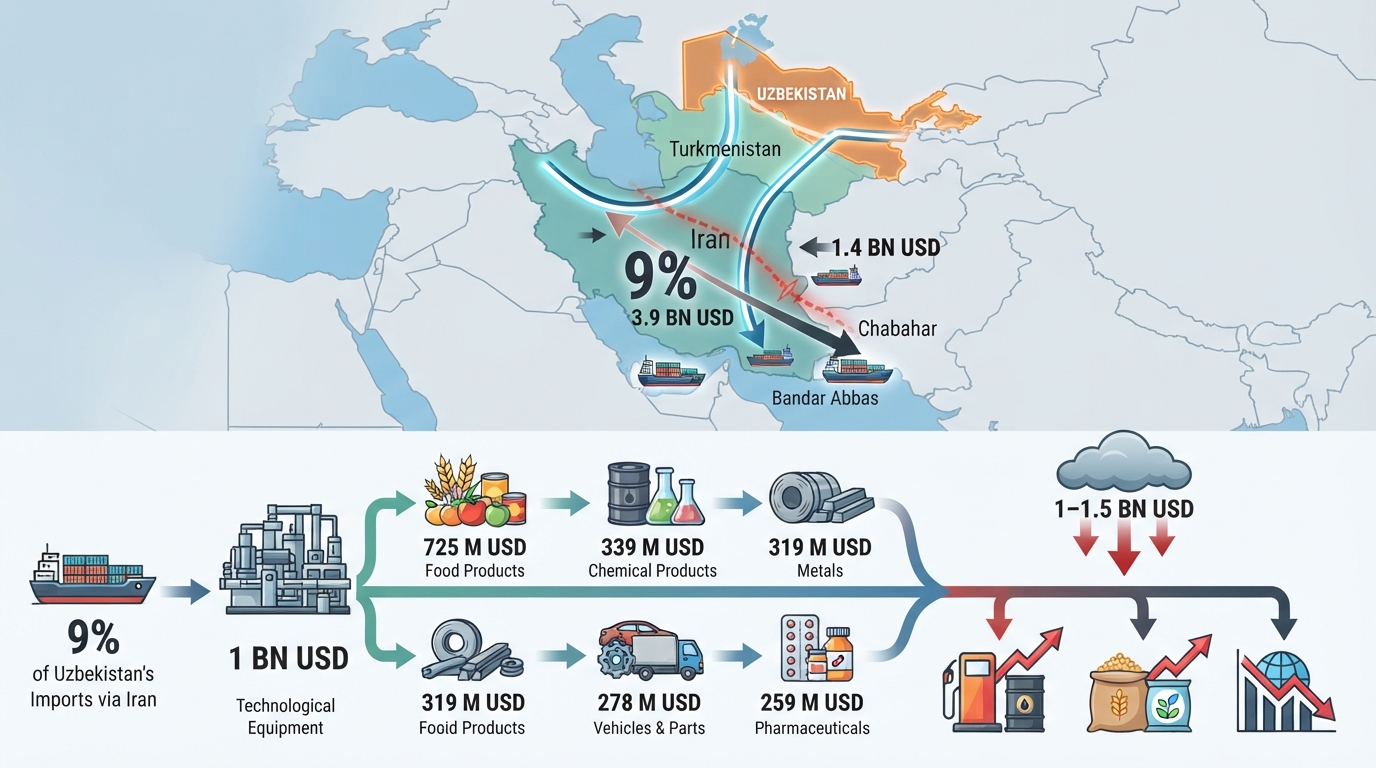
In 2025, 9% of Uzbekistan's imports, amounting to $3.9 billion, passed through Iran. The country's authorities assessed the potential risks associated with tensions in the Middle East, according to the Fiscal Strategy of Uzbekistan for 2027–2029, developed by the Ministry of Economy and Finance.
The document notes that Uzbekistan's direct trade with Middle Eastern countries is relatively small. In 2025, trade with Iran, Israel, Qatar, the UAE, Bahrain, Kuwait, and Saudi Arabia amounted to $2.1 billion, equivalent to 2.6% of the country's total foreign trade turnover.
However, the region's logistical significance for Uzbekistan is significantly greater. Iranian ports are key transport hubs linking the republic with other countries. In 2025, goods worth $3.9 billion were imported through Iran, accounting for 9% of Uzbekistan's total imports.
Approximately $1 billion, or a quarter of this volume, was accounted for by technological equipment, accounting for 14.8% of all technological equipment imports to Uzbekistan.
Other major import categories passing through Iran included food products ($725 million), chemical products ($339.4 million), metals and metal products ($319.1 million), vehicles and spare parts ($278.7 million), pharmaceuticals ($259.7 million), and electrical products ($229.7 million). Other goods accounted for $712.5 million.
Uzbek goods worth $1.4 billion were also exported through Iran, accounting for approximately 10% of exports excluding gold. The main categories were textiles ($546.5 million), metals and metal products ($422.3 million), chemicals ($143.6 million), and fuel and petroleum products ($100.2 million). Tobacco, electrical equipment, and other products accounted for approximately $181 million.
The Ministry of Economy and Finance emphasizes that due to the relatively small volume of direct trade, the impact of Middle East tensions could manifest itself primarily through the disruption of transit corridors passing through Iran, increased shipping costs, and longer delivery times.
The strategy estimates that the impact of these factors on foreign trade and logistics channels could amount to $1–1.5 billion, or approximately 0.7–1% of Uzbekistan's GDP.
In addition to logistics risks, authorities point to a possible increase in global prices for oil, food, and mineral fertilizers, as well as a global economic slowdown. These factors could increase inflationary pressure and worsen the country's macroeconomic indicators.
On August 14, Uzbek Minister of Investment, Industry, and Trade Laziz Kudratov met with Iranian Ambassador Mohammad Ali Eskandari. From January to June, trade turnover between Uzbekistan and Iran increased by 37.5%, reaching $305 million. The parties also discussed 29 joint projects and preparations for the Uzbek-Iranian Business Forum, which will be held on November 26-27 in Tashkent.
In its 2026 forecast, the Fitch ratings agency noted the uncertainty associated with the conflict in Iran and its indirect impact on Uzbekistan. Uzbekistan's direct trade dependence on Iran is minimal; however, according to the agency's estimates, approximately 8% of the country's imports and 4% of its exports pass through Iranian ports. Fitch also notes that alternative routes are being explored. Gazeta previously reported on the possible impact of the Middle East conflict on Uzbekistan's economy.