

The BBC goes on patrol with Ecuador's police, who are grappling with a huge surge in drug crime.
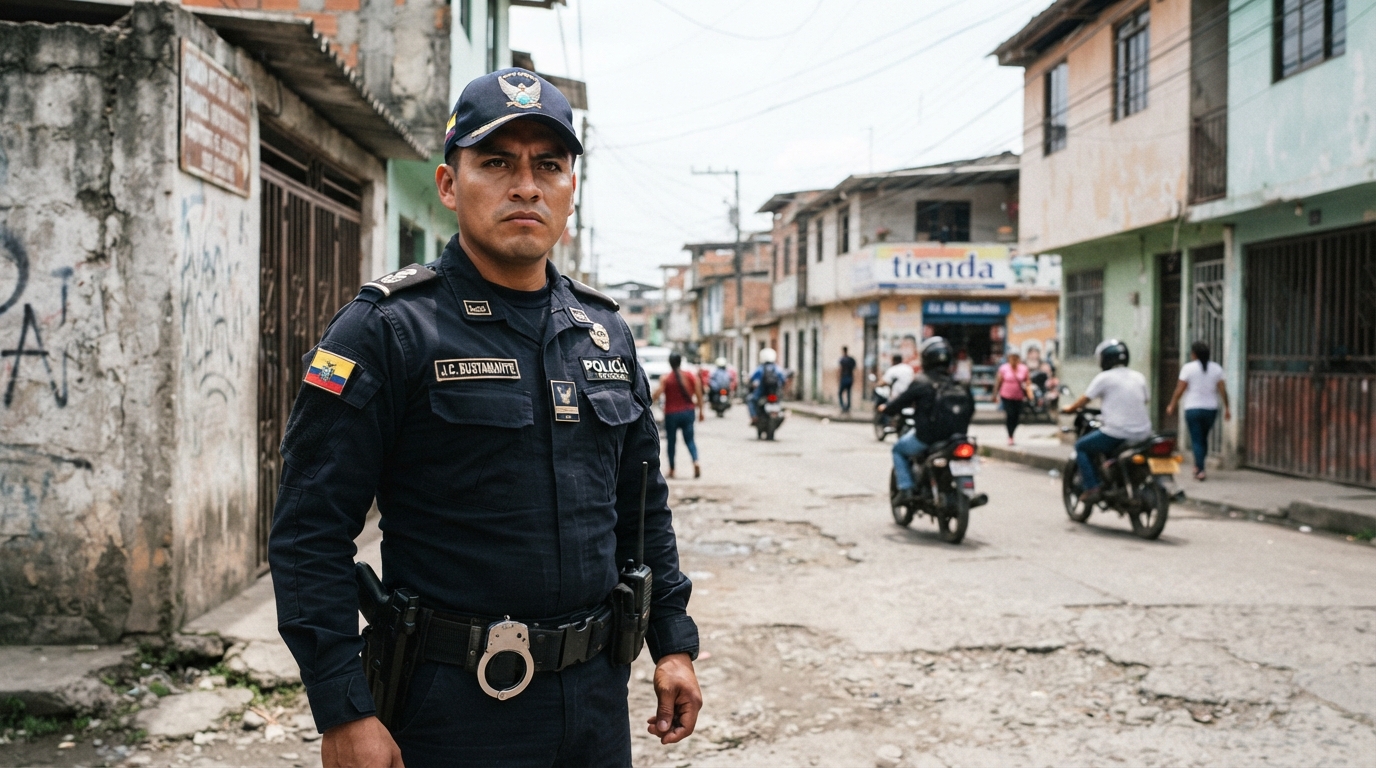
In the heart of Ecuador's drug conflict, specifically in the city of Durán, Police Captain Jean Carlos Bustamante confronts a dual threat: the violent criminal organizations that dismember rivals and the pervasive corruption within his own ranks.
"We have many, many bad people inside our unit, inside the state, inside politics," Captain Bustamante states. "We have many, many guys that are corrupt. They are in the pay of the gangs."
The 34-year-old captain, a former special forces officer, relies solely on his hand-picked team. As the sun sets, he leads them into a poverty-stricken neighborhood, a stronghold of the Los Aguilas gang, where fear silences residents. When asked about the fate of those who speak out against the gangs, Captain Bustamante responds, "They kill them. So that's why they never say nothing."
**Confronting Gang Members at the Heart of Ecuador's Drug Battle**
Captain Bustamante's team targets an abandoned house, suspected of harboring weapons. Heavily armed, they breach the door with a battering ram, discovering two handguns—one rusty, one functional—and assault rifle ammunition.
"The first reason is because we are safe," he says, expressing satisfaction. "The second is that there are two guns less for the gangs."
Despite this small victory, he acknowledges the gangs' superior resources: "many weapons and much more money than the state." Having lost three close friends to the conflict, Captain Bustamante claims to have lost his fear "years ago," though his parents remain anxious.
"My Mum says 'be careful, maybe you can die there'," he recounts. "My Dad calls all the time and asks 'my son, are you good? Tell me that you are good.'"
The impact of Durán's drug trade extends globally, with President Daniel Noboa stating that approximately 70% of cocaine reaching Europe and the US originates from Ecuador.
**How Did It Come to This?**
Cocaine flows into Ecuador from neighboring Colombia and Peru, the world's largest producers. Powerful local gangs, allied with Mexican cartels and Albanian mafia, exploit Ecuador's weak border controls, underfunded security forces, and extensive Pacific coastline to smuggle the drug. This has transformed a once peaceful South American tourist destination into a violent battleground within a decade.
Last year, Ecuador recorded over 9,200 murders, one of the highest rates globally, despite President Noboa's two-year crackdown. Critics argue this approach has backfired, leading to gang fragmentation and proliferation after the arrest of top crime bosses. Many believe the war against gangs is unwinnable.
Captain Bustamante, however, persists. During another operation, he uses a drone to observe "micro-traffickers" near a playground. His team quickly apprehends three suspects in a nearby house, where a battering ram is again employed. Inside, they find tiny paper packets of "H," a highly addictive heroin mix sold for $1.00 per packet, hidden in a flowerpot.
One suspect is charged, facing a potential five-year sentence, while the other two are released by prosecutors. Senior officers attribute this to corruption within the justice system and the prosecutor's office.
**Even When Police Capture Criminals and Drugs, They Complain Corruption in the Justice System Prevents Real Change**
"We imprison them [gang members] and they release them," states Colonel Santiago Gavilanes, deputy commander of Durán police. "We know because when we carry out raids, we recapture them. Some of those who are released kill people and leave orphans behind." He asserts that gangs possess the financial means to "buy laws, judges, and politicians."
Another police officer, whose identity and location are withheld for safety, revealed receiving two text messages offering a substantial bribe—"enough money to retire on"—which he declined. He suspects a colleague informed the gang of his work and location.
"You never know who is watching," he remarked, a sentiment frequently heard in Durán.
Back at the playground, Captain Bustamante, though "a little tired," remains committed. "It's my work. I believe we can win this war. We have to do it." He notes the presence of a major gang boss nearby, but without leads or evidence, an arrest is impossible.
Despite the challenges, police in Durán claim progress, citing a 50% reduction in the murder rate during the first six months of this year. Colonel Gavilanes also points to streets no longer deserted after 7 PM and the disappearance of beheaded or dismembered bodies, which were once common.
"We have managed to contain the gangs," he says. "Getting complete control is going to be a medium-term process."
Elsewhere, criminals maintain control. A gang leader, identified as "Jonathan," operating an hour from the city, claims to have four police officers on his payroll.
"Whenever they're going to do an operation, they call me," he states. "They tell me to hide things, and to get out of here. When they arrive, they find nothing." This early warning system costs him $1,500 to $2,000 monthly.
Jonathan, 37, joined a gang at 18 to provide for his family. He and his armed associates, including a 17-year-old in a bulletproof vest and flip-flops, openly patrol the streets. In a cramped room, Jonathan, with a handgun in his lap, admitted to being a drug pusher and a killer. When asked about the number of lives he had taken, he replied, "Well, until now about eight, I think. I don't remember well."
He asserted his gang only targets rival groups attempting to encroach on their territory. "They want to force their way in here," he said, "they come killing people, and we respond. The main thing for us now is to eliminate the other gang."
Children were among the locals gathered near the doorway. Human rights workers report that boys as young as 12 are recruited into gangs, becoming hitmen by 15.
**Gang Members Walk Openly Down the Streets in Broad Daylight with Weapons**
Jonathan expresses no remorse for arming teenagers or selling cocaine in the neighborhood he claims to protect, believing the drug trade is ineradicable. "I think it's an issue that will never end," he says. "If they shut us down, another one [gang] will come along, and if they shut that one down, there will be another."
He anticipates a violent death, stating, "Death is paid by death. But if they come to kill me, I won't make it easy for them."
Two nights later in Durán, the aftermath of a gang dispute was evident. A man's body lay beside a motorbike, surrounded by bullet casings and flashing police lights. Relatives wept. Police suspected a revenge attack. Forensic teams loaded the body into a refrigerated van, where another corpse already lay.
**Violent Deaths Have Skyrocketed in Ecuador Over the Last 10 Years**
A witness, who wished to remain anonymous, described the killing: "He already had a bullet in his back. As he fell, they finished him off with a shot to the head. He was shot six times by two men on a motorbike."
"We are used to this now because it happens every day," he added. "You might just step outside and catch a stray bullet. You can't even go out or talk to friends or family because someone could shoot you." He holds no hope for the president's anti-gang efforts.
"Criminals are like ghosts," he whispered, "They pop up wherever they please." He then vanished into the night.
You never know who is watching.
(Additional reporting by Wietske Burema, Lee Durant and Chris Gibson)