

The next fortnight sees two elections on different continents. The outcomes will shape geopolitics and the global economy, writes James Landale
Israel and the US are both heading to the polls — and the fallout will be worldwide
Within the next week, two elections on two different continents will take place, and their results could have major implications for the world.
By a quirk of election scheduling, millions of voters separated by about 6,000 miles will exercise their democratic rights within days of one another.
Voters in Israel will go to the polls on Tuesday to choose a new parliament; a week later, voters in the United States will elect a new Congress.
Tip O'Neill, a former speaker of that Congress, may once have said that "all politics is local". But the impact of these elections will clearly be global.
These contests are not only close in time, but connected.
Who governs Israel in the future will have a long-term effect on the Middle East and on the wars now raging across the region.
And any shift in America’s electoral map could influence not only those wars but also the future of the global economy.
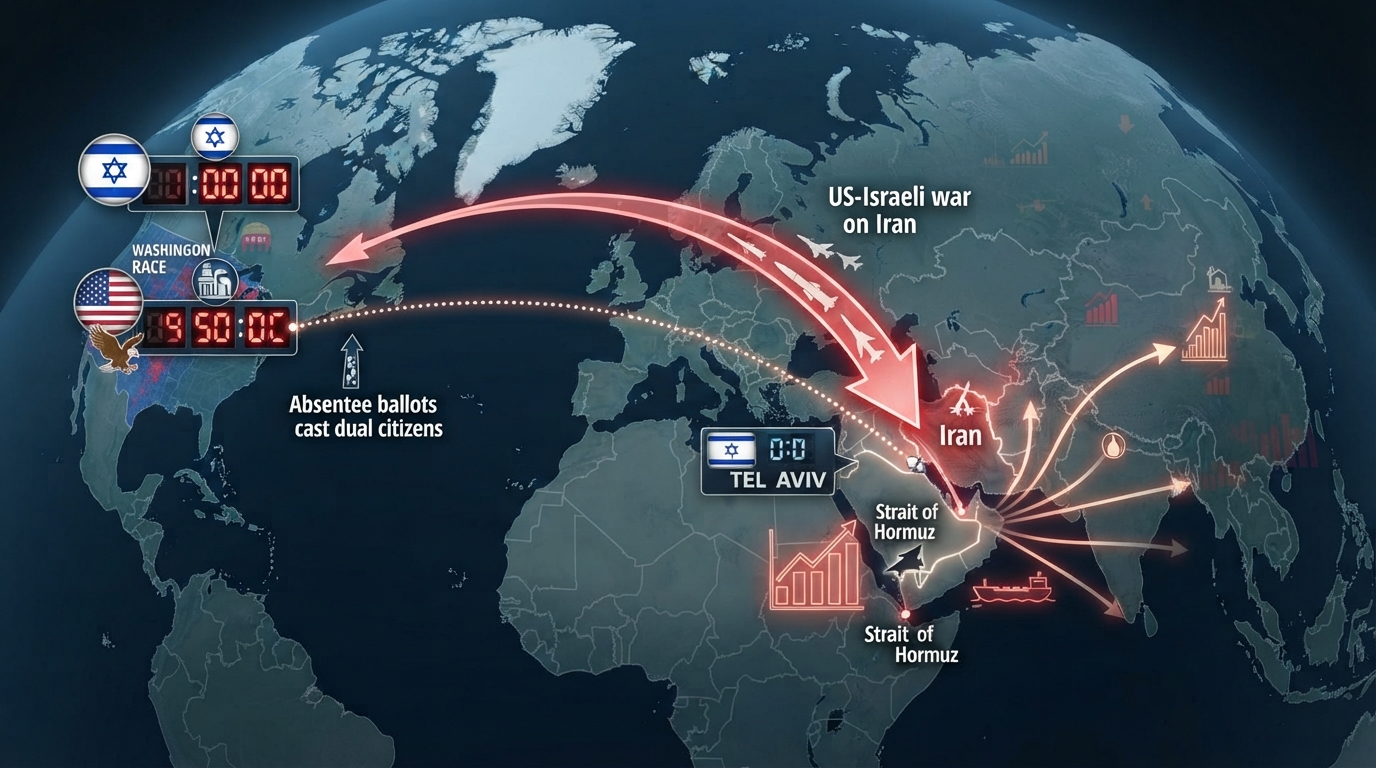
There is also a direct link between the two: the lobby group Republicans Overseas Israel says roughly half a million Israelis holding American passports are eligible to vote in both elections.
Israeli Prime Minister Benjamin Netanyahu has emphasized his alliance with US President Donald Trump — including on this Likud party election billboard in Tel Aviv.
Marc Zell, the group’s chairman, said these voters could sway close US races, including the Michigan Senate contest, where he estimated 10,000 absentee ballots would be cast from Israel. "They can really make a difference," he told the BBC.
But the policy connection may be even deeper — especially when it comes to the US-Israeli war on Iran. The huge aerial assault, which started in February, destroyed many military targets and killed much of Iran’s leadership. But it did not topple the regime, which struck back hard across the Gulf and took control of the Strait of Hormuz and much of the world’s energy supply.
The mere existence of the elections has already influenced decisions.
Israel’s Prime Minister Benjamin Netanyahu has used the campaign to raise the prospect of launching another attack on Iran.
He has made fresh claims — without evidence — about Iran’s nuclear threat, again insisting that the Islamic regime must be removed.
His goal: to strengthen his image as a security leader, which was badly damaged after the deadly 7 October Hamas-led attacks on Israel.
US President Donald Trump has fueled speculation about renewed strikes on Iran by backing Netanyahu’s re-election campaign, saying the two men should "soon finish the job" in Iran.
Yet despite the war talk, there have also been conflicting reports that Trump stepped in to stop Netanyahu from attacking Iran before polling day, worried that a new surge in energy prices would remind US voters of his unpopular war.
President Trump has been campaigning for Republican congressional candidates, including in Michigan on Sunday, where there is a tight Senate race.
So could an attack on Iran be postponed until after the elections? Israeli media is full of speculation that Netanyahu may try to secure his political survival by attacking Iran as caretaker prime minister after the vote.
Under that theory, he would argue for a government of national unity — with him in it — rather than a coalition of opposition parties. Netanyahu has long been regarded as a master survivor in Israeli politics. If he lost power, he would face an official inquiry into his conduct before the October 7 attacks and renewed legal proceedings over corruption allegations.
The speculation is so serious that Netanyahu’s rival, former military chief Gadi Eisenkot, has already ruled out joining any unity government. Like all mainstream Israeli politicians, Eisenkot sees Iran as an existential threat to Israel and supports military action against the Islamic regime. But he has explicitly warned against widening the war for political gain.
Trump may well be more willing to strike Iran after the midterms if he is no longer constrained by elections and wants to try one more push to extricate himself from the war. Some analysts think Iran is so economically weakened by war and sanctions that another round of strikes could prompt Iranians to overthrow the regime. Others dismiss that as wishful thinking. It is a strategy that has failed repeatedly, yet it still has support in Washington.
"After the midterms, he will be in legacy mode," one well-placed Western diplomat told me. "He will want to show agency on anything that is not the quagmire at home."
In Israel, most parties broadly agree on the threat from Iran and the need to contain it. But if voters choose a new government, they may end up with a prime minister who has less political and personal stake in launching fresh attacks.
In that case, Trump has hinted that his own position could change as well. "If Israel has the wrong Leader, which would be anyone other than Bibi [a nickname for Netanyahu], America will have to do this work ourselves, and I am not inclined to do so," he wrote on social media.
Netanyahu has used this year’s election campaign to highlight the possibility of a new strike on Iran.
It is no surprise, then, that policymakers in Tehran have been watching US opinion polls as closely as anyone in the Washington beltway. The danger, of course, is that any attacks after the elections could throw the Middle East into fresh turmoil if Iran retaliates forcefully.
Publicly and privately, Iranian officials have threatened to strike airports, pipelines, undersea cables, energy facilities, desalination plants, as well as US bases and warships.
Iran’s foreign minister, Abbas Araghchi, wrote in the Financial Times that new attacks would put "civilian lives and the wellbeing of all regional states and the global economy at great risk".
The two elections also intersect again over the global economy. Affordability and the cost of living have dominated the midterm campaign, problems worsened by Trump’s war, which pushed up prices as Iran restricted the flow of energy through the Strait of Hormuz.
The economy is also a major issue in Israel, where voters are dealing with high costs and low wages. But here too the war is a factor, with rising defense spending adding further strain to the public finances.
Trump has tried to calm voters ahead of the midterms. He has eased sanctions on Russia, hoping in vain that importing diesel from Moscow would bring prices down sharply. He has also taken a hard line on Ukraine, urging its leaders to make concessions in the hope — also so far in vain — of claiming a foreign policy win.
But Republican anger over his controversial approach is increasing. Senator Thom Tillis of North Carolina, a frequent Trump critic, told CBS News: "If the President wants to actually bring down energy prices, he can do it by solving the Iran problem, not by doing a solid [favour] for Vladimir Putin."
Early voting has already begun in many US states for next month’s midterms.
One result of the Iran war — along with Israel’s military actions in Gaza and the occupied West Bank — is that long-standing bipartisan support in the US has broken down. Abdul El-Sayed, the left-wing Democratic Senate candidate in Michigan, is campaigning on reducing military aid to Israel. "An ally that takes your money, to push you into wars you shouldn't be fighting, is not an ally," he told ABC News.
The US and Israel initially attacked Iran to destroy its ballistic missiles, weaken its nuclear capability, reduce its support for proxy militias and even remove the entire regime. Since then, the war aims have shifted to reopening the Strait of Hormuz.
Brad Lander, a Democratic congressional candidate in New York who also sits on the left of his party, even traveled to the West Bank just days before polling. He helped Palestinians harvest olives and was briefly detained by Israeli forces, all of which fed into his social media campaign. In the history of US politics, this is not normal. Even Netanyahu is warning that Israel may one day have to survive without a US security blanket.
The leader of Israel’s Yashar party, Gadi Eisenkot, has ruled out joining a unity government after the elections.
Of course, if Israel’s prime minister were to lose, his departure would end a rocky bromance that has seen Trump swing between praise and criticism. Last week the president called his Israeli counterpart a "great warrior prime minister". During the summer, he said Netanyahu was "effing crazy". A new Israeli leader would have to build a relationship with an outgoing US president, a very different situation.
If Democrats were to gain more control of Congress, that could impose some limits on blanket US backing for Israel. Congress has traditional powers it can use to restrain military spending. It could also cut military aid to Israel. But as president, Trump would still have substantial executive authority — and a veto — to keep prosecuting the conflict as he wished.
Israel and the US’s decision to go to war with Iran earlier this year transformed the global economy and international geopolitics. The choices voters in both countries make in the coming days may determine where the world goes next.