

The ultra-Orthodox community is resisting being drafted into the Israeli army. But will they now bring down the Netanyahu government?
The fierce dispute over military service that may determine Israel’s future
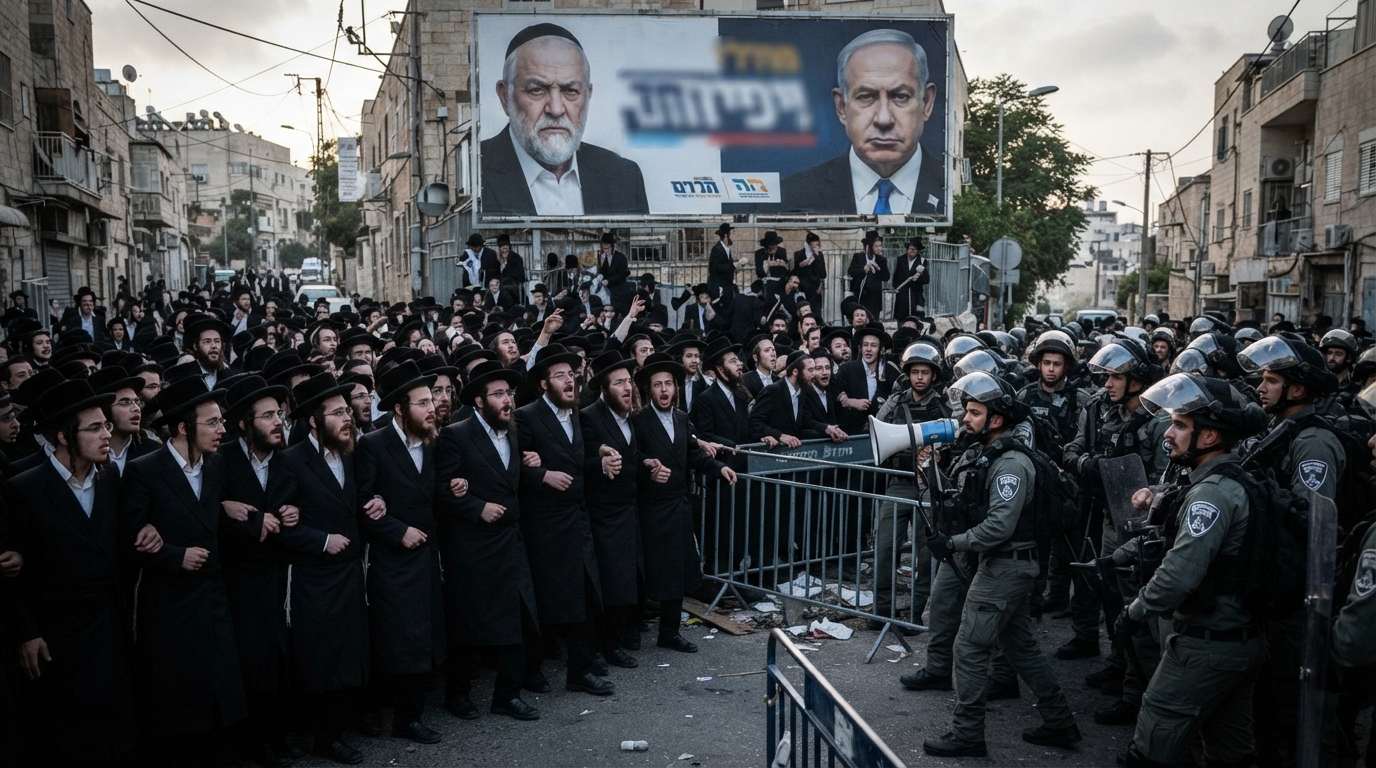
Angry demonstrators are calling Israeli security forces “Nazis” — but this is not a pro-Palestinian protest in London or Paris. The confrontation is taking place in the centre of Israel, where hundreds of ultra-Orthodox men in white shirts, black fedoras and long black frock coats are facing military police.
The confrontation centres on a building in Modi'in, a city halfway between Jerusalem and Tel Aviv, where a young ultra-Orthodox Jewish, or Haredi, man lives. Police arrived to arrest him after he did not show up for military service.
The early October clash, shown to the BBC in a video, is one of many in recent months that have made one of the deepest divisions in Israeli society increasingly visible.
This growing rift is unfolding against the backdrop of the wars Israel is now fighting, including the unresolved conflict with Hamas in Gaza, as well as rising violence by extremist settlers against Palestinians in the occupied West Bank.
Once a very small minority, the ultra-Orthodox remain distinct even as their numbers rise each year. They are currently estimated to account for about 14% of the population, and the community’s birth rate is still much higher than that of other Israelis. If that growth continues at the same pace, they could make up one-third of the Jewish Israeli population by 2050.
As the ultra-Orthodox community has expanded, so too has the argument over the cost of supporting them with stipends so they can dedicate themselves to full-time religious study. Subsidies for the group are estimated to cost the government 35bn shekels (£8.4bn) a year and, until recently, they were exempt from military service.
Now that they are no longer a negligible minority, they are under pressure to engage more with broader Israeli society.
Ultra-Orthodox Jews have staged many protests against being drafted into the military
National security and the economy are two of the main issues in this election. That makes the divide between the ultra-Orthodox and the majority of Israelis, who believe they are not carrying their fair share of either burden, sharper than ever.
With no current political alliance likely to win an outright majority, and with Prime Minister Benjamin Netanyahu’s future uncertain, the role of smaller parties — including Haredi parties — will again be decisive in determining who governs Israel.
If Netanyahu wants any chance of remaining in power, he must keep the ultra-Orthodox parties on his side, despite the pressure inside Israel to strip away their special status.
From the ultra-Orthodox point of view, their social contract with the Israeli state is increasingly under strain. Their near-exclusive emphasis on studying Judaism’s religious texts — such as the Torah, the Jewish Bible — means their education system is separate, and many Haredim are not part of Israel’s workforce.
For the ultra-Orthodox, the biggest issue is preserving the exemption from IDF service for students at traditional religious, or yeshiva, institutions. This dates back to the earliest years of the Israeli state, when the Haredim were a tiny community of survivors trying to rebuild after the near annihilation of the Holocaust.
But as Israel has become more embattled after the October 7 attacks, fighting wars on several fronts, their near-total absence from the country’s conscription army has become more controversial.
Religious students and their rabbis believe that if young ultra-Orthodox men join the military, they will be exposed to influences and behaviour that could permanently pull them away from their community. Beyond that, they believe remaining faithful to their community’s traditions is essential to the survival not only of Israel, but of the Jewish people.
When asked shortly after October 7 why the ultra-Orthodox were not contributing more to the military in such an emergency, one of the community’s most senior leaders, Rabbi Dov Landau, said that religious students should not only avoid army service, but should not even visit wounded soldiers or attend their funerals.
The Haredi birth rate is higher than in the rest of Israeli society
The rabbi said that in such a dangerous time, only Torah students could protect Israel spiritually. “Salvation only comes through Torah learning, orderly Torah learning. And any neglect of or disruption to Torah learning, woe and alas for what will happen… The more Torah learners multiply, the more Torah learners increase their learning, the better. They protect us.”
It would be a major understatement to say that wider Israeli society does not share this view. Polls have shown public backing for drafting the ultra-Orthodox rising sharply throughout the war in Gaza. Many regard it as a failure of responsibility by the Haredi community, made even more infuriating by the fact that this position is funded by taxpayers. The IDF has complained of a manpower shortage, while many Israelis have had to serve hundreds of days over the past three years.
Dahlia Scheindlin, a leading political consultant and pollster in Israel, says this issue is crucial for Netanyahu and central to understanding this moment in Israeli society against the backdrop of the Gaza war, especially on the political right. “Really the most burning, more immediate issue is the right-wing communities who are furious at the government for protecting the blanket exemption from the IDF at a time when, especially among the right, but really everybody in the Jewish community in Israel, is serving and many dying in these wars.”
Two years ago, the Supreme Court ruled that the exemption for ultra-Orthodox men from military service was effectively null and void. That could have meant that those devoted to full-time religious study would now be drafted.
The Haredi response was furious. Hundreds of thousands of Haredim staged protests and blocked major highways. And, as in the Modi'in incident, they tried to stop the arrest of religious students accused of dodging conscription. The protests have continued intermittently, and densely populated Haredi neighbourhoods are often the setting for clashes with security forces.
This is a dispute being fought out in the election.
There are two parties that have traditionally spoken for the Haredi community. One is United Torah Judaism, or UTJ, which represents Ashkenazi Jews, or Jews of European origin. The other is Shas, formed later, which represents Sephardi and Mizrahi Jews from North Africa and the Middle East. They share a core agenda that places religious study above everything else, including any questions about relations with the Palestinians.
Both UTJ and Shas have been part of Netanyahu’s coalition, and they used their political leverage to try to block enforcement of the Supreme Court ruling. On several occasions, they threatened to leave the alliance and bring down the government. UTJ followed through on that threat but kept supporting the government from outside, while Shas stayed inside the coalition.
Centre-right politician Gadi Eisenkot, who has emerged as Netanyahu’s main rival in this month’s election, does not back their position. He has made clear his view that the idea of the ultra-Orthodox forming a separate state within Israel with its own rules has become increasingly toxic. “A country that sends its best sons and daughters to fight and sacrifice their lives cannot tolerate a reality in which a state within a state exists,” he said.
All of this has made the issue of exemption from conscription for ultra-Orthodox men the top priority on the election agenda for both Shas and UTJ.
A recent comment by a UTJ parliamentary candidate, Eliakim Stark, has raised tensions further. He compared the situation of ultra-Orthodox men avoiding the draft to the persecution of Jews during the Holocaust. That prompted furious criticism from opposition leaders across the political spectrum.
Daniel Goldman, an activist who focuses on Haredi issues, says the two main Haredi parties feel increasingly under siege and less willing to compromise.
Protesters have blocked key highways
He says the ultra-Orthodox do not believe the state truly needs their boys to increase numbers. “It’s at least partly down to the fact that the Haredi parties see the state as wanting to take their boys out of the community and change them from ultra-Orthodox to either regular religious or secular, God forbid, as they perceive it,” he says. “And so in that environment of tension, they’ve actually hardened their positions.”
Yitzhak Goldknopf of UTJ, a former minister, has gone as far as issuing an ultimatum: “The Haredim will not change their way of life because there is an army and a war... If there is no choice and they must leave the country, they will leave.”
But this is clearly affecting the electoral prospects of the Netanyahu coalition — especially Shas, which has long been a key part of it. Without them, Netanyahu’s alliance would fall short of the more than 60 seats needed for a majority in the Knesset.
Dahlia Scheindlin says the refusal by Shas and UTJ to give up the draft exemption is hurting Netanyahu’s coalition. “It is one of the main reasons why the coalition is unable to win back the kind of support that they had in 2022 when they won 64 seats,” she says. “They’re currently polling at about 50 to 52 seats.”
All of Netanyahu’s rivals support ending the ultra-Orthodox exemption and cutting funding to institutions or individuals who refuse the draft. On the left, Yair Golan has called for an immediate mobilisation of those eligible.
Benjamin Netanyahu is relying on Haredi support which may not materialise
So, despite statements from Shas and UTJ that they would abandon Netanyahu if he weakened his backing for them, for now there appears to be nowhere else for them to go.
Anshel Pfeffer, a leading commentator on Israeli politics for years and now mainly the Economist’s correspondent in Israel, says Netanyahu’s position looks fragile. “There are two things that are bringing together the current opposition bloc,” he says. “One is obviously they want to replace Netanyahu and the other is they are capitalising on this really hostile environment nowadays towards the ultra-Orthodox, mainly over the issue of the draft to the army.
“Netanyahu has been willing for many years, to basically give the ultra-Orthodox whatever they want. They’re not going to get that from the opposition.”
Into this atmosphere of resentment and stubbornness, a new Haredi party has appeared this year, presenting itself as a break from the traditional approach of Shas and UTJ.
In essence, the Haredi Public Party is proposing a compromise in which the ultra-Orthodox would contribute more to Israel as a whole while preserving the core of their identity.
For the first time in the ultra-Orthodox community, it is also putting forward two female candidates.
One of them, Ziva Ginz, explained to the BBC her party’s position on the military draft. Central to it is the idea that men who serve should be allowed to remain culturally Haredi. “Anyone whose life is genuinely devoted to full-time Torah study should be able to continue learning. Everyone who isn’t sitting and studying for a full day should serve alongside the rest of Israeli youth, in frameworks where a young man can enter as a Haredi and finish as a Haredi,” she says.
But it may be too early for such compromise efforts to have an effect in this election.
Anshel Pfeffer says it is hard to shift the base vote in the ultra-Orthodox community, where most still essentially follow their rabbi’s instructions.
“And once people are voting for other parties, they won’t necessarily do so for another Haredi party,” Pfeffer explains. “That’s why we’re seeing people like [far-right leader and National Security Minister Itamar] Ben-Gvir making inroads in the Haredi community, because he’s the only non-Haredi party leader who actually talks to young Haredi. Basically, every other party in Israel doesn’t even try.”
Ben-Gvir is making inroads with Haredi voters
The polls reflect this, showing gains for his Jewish Power party.
Although Ben-Gvir’s actions are increasingly seen as damaging Israel’s international image through his support for policies such as annexing the occupied West Bank, his hard-right message is drawing a larger base of support inside the country. His ultra-nationalist outlook is not one that traditionally overlaps with Haredi party policies, but they do share a place on the right of Israeli politics.
So for some ultra-Orthodox voters seeking a new political home, Ben-Gvir is the closest option. His image as a strongman willing to take an extreme line against those he sees as Israel’s enemies, despite international condemnation, may appeal to some in the Haredi community who are already leaning far right.
Gadi Eisenkot has been firm in his support for Haredi Jews serving in the military
No alliance appears close to winning a majority, however, so there is likely to be extensive bargaining to assemble a workable coalition after the vote.
Netanyahu will, as always, use his exceptional political skills to try to find a way to stay in power.
That leaves the smaller parties with the power to act as kingmaker. The ultra-Orthodox parties have played that role before. But this time they may not be the decisive force.
“The truth is, any small party can become a kingmaker,” Dahlia Scheindlin says. “I don’t think it would take too much to lure the Haredi parties away from Netanyahu... The thing is, though, I don’t think the opposition parties will want to lure them in unless they have some promise that they’re really prepared to make serious concessions on the draft. The opposition parties are absolutely staking their platforms and their promise to the voters on that issue.”
This time, instead of being the kingmakers, the ultra-Orthodox parties may end up helping to bring down the king.