

Meeting travellers' expectations could be challenging, experts warn.
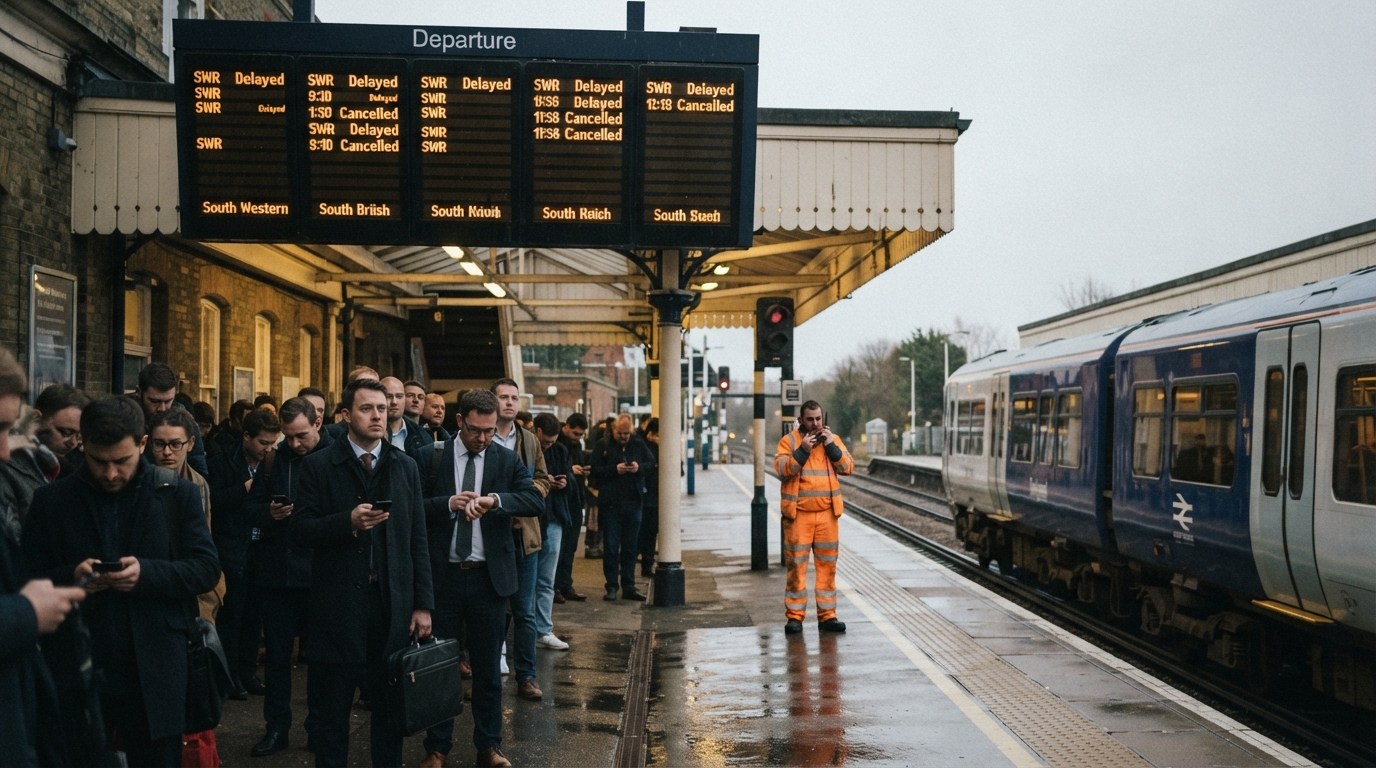
Publicly owned rail is popular. But is it making the trains run on time?
The early afternoon of Wednesday 6 August was nothing out of the ordinary on the rail network. Then, just before 14:00, a power failure stopped trains across the north-west of England.
Chaos followed: passengers told the BBC they were left stranded on platforms for hours, and some had to book hotels for the night.
The incident, caused by a brief power cut that affected Network Rail's operating centre in Manchester, was unusual in itself. But it added to a difficult summer for rail passengers.
Repeated heatwaves forced risk-control measures such as speed restrictions to prevent tracks from being damaged by the heat, causing delays and cancellations. There was a serious derailment near Lewes, East Sussex, and another smaller incident near Wickford in Essex soon afterwards.
Against a backdrop of relatively high cancellation rates and steep fares compared with previous decades, rail users could be forgiven for thinking things are not working.
Yet something is changing: Labour is steadily bringing almost all passenger rail services into public ownership. Nationalisation is a popular idea - a YouGov tracker poll suggests almost two thirds of the public back public ownership.
In practice, though, the plans are still at an early stage. Major structural changes have not yet been introduced. And experts warn it is too soon to judge how successful they will be.
So can rail nationalisation live up to public expectations? Or are the delays and cancellations currently being seen under a partly nationalised network a sign that it may struggle to deliver real improvement?
South Western Railway (SWR) was nationalised in May 2025, becoming the first of six services brought into public ownership under Labour so far.
At Woking station, served by SWR, regular commuter Leo says he had been hopeful about public ownership, but has not seen any difference yet: "I think the phrase 'emperor's new clothes' comes to mind… it's still unreliable."
SWR recorded a clear rise in cancellations during its first year in public hands.
But how much of that was because of nationalisation?
The Conservatives have pointed to SWR as evidence that public control does not necessarily bring improvements or solve key problems.
The government, however, says SWR's early period in public ownership was affected by high summer temperatures, signal failures and trespass incidents.
Lord Hendy, the rail minister, says efforts to turn the operator around have included introducing long-delayed new trains on suburban routes and hiring more drivers, which has reduced cancellations caused by staff shortages.
TransPennine Express was nationalised in May 2023 under the Conservative government. Many passengers had reached breaking point as the operator struggled to run to timetable and suffered from poor industrial relations.
A reliability improvement plan was introduced, including cutting some services and even removing one type of train to address staffing problems. A new deal with the drivers' union also helped - something an insider at the former private-sector operator told me their company had not been allowed to do.
So has it worked? Cancellations have fallen significantly. But they were still above the Great Britain average in the year to August.
It is important to say the data can only tell us so much. Many different factors can affect the performance of each service: for example, the condition of the infrastructure it depends on, weather events or simply how well it was performing before the government took over.
Also, of the operators nationalised since Labour came to power, only SWR and c2c have completed a full year in public hands. Even for those nationalised earlier, the picture is blurred by the pandemic, when passenger numbers collapsed.
But according to Alex Hynes, chief executive of DfT Operator Limited (DfTO), the government company that currently owns publicly run operators, some short-term changes have been possible. These notably include making one team jointly responsible for managing infrastructure and passenger train services in some areas, including the south-west of England.
"The railway is a system: track, train, people," he says. "So by putting one person in charge, they can fix all elements of the system to deliver a better service to customers."
Hynes also points to changes on the recently nationalised Thameslink; investment in better cleaning, improved toilets and replacement of unpopular upright "ironing-board" seats.
But when it comes to the pure performance data of operators nationalised in recent years - delays and cancellations - can we really draw any conclusions yet about whether the policy is working?
"I think it's completely hopeless to try and do that assessment over such a short period," says Stephen Glaister, former chair of the Office of Rail and Road and now emeritus professor of transport and infrastructure at Imperial College London. He believes a decade is needed to judge the impact of nationalisation.
The government says official data indicates publicly owned train operators are performing better overall on punctuality and cancellations than those still under DfT contracts to private operators.
Experts note that whoever runs the passenger trains, some constraints remain. Many delays are caused by infrastructure failures, such as signals. There is only so much capacity on the existing network. And getting better trains or more staff can take years.
The belief that privatisation ultimately failed, leaving unreliable services and high fares, may be widespread. But Prof Glaister says that for a few years in the 1990s, the old privatised system actually worked well. Operating costs and subsidies were falling while train services and passenger numbers rose, he says.
And in the current context, it is important to be clear about what nationalisation actually means.
The railways Labour inherited were not, in truth, fully privatised, and nationalisation does not mean a return to British Rail.
For instance, the infrastructure manager Network Rail has been entirely under public control for more than two decades. Several train companies, including LNER and Northern, had already been nationalised under the Conservatives. Scotrail, Transport for Wales and Caledonian Sleeper are controlled by devolved national governments.
And even the operators still under DfT contracts at Westminster have been heavily controlled by the government for years. During Covid, private operators began being paid a fixed fee to run services, while the taxpayer took on the financial risk. The contract terms meant train companies had to "ask government for permission to blow their nose", according to one senior industry executive, who asked not to be named so they could speak freely.
Highly profitable rolling stock companies ("ROSCOS") still own the actual trains. Freight companies also operate privately, and there are a handful of fully commercial "open access operators" on the rails such as Lumo, Hull Trains and Grand Central - although there are concerns in the industry that these could end up squeezed.
So what is often described as rail nationalisation is, in fact, a gradual return of passenger train operators run by private companies to public hands as their contracts expire - and making that the default.
But that is not all that is happening. The government hopes that reorganising the railways under a new publicly run body, Great British Railways (GBR), will make a major difference. This will combine train and track operations, ending the current fragmented system.
A botched rail timetable introduction in 2018 prompted the then-Conservative government eventually to propose GBR as a new overarching body - although the Tories believe private competition should not be ruled out.
Some trains are already carrying distinctive GBR branding, but the organisation does not yet exist. A new law to create it is moving through parliament. Questions remain, including exactly how GBR will work with devolved governments and who its senior leaders will be.
Transport expert and author Prof Jon Shaw, of the University of Plymouth, says the idea of a "single guiding mind" should create "a better planned railway that's more aligned to the customer".
Prof Shaw believes possible benefits include better long-term planning for rolling stock and timetables, and the removal of "the compensation merry-go-round", where train companies and Network Rail argue over whose fault a delay was.
Hynes says: "The way you get the railway to work is you get the infrastructure and the trains and the people working in harmony because it's a system. And we can do that in a publicly owned GBR railway in a way that we haven't been able to do for a generation."
But Prof Shaw warns of possible pitfalls. For example, "there remains very little money", and "a massive issue is whether or not the rail minister or DfT more generally - or the Treasury - will be able to butt out" and leave rail leaders to run the railway.
Prof Glaister also fears politically sensitive issues such as fares and service levels could tempt politicians to run the railways themselves, because so much public money is involved.
"Actually, governments are not very good at running railways," he says. "So you want management who are somewhat independent and able to run it."
Lord Hendy insists that despite the Transport Secretary having final approval over GBR's strategy, the body will be genuinely arms-length from government.
"The point of this is to get a cadre of people who are committed to the outcomes that the secretary of state and I want for it, who can go off and run it on their own," he says, adding: "They'll have a lot more chance in the future than they've had in the last 20 years."
The railways are currently subsidised to the tune of around £12bn a year - not including spending on major projects like HS2.
Transport Secretary Heidi Alexander says she wants subsidy levels to fall. Meanwhile, Network Rail has acknowledged that a squeezed budget means difficult choices, and protecting the network against the effects of more extreme weather requires investment.
Prof Glaister says: "When the public is hoping for a better level of service, more reliability, fewer breakdowns and lower fares, what they're really asking for is more money to be put into the railway.
"I don't think it's likely the government is going to be able to find more money, probably [it will have] less, actually. And so I think there's a real problem with ministers raising expectations from this policy."
But Hynes does not see a contradiction between cutting taxpayer subsidy and improving train services.
"My two north stars are performance up and subsidy down," he says. "If the service is better, we get more customers, we get more revenue."
Lord Hendy and Hynes also reject the idea that the answer to better reliability might be running fewer trains.
Hynes says: "In an industry with high fixed costs, the best way of getting the subsidy down is to go for growth."
There are also questions about how GBR will handle industrial relations. Terms and conditions currently differ across operators. What will cost-conscious ministers do if unions try to standardise them at the most generous level across the network?
While ministers say they are pressing ahead with improvements people will notice, there is recognition that the pace of change will differ between operators.
Lord Hendy says some changes "ought to be dead boring… to make sure tomorrow is a little better than today if you can do it".
But he says "more than 30 years worth of behaviors" will need to change for the railway to run solely in the interests of the customer.
At Woking, is there hope that things will improve in the long term?
"I really hope so," says Leo, "it would be amazing - as it's not the best service now."