

Are people going to have to increasingly accept more delays and diversions as the effects of climate change intensify?
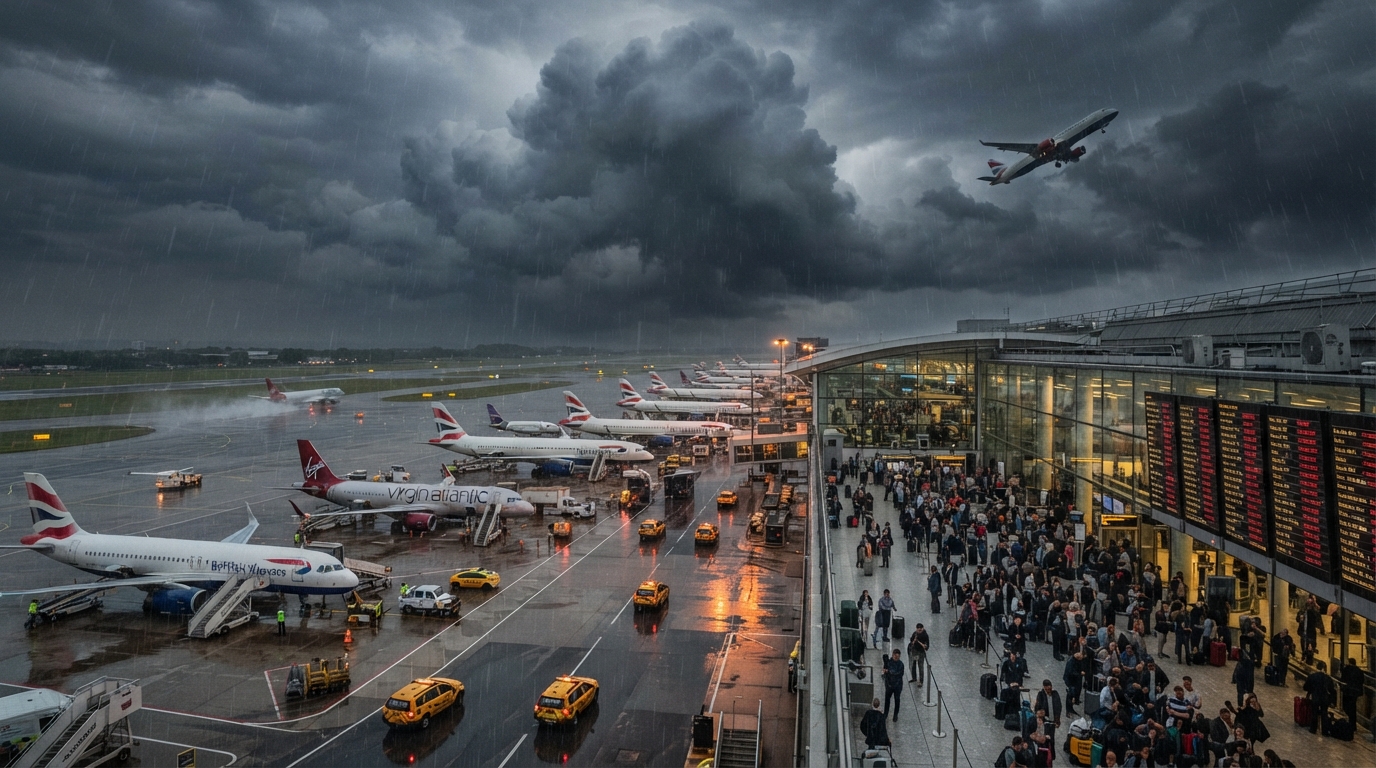
Aviation is heading into hotter, stormier skies — and passengers may need to get used to more disruption
In late June, as the country baked through one of many heatwaves in a scorching summer, huge thunderclouds were building over southern England and much of northern Europe. It was a Saturday, and with the holiday season beginning, thousands of passengers were making their way to London’s Heathrow and Gatwick airports to board flights overseas. It was always going to be an exceptionally busy day.
What happened next, though, was chaos for travellers. As air traffic controllers tried to steer aircraft around the storms, airspace became badly congested and many planes scheduled to depart were simply held on the ground. In the end, around 900 flights to and from the two airports were delayed, some by as much as 11 hours. Dozens more were cancelled. Across airports in Europe, passengers hoping to fly into London also faced long delays and uncertainty.
The UK weather may have since cooled, and passengers may soon move on from the experience. But some in the industry say June’s events should be treated as a warning.
In this instance, the timing was plainly unfortunate. But there are fears that incidents like this will become more frequent as climate change intensifies around the world and weather systems grow increasingly unstable, making disruption more likely and adding costs for airlines, airports and travellers.
Tim Atkinson, an airline risk consultant and former pilot, says the crowded skies over the UK and northern Europe make the region especially vulnerable.
He believes there is a genuine risk, for instance, that storms could affect all of London’s airports at once, with potentially serious consequences both in the air and on the ground.
“What we’re seeing now is very rapid climate change,” he says.
“We’re going from the kind of weather activity which takes out an airport, and which the system kind of copes with… to a situation where, with very little predictability, it would be possible to lose all of the London airports from real-time operation quite swiftly and with little notice”.
He thinks such a scenario would make the disruption passengers experienced in June look relatively minor — and could even endanger lives. But how likely is it?
For controllers at National Air Traffic Services’s (NATS) main control centre in Swanwick, Hampshire, thunderstorms are a major concern. When I visit, it is a hot, humid day, dark clouds look threatening overhead, and heavy thundery downpours are hitting the surrounding area.
In Terminal Control, the section of the building responsible for flights to and from airports in London and southern England, those same storm cells are being watched constantly. Their movement is tracked on large radar screens, while weather forecasts are examined closely at the same time.
Air traffic tends to arrive in waves through the day. At lunchtime, it is relatively quiet and the storms have not yet affected major routes. But with activity expected to pick up in the afternoon, staff are already preparing for what could be a difficult few hours.
Stormy weather can reduce the amount of airspace available, meaning traffic has to be restricted and rerouted. If planes cannot land at one airport, for example because of strong winds, they may need to divert elsewhere. But that can create problems of its own; if too many unscheduled aircraft arrive at an already busy airport, it may not have the infrastructure to handle them all.
Heavy rain and storms can make flying harder
Planes need fuel and somewhere to park. Passengers need food and facilities. In the end, if there is no room, an airport can simply refuse to accept anything except emergency traffic.
This is where Atkinson’s scenario comes in. He warns of a situation in which traffic is diverted from Heathrow, Gatwick, Luton and Stansted at the same time, leaving aircraft arriving across the Atlantic and many European flights all searching for somewhere to land simultaneously, some with fuel reserves running low.
At the very least, this would cause major disruption for passengers, who could end up hundreds of miles from where they were meant to be. But he also thinks it could create “a very serious risk event, such as an aircraft running out of fuel in the sky”.
Aircraft are legally required to carry enough fuel to reach an alternative airport if needed, plus an extra 30 minutes of flying time on top of that.
Not everyone agrees with Atkinson’s concerns. Andrew Charlton, a former airline executive who runs the Swiss-based consultancy Aviation Advocacy, believes the risk is low.
“You’ve always got to imagine the worst-case scenario”, he says. “But I also think we need to keep that worst case in context.
“Yes, it’s possible to imagine it. But I’m also fairly comfortable with the ability of this industry to react well and make good decisions… of all the things that wake me up at 3am…this is not the top of that list.”
Thunderstorms are caused by convective activity, in which moist air near the ground warms quickly and rises rapidly. As it rises, it expands and cools, causing the moisture it carries to condense into large clouds. More heat means more convective energy, which can create instability. In addition, for every degree the Earth warms, the atmosphere can hold about 7% more moisture, raising the chance of heavy rainfall.
It is not certain that this will mean more thunderstorms in the UK and across Europe, because many variables are involved beyond simple energy and moisture. Some regions may even see fewer. However, studies have shown that higher latitudes, especially in the northern hemisphere, will see the biggest increases in conditions favourable for storm formation, and storms that do develop may be more violent. According to the UK’s Met Office, “while we may not see more thunderstorms overall, the ones we do experience could be more impactful”.
Whenever possible, pilots will avoid flying through convective weather. Even though aircraft are built to withstand severe conditions, storms can produce intense turbulence capable of damaging the aircraft’s structural frame, as well as throwing people around the cabin if they are not strapped in. Hail can also be a major hazard, potentially cracking windscreens or causing engine problems. So however inconvenient it may be for passengers, crews will always put safety first.
New technology helps pilots navigate tricky flying conditions
Onboard weather radar can help aircrew see up to 320 nautical miles ahead. They also have access to live weather forecasting tools online. But thunderstorms can move fast and, according to Prof Guy Gratton, an aeronautics expert at Cranfield University, these systems are essentially “tactical rather than strategic”. In other words, while they allow pilots to spot storm cells on their screens from a relatively short distance and request a diversion, they do not support detailed long-range planning.
As a result, unscheduled diversions often happen late in a flight, which is likely to mean burning more fuel. If storm delays do become more common, Andrew Charlton says aircraft will have to carry more fuel routinely, in case trouble is developing ahead. “Aircraft are going to have to fly further, and they’re going to have to factor in the assumption they’re going to fly further,” he says. For an airline, fuel is one of its biggest costs — and if the fuel bill rises, he says, passengers will inevitably pay more.
More intense storms would likely make air traffic management in busy regions more difficult and could lead to more delays and cancellations. However, some of this may be reduced by new technologies.
For example, both Heathrow and Gatwick have moved away from requiring minimum distances between arriving aircraft and now use a system that continuously calculates spacing times based on wind speeds and aircraft types. In practice, this is intended to let controllers reduce the distance between landing aircraft, especially in strong winds, and get them on the ground more quickly. According to NATS, it has successfully increased landing rates and cut delays significantly.
But more severe storms could bring other effects too. Heavier rainfall, for example, raises the risk of flooding. In the worst case, this can bring airport operations to a halt, as happened in April 2024 when torrential rain hit Dubai International Airport. It briefly had to close its runways, and disruption lasted for two days. More than 1,200 flights were cancelled, affecting tens of thousands of passengers.
Passengers were delayed during the floods in Dubai
Even if runways and taxiways are clear and aircraft can fly without difficulty, passengers may still struggle to reach their flights if roads, railways or car parks are flooded.
Defending against these risks can be costly. Gatwick Airport, which suffered severe flooding over the Christmas period in 2013, has spent tens of millions of pounds on mitigation measures in recent years — though that is far less than the more than £2bn it expects to invest in its current expansion plans.
Clear-air turbulence is another genuine problem. It cannot be seen, and it is becoming more common as the climate warms.
This is when air moves violently at high altitude without clouds or other visual clues to help a pilot avoid it. For passengers, it usually means only a bit of bumpiness, but sometimes it can be much more serious. On 1 March 2023, for example, a Lufthansa flight from Austin, Texas to Frankfurt encountered what the airline described as “brief but severe” turbulence.
Those on board said passengers and crew were thrown around the cabin as the aircraft suddenly lost altitude. After an emergency landing in Washington DC, seven people were taken to hospital.
Although still rare, this kind of turbulence is already far more common than it once was and is likely to become even more so.
“You know the projections are pretty dire: doubling, trebling or worse in the amount of severe turbulence on many busy flight routes around the world,” says Paul Williams, a professor of atmospheric science at the University of Reading. He says incidents over the North Atlantic have risen by 55% since 1979.
Even so, he remains confident that solutions can be found, including better forecasting and the use of laser-based technology.
There is another climate-related threat to aviation that may be especially difficult to overcome: rising sea levels. When Hurricane Sandy reached the US East Coast in October 2012, it triggered a storm surge that flooded the city. The two runways at New York’s LaGuardia airport were left underwater for several days, preventing it from reopening even after the winds had eased.
Flooding severe enough to affect the New York City area once every 500 years in pre-industrial times is now happening roughly every 25 years — and could happen every five years by the middle of the century, according to one major study. That makes LaGuardia, built on reclaimed land beside Flushing Bay, look highly exposed.
LaGuardia could face a greater risk of flooding and future closures
It is not alone. With about 40% of the world’s population living within 100km of coastlines, many airports have been built in low-lying areas near the sea. According to research from Newcastle University, 269 airports worldwide are already at risk of flooding because of rising sea levels, and that number is expected to increase. Among those potentially most exposed are Amsterdam Schiphol, London City, Bahrain International and Newark Liberty International.
Many airports already have some level of flood protection, especially larger ones. But preventing flood risks from increasing over the next century will require expensive investment in flood defences, raising runways, or even relocating airports. According to the Newcastle report, it could cost as much as $57bn (£42bn). Those costs are ultimately likely to be paid by taxpayers or travellers.
The aviation industry is often criticised for its own contribution to climate change emissions. It faces a daunting challenge in trying to meet a target of being carbon neutral by 2050, while also accommodating growth that is expected to see the global aircraft fleet double in size over the next two decades.
The overlooked factor driving the childhood obesity crisis
The race to stop England running out of water
How a new era of heatwaves could shake up the school calendar
Yet it is clear that the effects of climate change will also be felt by airlines, airports and, inevitably, passengers.
“I think the best we can do is mitigate”, says Andrew Charlton.
“We need to make sure we have enough space at air terminals for people whose flights are being disrupted and delayed, that we have enough hotel rooms and parking space and so on.”
But ultimately, he says, “disagreeable moments are going to happen more”.
Passengers, he thinks, will have to accept that as part of flying life.