

Newborn twins fight for survival as conflict fuels Yemen's hunger crisis
Raghad and Raad's family had to flee their home on foot because of the fighting between pro-government forces and the Houthis.
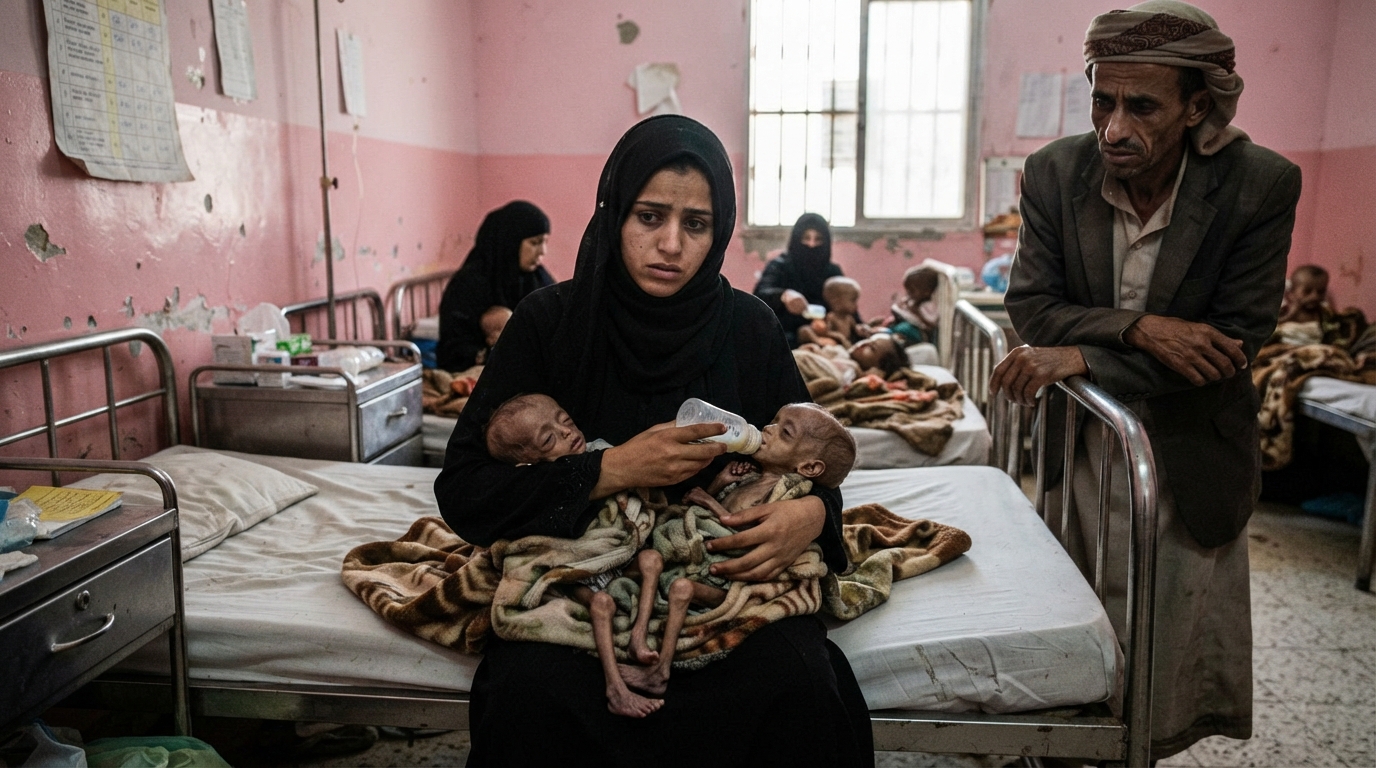
Newborn twins fight for survival as conflict deepens Yemen's hunger crisis
From the moment they were born, just seven weeks ago, twins Raghad Hassan and her brother Raad have been struggling to stay alive.
They arrived prematurely as the fighting intensified in Yemen's long-running civil war between Houthi rebel fighters and government forces.
When the Houthis reached their village in the Kahboub mountains in south-west Yemen, their family of seven was forced to flee amid bombs, missiles, and drone attacks, with the twins shielded only by blankets.
What followed was a three-day journey on foot toward the port city of Aden.
"It was very difficult," says their father, Bajash Ali Sagir Hassan, a softly spoken shepherd. "We didn't find cars or transportation. One kind person brought us here [on the fourth day] while others refused."
As the family walked, the twins grew weaker, according to their mother Lina. "They were exhausted… there was cold and dust. Their vomiting and diarrhoea got worse."
By the time the newly homeless family reached al-Sadaqah hospital in Aden, the twins were barely holding on to life. "Just skin and bone," said a doctor, shaking his head as he examined their wasted limbs.
Raad was the more seriously ill of the two - his ribs showing and his chest rising and falling as he breathed in quick, shallow gasps. He was scarcely larger than the nurse's hands as she carried him gently to be weighed and measured.
Bajash watched anxiously, worry written across his face. He said the twins were fed twice a day, but sometimes he could give them only water after the war pushed up the price of baby milk.
The diagnosis came fast - severe acute malnutrition. That can be as deadly as a bullet.
More than 250,000 people have been displaced over the past three months, the UN says
Malnutrition in Yemen is a crisis inside another crisis - yet another front in a devastating civil war. Hunger did not begin with the conflict, but it is spreading with the latest bloodshed.
The United Nations says about 800,000 people can no longer receive lifesaving aid and more than 250,000 have been displaced after an informal ceasefire collapsed in the summer.
Since then, the Houthis have made a lightning advance along the Red Sea coast, and they have now completely cut off Yemen's third largest city, Taiz.
The UN says civilians there are "at grave risk" and short of food because prices have soared.
The internationally-recognised government is fighting back against the Houthis - or trying to - with the help of Saudi air strikes.
Caught in the middle are fathers like Bajash, struggling to get help for their children. We saw another mother with a malnourished baby being turned away.
Raad was unable to keep down the fortified milk his mother Lina fed him
We followed Bajash as he hurried through the corridors, trying to secure the crucial admissions slip. He found support in a determined supervising nurse, Aisha Ragab, who had fled the war herself back in 2018.
"I feel for them," she said, "because I have already lived through the situation myself."
Two beds could not be found, but Aisha was not discouraged.
"I will settle this by having the twins share a bed... so that we can save them. By God, I will convince them [the doctors]."
Within an hour, the twins were lying on one bed, their tiny bodies taking up very little room.
Lina was giving them sips of fortified milk from a small bottle, but Raad could not keep it down. He was held in her arms - his eyes wide and his cheeks hollow. When asked whether she thought her twins would recover, Lina answered softly, "God willing."
Raghad, like her brother, was diagnosed as having severe acute malnutrition
As we moved through the unit with its pink walls, some doors were padlocked shut.
There are 22 beds, but staff told us only 13 patients were admitted at a time - the most critical cases - because of a lack of international funding, staff, and equipment.
That is a bitter reality for Dr Noor Mohammed, a harried young doctor.
"It's sad to say, but we lose patients [because of the conditions]," she says.
"We don't have good equipment like ventilation machines, and oxygen bottles," she adds. "There are no good resources. A lot of laboratory investigations... it's very hard to do them."
A recent surge in fighting has put civilians in the line of fire.
Even before the latest escalation, the UN estimated that half a million Yemeni children would suffer from severe acute malnutrition this year.
Dr Noor Mohammed says families with no money or insurance rely on her hospital for treatment
The malnutrition unit at al-Sadaqah hospital is a conveyor belt of suffering. As one critically ill baby leaves, another arrives. And some of those discharged return far too soon.
"Sometimes a child comes back to us after a week, or two days," says Dr Mohammed. "Sometimes it is the same day. They come back and we admit them and the story begins again."
They return because parents cannot afford proper nutrition or vitamins or antibiotics.
"Every child here, his parents came because they don't have anything," she tells me. "They don't have money or insurance. They are here because they can't afford a private hospital."
She says she does her best for them, and she cries for them.
Bajash and his other children were forced to sleep on the street
Many parents - like Bajash - are trying to escape both war and poverty. He is now a shepherd without a flock. When he fled, he had to leave behind 10 sheep. They were his only source of income.
While doctors watched over his twins, he looked after his three older children - all under five. They sat on a bench in the hospital reception area without toys, bedding or any baggage at all. But they could not sleep there.
So they spent the night outside, on the street - one more family with war wounds that cannot be seen but will scar a generation.