

New Zealand Election 2026: What you need to know
Voters will elect a new parliament on 7 November with the cost of living among the key issues.
**New Zealand Election 2026: What you need to know**
New Zealand holds a general election every three years.
On 7 November, New Zealanders will go to the polls to choose a new government.
Voters are focused on issues including the rising cost of living, unemployment and healthcare, and they will elect members of parliament.
Pre-election polls do not show a clear frontrunner. The sitting centre-right prime minister, Christopher Luxon, won the previous election in 2023 on a pledge to "build the economy".
Here is everything you need to know about New Zealand's 2026 general election.
New Zealand's general election takes place every three years and uses a Mixed-Member Proportional system, or MMP.
Each voter casts two votes: one for their local constituency representative in parliament and one for a political party.
The candidate who receives the most votes in a constituency wins and becomes an MP.
Political parties, meanwhile, must win at least 5% of the total party vote to gain seats in parliament. Seats are then distributed proportionally - for example, if a party wins 40% of the total party votes, it will receive 40% of the seats allocated to parties.
The New Zealand parliament usually has 120 seats - 71 are assigned to constituencies and the other 49 are divided among parties proportionally.
New Zealand elections seldom produce an outright majority, so parties build coalitions to form a government.
New Zealand introduced MMP in 1996 to address concerns that smaller parties were being excluded from representation.
The current government is headed by Prime Minister Christopher Luxon, whose centre-right National party came to power in 2023.
It governs in coalition with the ACT and New Zealand First parties.
His party has stressed economic management, restoring a budget surplus, and expanding KiwiSaver, New Zealand's retirement savings scheme.
The main opposition is the centre-left Labour party, led by former prime minister Chris Hipkins.
Labour has concentrated on lowering living costs, improving healthcare and transport, and investing in housing, jobs and public services.
National's coalition partners have their own priorities as well. ACT, led by David Seymour, has pushed for tougher immigration policies, while New Zealand First, led by Winston Peters, has suggested changes to voting eligibility, with the party proposing that voting in New Zealand should be limited to citizens only.
The Green Party, co-led by Chlöe Swarbrick and Marama Davidson, is another contender. It has campaigned on issues such as wealth taxes, renewable energy and public services.
Te Pāti Māori, which represents Māori interests, is also contesting parliamentary seats, with housing, healthcare, education and constitutional reform among its priorities.
Cost of living remains a major issue for New Zealanders.
A September 2026 Ipsos survey found that 63% of respondents named inflation and the cost of living as one of the country's most important issues. Healthcare and hospitals ranked second at 44%, followed by the economy at 34%.
Unemployment is also becoming a bigger concern, with 21% of respondents identifying it as a major issue in the same survey. It moved ahead of housing to become New Zealand's fourth most important issue.
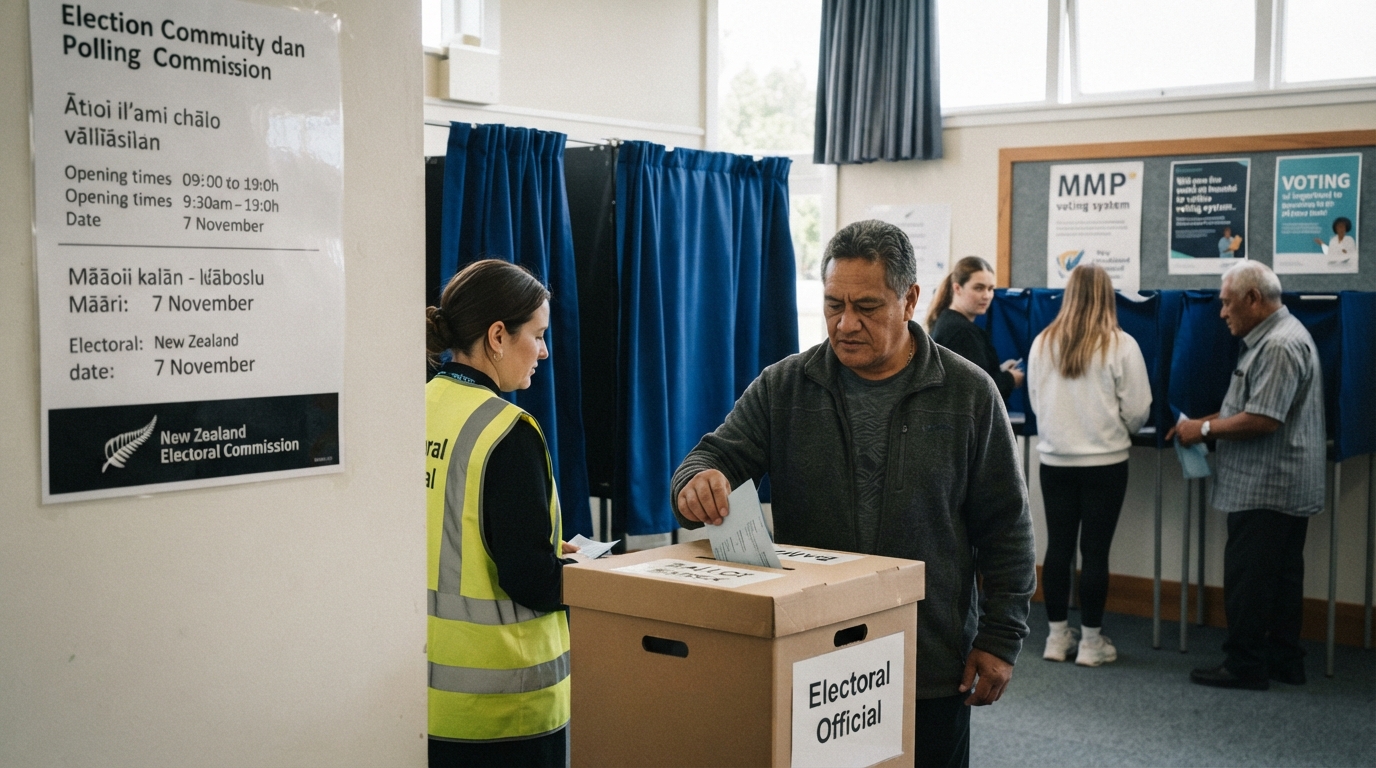
Polling places open at 09:00 local time on 7 November (20:00 GMT 6 November). Voting closes at 19:00. Advance voting began on 26 October, while overseas voting started earlier on 21 October.
Preliminary results will be published gradually from 19:00 on election night on New Zealand's official election results website. These early figures will not be the official final count.
The Electoral Commission is due to announce official results on 27 November, once counting and verification are complete.
A decisive result on election night could offer an early clue about which parties are best positioned to form a government. But a close contest could slow negotiations if no party secures an outright majority.
New Zealanders may therefore have to wait beyond election night to learn which parties will make up the next government and who will lead the country for the next three years.