

New regulatory requirements may be introduced for crypto asset service providers in Uzbekistan
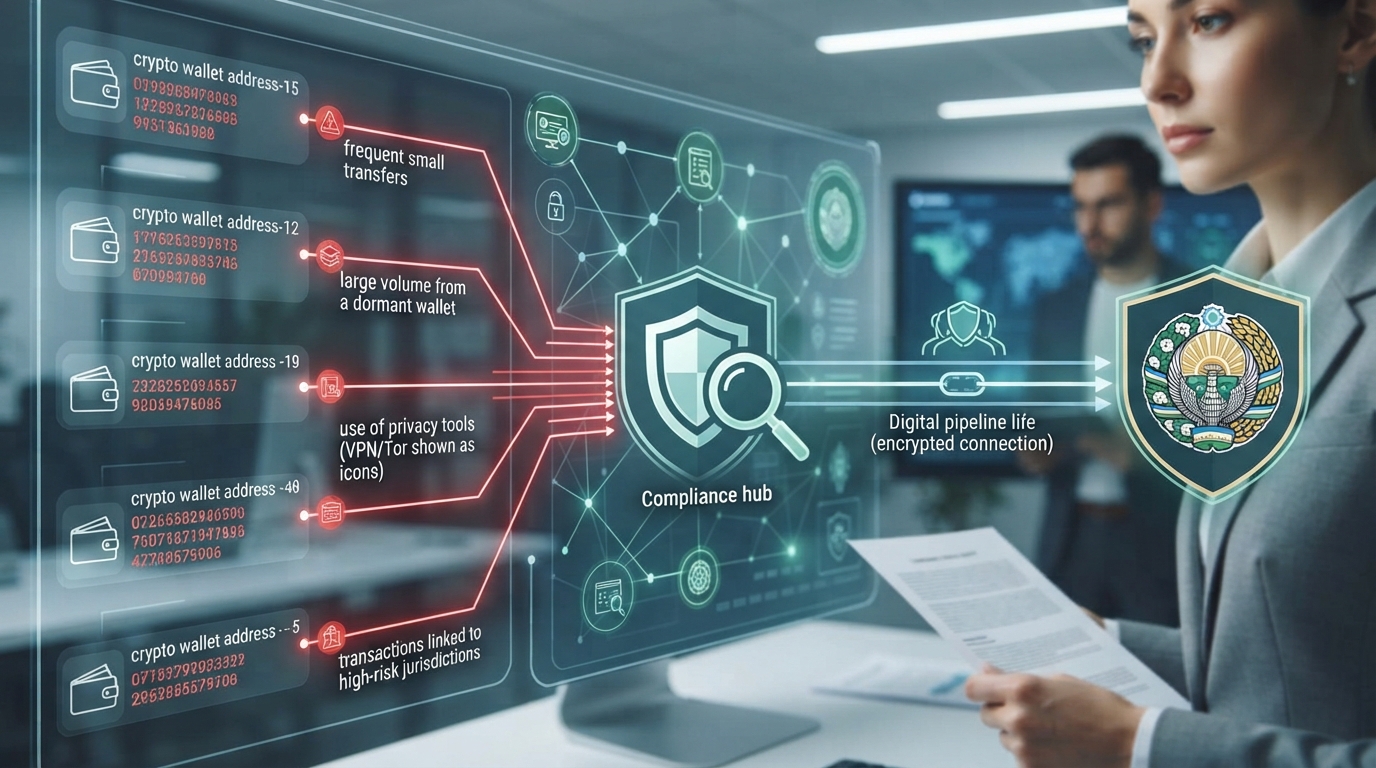
New control requirements may be introduced for crypto-asset service providers in Uzbekistan. This is stated in the relevant draft document, which was released for public discussion on August 12.
Developed by the National Agency for Promising Projects and the Department for Combating Economic Crimes under the Prosecutor General's Office, the draft is aimed at improving internal control in the field of crypto-assets to combat the legalization of proceeds from criminal activities, the financing of terrorism and the financing of the proliferation of weapons of mass destruction.
**The concept of persons related to crypto-assets will be changed**
The draft proposes to replace the term “persons carrying out activities in the field of crypto-asset circulation” used in current documents with the concept of “service providers in the field of crypto-asset circulation”. A service provider is defined as a person who has received a license in the prescribed manner to carry out activities in the field of crypto-asset circulation.
It is also proposed to introduce the concept of “third party” into the rules. According to it, a third party is an organization that provides services for confirming the authenticity of information about a person provided by the authorized bodies of Uzbekistan or a foreign state.
**Appointment of a responsible officer will be mandatory**
According to the draft, the service provider will be required to appoint an officer responsible for internal control against legalization of proceeds from criminal activities within one month after receiving a license. The responsible officer will be appointed from among the deputies of the provider's head. His surname, first name, patronymic and TIN must be sent to the Agency.
In the event of a change in the responsible officer, it is required to notify this no later than the working day of the appointment of the new officer. Also, service providers will be required to submit information to the Agency on the compliance with the requirements of the responsible officer and internal control rules by January 10 of each year.
**Certain persons are prohibited from being directors and participating in the authorized capital**
The draft document also sets out requirements for the directors and responsible officers of service providers. In particular, persons who have participated in terrorist activities or the proliferation of weapons of mass destruction or are suspected of doing so, as well as persons whose convictions for economic crimes, corruption, drug trafficking, crimes related to information technologies and other relevant crimes have not been completed or have not been expunged, will not be appointed to the position of director.
Also, persons permanently residing, staying or registered in countries that do not participate in international cooperation will not be allowed to be directors of service providers. It is proposed that such persons, as well as companies registered in the relevant countries, will also be prohibited from participating in the authorized capital of service providers.
**Criteria for suspicious transactions related to crypto-wallets will be expanded**
One of the main parts of the draft is devoted to establishing criteria for identifying suspicious transactions. According to it, doubts about the authenticity of documents, the lack of a clear economic substance of the transaction, the unreasonable refusal of the client to provide the necessary information, or the inability to complete identification can be considered signs of a suspicious transaction.
In addition, cryptoassets:
* transferred to persons residing or registered in offshore territories;
* regularly sent to different crypto-wallets in the same amounts;
* exchanged several times in a short period of time;
* used in many large transactions within 24 hours;
* moved in large amounts from newly opened or long-unused wallets;
* transferred to private or anonymous crypto-wallets can also be considered suspicious transactions.
Also, suspicious signs include receiving assets from crypto-wallets previously used for criminal purposes, adding large amounts of crypto-assets to the wallet that do not correspond to the client's usual turnover, exchanging crypto-assets for currency at a high commission or at an unfavorable rate.
**IP address and crypto-wallets are also monitored**
The project also provides for taking into account the technological behavior of clients. In particular, the regular use of programs that hide the IP address and provide privacy, opening a large number of crypto-wallets from one IP address, frequent changes in the email address, IP address, domain or identification information about the crypto-wallet owner are defined as criteria for suspicious operations.
The rapid increase in the value of a newly issued crypto-asset, its active circulation only within one crypto-exchange or platform, and the presence of signs of price manipulation can also be monitored. In addition, the absence of a “White Paper” declaration of a newly issued crypto asset or the inaccuracy of the information contained therein is also considered suspicious.
**Risk assessment for new technologies**
It is proposed to impose on service providers the obligation to identify and assess in advance the risks associated with the use of new or emerging technologies. Such an assessment should be carried out before the start of the use of the relevant technologies.
Service providers will also be required to understand the client’s activities, ownership and management structure, identify and verify the client based on reliable sources and documents. It is also envisaged to update the information obtained as a result of due diligence and identification of the client at least once a year.
**Suspicious transactions will be reported no later than the next business day**
According to the draft, the service provider must report this to a specially authorized state body no later than the business day following the day a suspicious transaction is detected. Messages can be sent via electronic systems with cryptographic information protection, a special protected e-mail or a personal account in the system for receiving messages about suspicious transactions of a specially authorized state body.
A requirement is also introduced to immediately report any information confirming or excluding the suspicion of a transaction. In the event that a transaction of a person included in the list is suspended or crypto-assets are blocked, the responsible employee will be required to notify him of this as soon as possible and explain the procedure for restoring the transaction.
We recall that on April 15, the procedure for introducing a special legal regime for regulating the circulation of stable tokens was registered. According to the document, now the possibility of using stable tokens as a means of payment will be created throughout the country.