

Nepal observes national day of mourning for victims of flash flood disaster
Flags flew at half mast on the 13th day since the disaster, the last day of the Hindu mourning period.
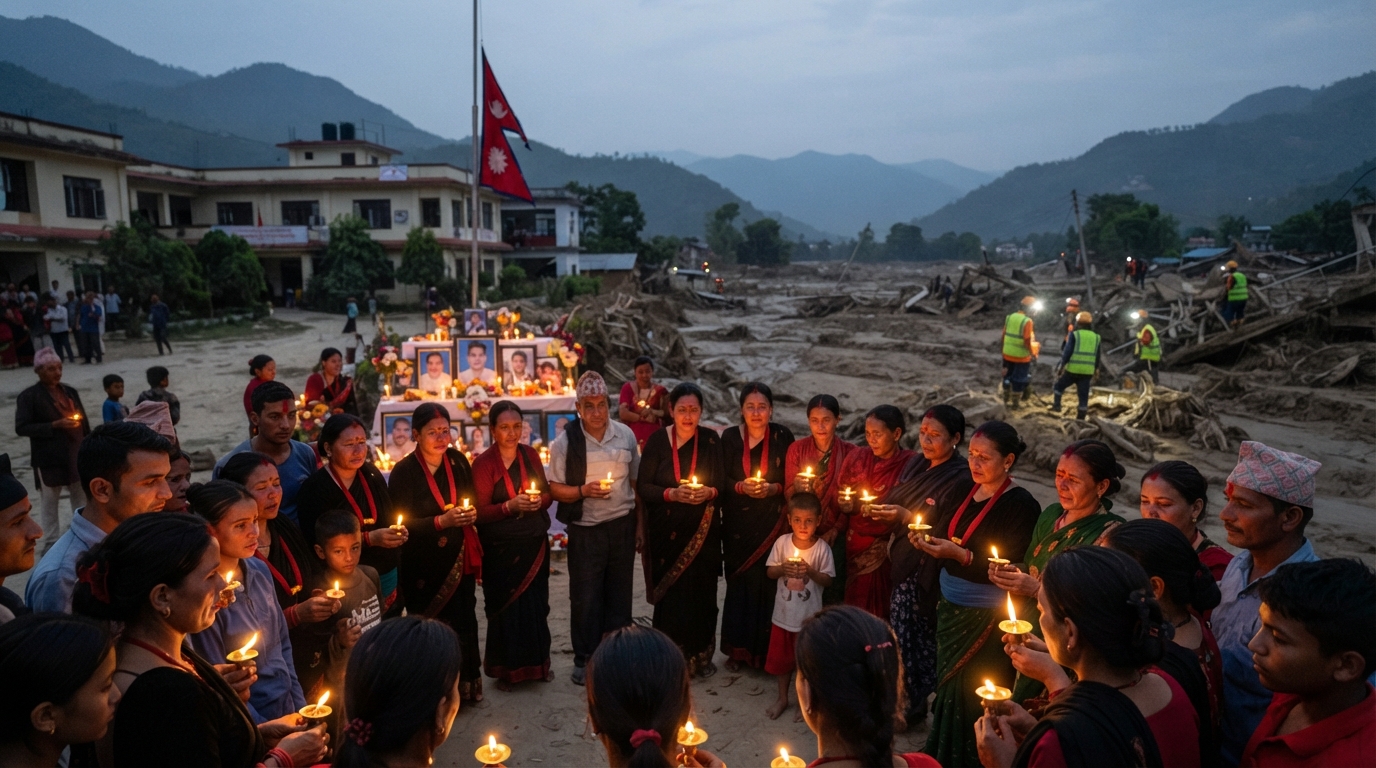
Nepal marks national day of mourning for flash flood victims
Nepalis observed a national day of mourning on Monday for those killed in the flash flood, lighting candles on the final day of the traditional 13-day Hindu mourning period.
Flags were flown at half mast, and commemorations were reduced as rescue teams kept searching for survivors. Candlelight vigils were scheduled for Monday evening.
At least 1,287 people are known to have died after a flash flood, believed to have been caused by a glacial collapse, swept through villages in a Himalayan valley along the border between Nepal and Tibet.
Nearly two weeks on, more than 5,000 people remain missing.
Phanindra Paudel of the National Emergency Operation Centre (NEOC) told the Reuters news agency that there would be "no government programmes organised as the rescue and search operation is still going on in the flood-hit areas."
Nepal's president, Ram Chandra Paudel, visited areas devastated by the floods on Monday, an aide told Reuters.
The home ministry said government offices, along with missions abroad, would fly the national flag at half mast to mark the last day of the mourning period.
Army spokesperson Raja Ram Basnet told Agence France-Presse that rescue operations were continuing "with the same tempo we had on day one".
"Our focus is on search and rescue at three levels - on ground, by air, and in the tunnels," he said.
"We are making sure that no one is still stranded."
One of the few places where rescuers still believe survivors may be found is in tunnels that are part of the region's hydropower stations, where hundreds of workers are among the missing.
Australian tunnel rescue expert Arnold Dix, who is advising Nepali teams, said in an update on X that the operation involved facing "multiple potential rescues, unfolding at the same time, in different places, each with its own dangers, uncertainties and lives that may still be saved."
Four people have been rescued in recent days, three of them at hydropower stations or tunnels.
On Saturday, a 64-year-old Nepali woman was pulled from her buried house more than 10 days after a wall of ice, rock and mud partially buried her home in Nuwakot district.
She was found alive on the fourth floor of the building by Nepal's Armed Police Force and airlifted to a hospital in Kathmandu for treatment.
On Sunday, rescue workers in China recovered twelve bodies on the Nepal-Tibet border, using excavators, shovels and ground penetrating radar at the site.
At least 5,083 people are still missing in Nepal. On the Tibetan side, the death toll reported by Chinese media on Friday was 31, with 531 people unaccounted for.