

"Muruvvat" House Fraud: Man Who Received Loan in Colleagues' Names Arrested
The court considered M.G.'s full confession, remorse for his actions, and his family and financial situation as mitigating circumstances.
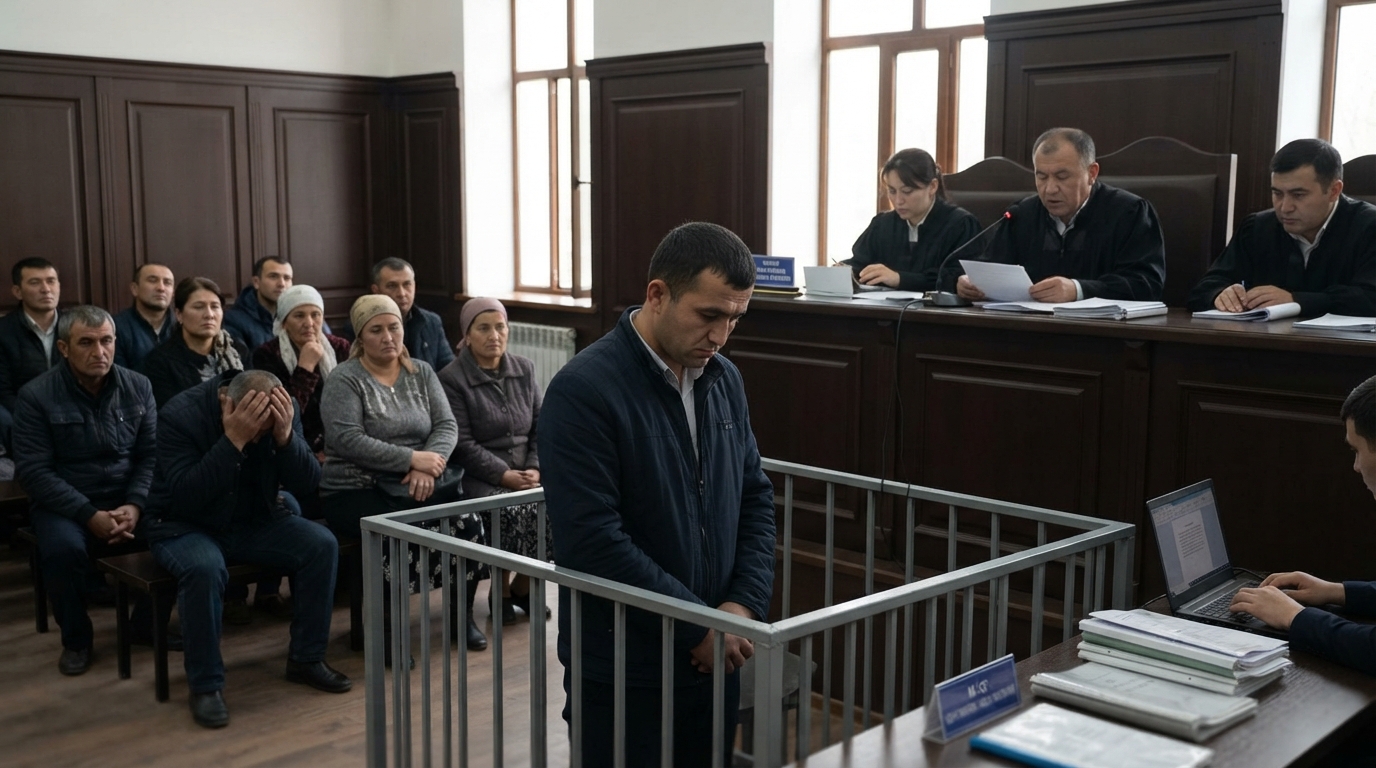
**Fraud at the Muruvvat Home: Person who took out a loan in the name of his colleagues was imprisoned**
A person who secretly issued a loan in the name of employees of the Muruvvat boarding house in Karakol apologized to his colleagues at the court hearing. However, the court, taking into account that he had previously committed a crime and committed his next crime while serving a sentence for a previous crime, sentenced him to a suitable sentence.
Colleagues who worked in the same place trusted each other. Some needed money and asked for help in obtaining an online loan. Some entrusted their passport data, phone number, facial image and other personal information. However, according to the recorded cases, this trust later became a means to secretly issue loans in their names.
The chairman of the Karakul District Criminal Court, Boborahim Ochilov, told Khabar.uz that a number of employees who worked together at the Muruvvat men's boarding house in the district provided their personal information to their colleague M.G. to help them apply for a loan. M.G., in turn, used this information to apply for online loans through various banks and financial institutions without their knowledge.
It is not about one or two million soums. The court verdict indicates that the total damage caused to the 11 victims exceeded 815 million 111 thousand 632 soums.
The most sad thing is that some of the victims did not know for months that a loan had been taken out in their name. Someone went to the bank to vouch for a relative, someone had money debited from their card for a loan payment, and someone else found out that there were debts in their name when they checked their KATM information.
Thus, a simple collegial trust formed at one workplace led to the burden of hundreds of millions of soums of debt on the shoulders of several citizens.
According to court documents, M.G. first helped some colleagues apply for online loans. In the process, he learned all the necessary information about them. Then, by installing mobile applications of banks and financial institutions on his phone, he used this information to apply for loans in their names.
It is important to note here that it is important to distinguish between cases where the victims initially agreed to receive loans and cases where loans were subsequently issued without their knowledge. The court considered it to be the latter actions as a criminal offense.
For example, in November 2023, J.O. asked his colleague for help in obtaining an online loan in his name. M.G. first tried to apply for a loan via J.O.'s phone, but this was not possible. Then he took out a loan in his name via his phone.
Some time later, it became known that J.O. had a bank debt. When he checked his credit history through KATM, he found that several loans had been issued in his name. The court verdict stated that the damage caused to J.O. was 100.6 million soums.
Also, loans were issued in the name of O.N. through various banks and financial institutions, causing him more than 141.2 million soums of damage. The damage to M.Sh. was 126.6 million soums, to X.O. 93 million soums, and to F.D. 73.9 million soums.
— From the testimonies of the victims we gave, it is clear that some of them first trusted M.G. because he helped them in issuing loans. And then it was this trust that caused them to have debts in their names. That is, trust has turned into debt, — says the chairman of the court.
In court, bank employees instructed that in the process of obtaining an online loan, citizens will be required to provide information such as passport data, Social Security Number, phone number, Face ID. In some financial institutions, a special SMS code is sent to the phone number to confirm the contract.
— So, providing personal data to another person can pose a serious risk in itself. Especially if this data, along with bank applications, SMS codes and biometric data, falls into the hands of another person, the risk of obligations arising in the name of the citizen that he is not aware of increases, — continues the chairman of the court.
In this case, the court noted that these circumstances led to criminal consequences.
The court verdict indicated the damage caused to 11 victims as follows: O.N. - 141.2 million soums; J.O. - 100.6 million soums; M.Sh. - 126.6 million soums; X.O. - 93 million soums; F.D. - 73.9 million soums; A.B. - 72.3 million soums; A.N. - 57.8 million soums; S.H. - 50 million soums; T.J. - 39.1 million soums; R.U. - 38.3 million soums and N.I. - 21.8 million soums. A total of 815 million 111 thousand 632 soums 16 tyyins.
It is noted that all the loans were issued in the names of the victims without their knowledge and secretly, and the funds received were spent on the personal needs of the defendant.
In one case, the culprit A.N. A total of about 58 million soums of loans were issued through the National Bank in the name of O.N., part of the money was spent on paying off other loans, and the rest on personal needs.
Also, O.N. received 9 loans through various banks and financial institutions, and about 74 million soums remained unpaid. M.G. has recorded a large number of such criminal acts “on his account”.
Thus, the general situation in the testimonies of the victims is the same: M.G. entered their passport data, facial image, phone number and other information into the banking applications on his phone, and then, in some cases, issued additional loans without their consent. The victims asked the court to recover the damage caused.
According to the testimony of bank employees, the loan agreements stipulate that the citizen himself is responsible for providing personal information to another person. Therefore, the court concluded that the issue of compensation for the bank's losses should be resolved in a civil procedure, not in a criminal case.
According to the indictment, M.G. committed these actions repeatedly, through unauthorized access to and use of information systems. He was charged with criminal offenses related to theft.
The court took into account M.G.'s full confession, remorse for his actions, and his family and financial situation as mitigating circumstances. However, taking into account his previous convictions and the fact that he committed a new intentional crime while serving his previous sentence, it imposed a sentence of imprisonment.
— M.G. was initially sentenced to 5 years and 6 months in prison for this crime. The unserved part of the sentence imposed by the previous court verdict was also partially added, and he was sentenced to 6 years of continuous imprisonment. The sentence will be served in a general regime colony. In addition, the court ordered the recovery of material damage in favor of the victims. The most important lesson of this case is not left in the courtroom: passport information, a phone number or a confirmation code in a bank application, given in confidence, can lead to a citizen becoming indebted to millions of soums in his own name. This incident in "Muruvvat" became one of the painful examples of how big the difference is between trusting a colleague and entrusting him with personal financial information, - said the chairman of the court.