

Mum's plea to end jail terms with no end date after son dies in prison
Theresa Mcrae, from Southampton, is demanding immediate action to end "torturous" indefinite prison terms.
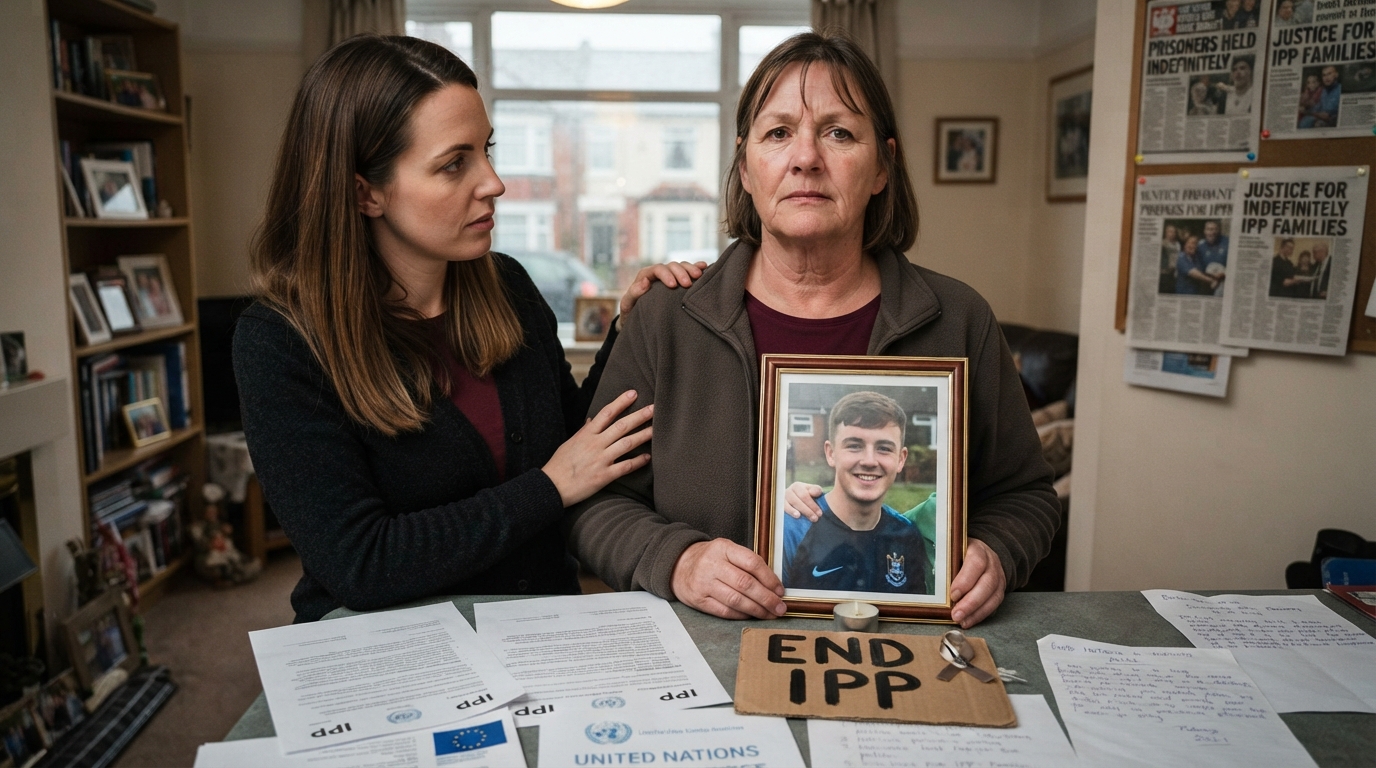
Following the death of her son, Josh, in prison, Theresa Mcrae, along with Josh's cousin Faith Chorley, is spearheading a campaign to abolish Imprisonment for Public Protection (IPP) sentences, which have no fixed end date.
Josh Mcrae was one of five men serving IPP sentences whose cases were recently reviewed by the United Nations. The UN determined that their continued incarceration was "arbitrary."
Theresa Mcrae, who resides in Southampton, Hampshire, stated that "nearly 100 men have ended their lives because they just cannot continue" without knowing when they will be released.
The government has indicated that it has enhanced "rehabilitation and mental health support" for IPP offenders and is "now looking at" additional measures.
Currently, over 2,000 prisoners in England and Wales are being held indefinitely without a set release date.
Josh Mcrae died in prison after serving more than 16 years for grievous bodily harm (GBH). He was a teenager when he received an IPP sentence with a minimum four-year tariff following a pub fight.
A talented footballer, Josh participated in a TV documentary presented by former professional Ian Wright while at HMP Portland, telling Theresa that the final match was the "best day of his life."
He was released on license in 2012 after serving six years. Theresa recalls him being signed by Bournemouth Football Club's second team and playing one match before he was recalled to prison for actual bodily harm.
After nearly 11 more years in custody, Mcrae was found dead in his cell at HMP Long Lartin, Worcestershire, in September 2024.
"Josh's suffering is over, but ours continues, as does the suffering of thousands of other prisoners and families still trapped by this injustice," Theresa commented.
According to the Prison Reform Trust, IPP sentences were introduced in England and Wales in 2005 for individuals deemed "dangerous" but whose offense did not warrant a life sentence. These sentences had a minimum term, but release was not automatic; prisoners had to convince a parole board they no longer posed a threat to the public. If released, it was under strict license conditions, the breach of which led to recall to prison.
The IPP regime was abolished in 2012, but this abolition was not applied retrospectively to those already serving the sentences. The Ministry of Justice (MoJ) stated that those still in prison would need to be resentenced for a fixed term with an automatic release date.
Lord Brown of Eaton-under-Heywood, a former Supreme Court justice, has called the ongoing impact of IPPs the "greatest single stain on our criminal justice system."
Theresa expressed her heartbreak that Josh did not live to see a United Nations (UN) working group conclude last month that he and four other IPP prisoners had been arbitrarily detained.
Among the UN Working Group on Arbitrary Detention's findings were:
* There was no legal basis under international law for the men's continued detention.
* The UK government has "not established compelling reasons to justify their continued detention" or shown that the threat they pose "cannot be addressed by alternative measures."
* Indeterminate sentences created a "structural circularity" where the "psychological harm inflicted... itself generates behaviours and presentations that are relied upon as evidence of continued risk."
This comes as the government plans to release 5,000 offenders from October under new laws to alleviate prison overcrowding. This has generated significant public and political pressure regarding the potential release of PC Andrew Harper's killers, prompting the prime minister to order a review of the plans.
One alternative option to create space is the release of all 2,271 prisoners serving IPP sentences.
Referring to the early release scheme, Theresa said: "What a kick in the teeth to IPP prisoners, who cannot get out for love or money, they've been taking spaces up in prison for years."
"My message to the government is why can you not see how wrong, inhumane, torturous, impossible a sentence these men are having to endure?"
Josh's cousin, Faith Chorley, described him as "funny, kind and a lovely soul" and added that "he always wanted to be strong for his mum."
She said: "But it's the not knowing his date of freedom, not knowing when that torturous sentence was going to come to an end - it did impact him massively. He wanted to fight, just like we're fighting now, and he wanted to stand up for everybody who was in the same position as him, everybody who didn't have hope. He never got married, never had children, never drove a car, never went on a plane and it's not right."
Faith added: "They're destroying their souls and that's what happened to Josh and it shouldn't be too late for anyone else now."
In October, the women hope an inquest into Josh's death will determine how he died in his cell.
A Government spokesperson stated: "While we cannot comment on individual cases, it is right that IPP sentences were abolished. As the IPP annual report shows, support has significantly improved for these offenders, with greater access to rehabilitation and mental health support. We are now looking at what more can be done."
The MoJ added that there has "never been a finding in the European Court of Human Rights or in UK domestic courts that the IPP sentence was, or is, unlawful." It also noted that the number of people serving IPP sentences in the community has decreased from 3,018 in December 2023 to 891 in December 2025, and that over a thousand recalled prisoners have been released in the past two years.
Barristers from Great James Street Chambers are preparing to take High Court action against the UK government, seeking to have ongoing detention under IPP declared unlawful.