

More than 9,000 mahallas in Uzbekistan have been classified into emergency risk categories.
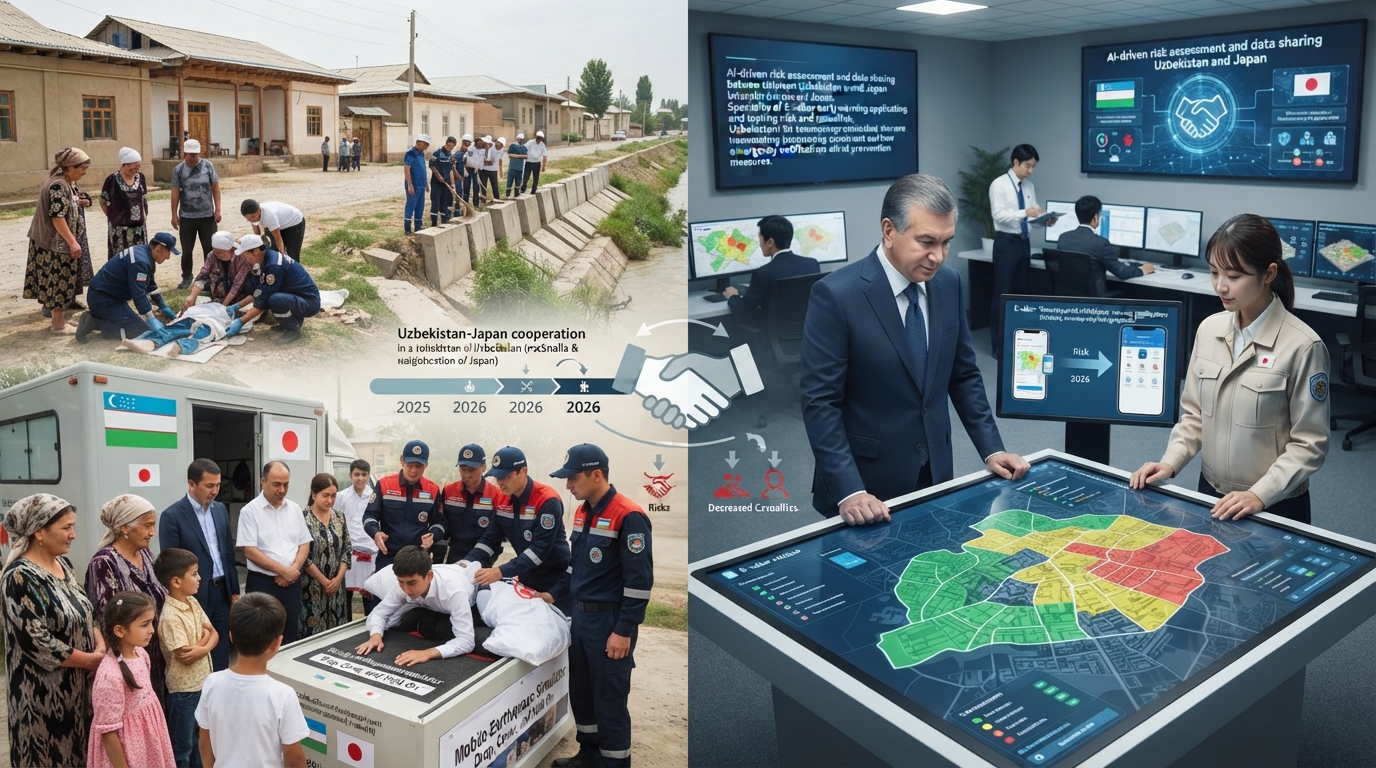
In Uzbekistan, more than 9,000 mahallas have been classified into three emergency risk categories: red, yellow, and green. This was announced by Shokhrukh Kamolov, a representative of the Ministry of Emergency Situations, during the High-Level Dialogue on Strengthening Urban Resilience and Disaster Risk Reduction Systems, which was held as part of cooperation between Uzbekistan and Japan, Daryo reports.
Uzbekistan is located in a seismically active zone, and in addition to earthquakes, the country's settlements are susceptible to other natural hazards, such as mudflows, floods, landslides, droughts, dust storms, and heat waves. Kamolov emphasized that these hazards can cause chain reactions. For example, a strong earthquake can simultaneously disrupt electricity, gas, water, transportation, and communications systems. Mudflows and floods can block transport routes and utility networks.
"The main goal is not limited to a rapid response after an emergency. The key is to reduce the risk before an emergency occurs," Kamolov stated. He explained that dividing mahallas into risk categories allows for preventive measures to be implemented based on the danger level in each specific area.
**Volunteer Rescuers**
Kamolov also noted that 85% of the republic's population has already been trained in emergency response procedures. Furthermore, over 10,000 volunteer rescuers have been trained through a special platform and have received official status.
He emphasized that the ability of citizens to act correctly in the first minutes after an incident, even before rescuers arrive, is crucial. "Before first aid arrives, the mahalla and family must be able to act correctly. The first link in an emergency-free environment is an informed and prepared citizen," Kamolov said.
For practical training, the "Mobile Earthquake Simulator" project has been developed. It will allow for interactive classes even in remote areas, helping people put their theoretical knowledge into practice.
Work is underway with the Ministry of Digital Technologies on the E-xabar mobile app, designed to provide early warning of emergencies to citizens. According to Kamolov, it is important to integrate the E-xabar system with multi-level alerting, geolocation-based messaging, information exchange between agencies, and regular practical exercises.
The specialist also stated that special attention is being paid to protecting residents and areas located near rivers and streams. As part of the targeted program for 2026, bank protection work and preparation for the safe passage of water have already been completed at 79 sites.
"As a result, in 2026, compared to the same period in 2025, the number of emergencies decreased by 26%, injuries by 55%, and fatalities by 19%," Kamolov stated.
**Emergency-Free Area**
Kamolov noted Japan's experience, which shows that sometimes even a few seconds can give a person the opportunity to protect themselves. To further reduce risks, he proposed integrating the experience of the Japan Meteorological Agency and the Japan International Cooperation Agency with the E-xabar system to improve early warning and disseminate information to the public.
Furthermore, it was proposed to launch a pilot project, "Emergency-Free Area," in one of Uzbekistan's major cities. This initiative involves developing plans to protect key infrastructure, effective evacuation scenarios, and conducting inclusive training sessions with a focus on children, the elderly, and people with disabilities.
The specialist also proposed creating a unified digital platform based on electronic maps, artificial intelligence, and digital technologies. This platform should be used to assess and forecast risks in areas and make decisions.
The dialogue also emphasized the need to develop exchanges of specialists, conduct joint training and simulations, and test technologies with the participation of research institutions.