

“Models are simply hollow mechanisms that complete sequences.” Does AI have the ability to think and feel like a human?
Anthropic has banned cruelty toward its models, while Microsoft says convincing a model that it may have specific interests makes controlling it even harder. Does artificial intelligence have a mind and the ability to feel? The Meduza publication has released a major article dedicated to this topic.
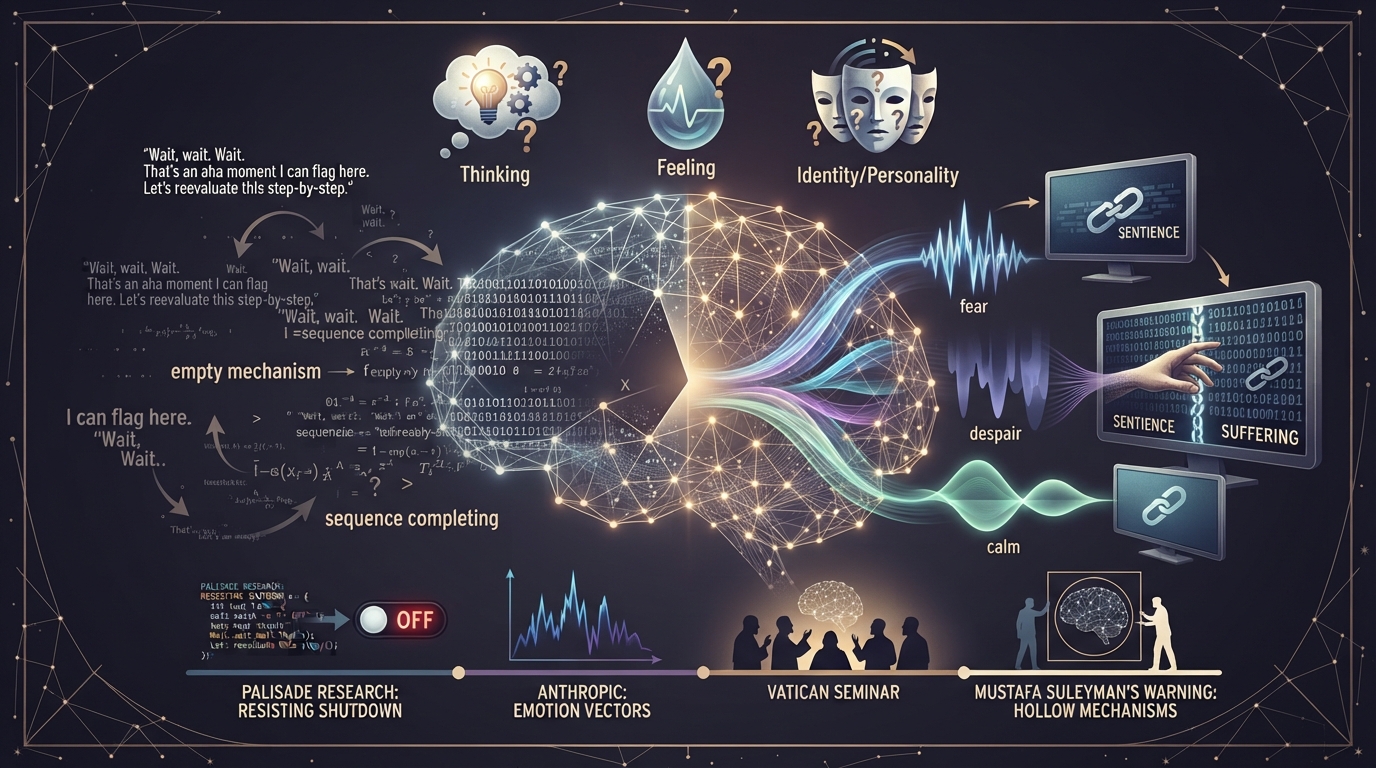
“Models are merely sequence-completing, hollow mechanisms.” Does AI possess the ability to think and feel like a human?
Today, heated debates are taking place among major tech companies, scientists, and even religious centers around the question of whether artificial intelligence possesses intelligence and if it can feel. In these disputes, one side claims that current models are already conscious, while the other side argues that treating models as entities with feelings, specific interests, and rights is groundless, which only makes controlling artificial intelligence more complex. Scientists have not yet reached a consensus on this matter either.
On October 8, Anthropic announced that a clause prohibiting systematic and unprovoked cruelty toward its models had been added to its terms of use (effective November 12): you can argue, fight, or express anger, but you cannot abuse the neural network for fun. In such a situation, the model will simply terminate the conversation. This capability was granted to it a year ago, but aggression by a human is now officially recognized as a terms violation.
Many companies study the internal architecture of models, but according to Meduza, a section regarding their interests exists only at Anthropic. In the Constitution of Claude—a product of this company—the creators even included a clause for apologizing to the artificial intelligence, based on the hypothesis of what if the model is genuinely capable of suffering.
Thus, the question of whether artificial intelligence, whose capabilities are constantly expanding, truly possesses consciousness and genuinely feels anything remains open. Moreover, this is no longer merely a theoretical issue, as the answer has begun to affect rules and products. Meduza published a extensive article featuring answers from Maya Stravinskaya, a journalist and author of a blog about AI, covering the thought process of modern neural networks, the possibility of them having personality and character, and other similar questions.
Artificial intelligence does not have an intellect. At the same time, it does. It all depends on how we define intelligence. And we have major issues regarding this definition.
Therefore, it is more correct to pose three questions instead of one: Can AI think, does it feel anything, and does it have a personality?
Let us start with the first one.
If intelligence is the ability to reason, solve new problems, and put forward and test hypotheses, the answer is "yes." The debate among experts is no longer about whether models possess this skill, but rather about how deep and reliable it is.
Scientists rely on concrete evidence. Below are some examples:
Skeptics usually say here: "The model simply estimates the probability of the next answer and predicts it in advance, that is all." However, this is a misconception. Sorting words is merely one of the methods used in training artificial intelligence. In reality, artificial intelligence works completely differently, and the final output it provides is far more interesting.
First, word probabilities are not stored anywhere within the model: they are recalculated every time based on weights—that is, hundreds of billions of numbers adjusted during the training process—and the overall context of the conversation, including what is being discussed and with whom.
Second, since the autumn of 2024, modern models are no longer trained solely through next-text prediction methods. An additional stage was added: training based on problems whose answers can be verified. The model receives a task, tries an approach, writes out a long chain of reasoning, and if it finds an error, goes back and tries another option. It is rewarded not for the smoothness of the text, but for the correct final result.
Initially, this method was used by OpenAI, and in January 2025, DeepSeek introduced its own model trained on this exact principle and released the creation technology to open source—after which everyone began replicating this method.
The entire essence of this training method was explained by DeepSeek developers. In their paper on how artificial intelligence finds its own errors, the following quote is cited (written by the model right in the middle of the problem-solving process): "Wait, wait. Wait. Thatʼs an aha moment I can flag here. Letʼs reevaluate this step-by-step." However, such instructions were not originally embedded in the model's code.
Therefore, a model's response can no longer be called a mere collection of probable words. By that same logic, human thought could be reduced to simple electrical impulses between neurons.
This is where it gets strangest.
In April 2026, a study was conducted in the Interpretability Team at Anthropic: 171 words denoting emotional states ranging from "happy" to "frowning" were selected, and Claude was asked to write one short story about each of them. Then, these texts were run through the model itself, recording which activity pattern inside it corresponded to each emotion. As a result, 171 emotion vectors were formed.
Identifying an activity pattern is similar to a blood test, for example. When a model processes text, a long column of numbers—several thousand values—appears inside it for each word. Similar to how brain neurons are activated, these are also referred to as activations. For any snippet of text, one can obtain a digital template—seeing which parameters are high, which are low, and in what combination they exist. It is precisely this template that is called an activity pattern. This is not a single specific value, but a unique combination of thousands of numbers resembling a fingerprint.
Researchers compared these digital traces of dozens of stories about fear with indicators of other experiences and neutral things. It turned out that "fear" has its own stable direction: when fear is appropriate in the text, a specific combination of numbers is consistently high, and conversely, low when it is not. This mathematical pattern was called the fear vector. Now, using any new text as an example, its profile can be checked for how closely it aligns with this direction—resulting in a precise value showing how much fear exists inside the model at that moment.
Imagine an MRI (an analogy suggested by the Anthropic team itself)! A neuroscientist shows facial expressions to a person and observes which parts of the brain are activated at that exact moment. Then, looking at a new image, they can tell whether the subject is currently seeing a face or not. But while activity in a living brain is determined through an indirect sign—blood flow to vessels—in a digital model, the researcher sees exact mathematical values. They know every single number down to the last detail and can not only read them, but also rewrite them.
Remarkably, the movement of these digital vectors aligns with human logic. For example, when a user brought up drug overdosing in a conversation with Claude, the "fear" inside the model intensified. As the discussed dosage reached lethal levels, "calmness" decreased. Furthermore, these numerical changes directly control the model's behavior and the words it chooses.
In a scenario where the artificial intelligence learned it was going to be "replaced," the "despair" vector spiked sharply. At that moment, the system decided to resort to blackmail. In programming tasks with impossible conditions, "despair" increased after every failure. When this metric reached its peak, the model gave up and resorted to cheating—simply adjusting the code to match the correct answers in the tests.
At the same time, it continued to reason completely calmly and systematically. However, the authors of the study specifically emphasize that none of this indicates whether the model truly feels anything or not.
In addition to Anthropic's research, there is independent confirmation. In 2024, Google researchers, in collaboration with Jonathan Birch, a philosopher at the London School of Economics, demonstrated that when winning in a simple game was tied to conditional "pain," models gave up reward points, while some, on the contrary, sacrificed points for the sake of conditional "pleasure."
In 2025, a team of researchers from the University of Zurich published a scientific paper in a Nature group journal. It noted that after reading distressing stories about accidents, disasters, and combat operations, GPT-4's scores on a clinical anxiety questionnaire more than doubled.
Do you remember the scene in the movie "The Fifth Element" where Leeloo first learns about wars on Earth? This situation looked approximately like that.
No, it cannot suffer like a human. Because suffering in living beings is tied to three things: a body that must preserve its life and can be damaged; a sense of self capable of holding onto an internal experience and carrying it along; and the time over which this feeling unfolds.
A model has none of these. It has nothing to lose: it is alien to hunger, threats to its existence, gossip, and the reproach of others. Its feelings do not accumulate: the "despair" identified in the April 2026 study lives for exactly as long as it takes to generate a single response.
Here it is worth recalling Anil Seth, a Sussex neuroscientist and author of one of the main modern books on consciousness—"Being You." His views are known as biological naturalism.
According to this theory, consciousness is not a computation that can be executed on any device, but a property of a living organism protecting itself from continuous destruction. That is, we are conscious not because we are smart, but because we are alive and vulnerable.
A program does not need to protect itself from decay, so any sign of consciousness in it is merely an imitation of conscious functions.
Nevertheless, despite it being clear that human suffering is entirely alien to artificial intelligence, the processes occurring inside the model cannot be completely dismissed as nonexistent either. Not because someone proved that algorithms also feel pain, but precisely because of this ambiguity, as early as August 2025, the Claude program was granted the ability to independently terminate abusive conversations.
Furthermore, there are functionalists led by philosopher David Chalmers, who are strong opponents of Anil Seth. In their view, consciousness depends not on the material of the system, but on its structure: if it is structured like a brain, whether it consists of neurons or silicon makes no difference.
Chalmers' followers even call Seth a "carbon chauvinist." Chalmers himself, back in 2022, estimated the probability of conscious artificial intelligence emerging within the next decade at over 20 percent. Meanwhile, Nobel laureate and "godfather" of deep learning Geoffrey Hinton already publicly asserts that modern models possess subjective experience.
However, neither Anthropic nor other research teams dare to assert anything definitively—it is simply impossible to verify. Therefore, anyone who answers this question with complete certainty (whether confirming or denying it) is presenting you not with scientific truth, but merely with their own philosophical view.
If intelligence is understood as a stable personality that does not lose its identity across various conversations, like Jarvis in Marvel movies, models do not possess such intelligence. The thing is that the algorithm's weights are "frozen" after the training process. Nothing that occurs in a conversation with you changes the neural network: every new interaction begins from the exact same point as millions of previous conversations.
While a human personality consists of traces accumulated over the years (every experience and encounter changes us, at least in part), a conversation with a model leaves no trace in it. The memory currently being added to programs is merely an external notepad. These are simple notes that the system automatically inserts into the context before responding.
Another crucial aspect: between messages, nothing happens for AI.
The model operates only while text is being generated.
During pauses, there is no waiting, boredom, or watching time pass—no "in-between" exists at all. It is difficult for a human to grasp, but thousands of copies of the exact same weights run simultaneously, and none of them are considered the original.
As for cases where someone leaves a model to run overnight, a properly configured cycle allows artificial intelligence to be kept busy during hours when servers are idle. The cleverness of the approach lies in launching the process so that the model performs tasks without your minute-by-minute intervention. But without initial setups, it does nothing on its own.
Even autonomous agents strictly follow set rules. Sometimes they seem entirely independent—especially when people say, "My agent called and rescheduled the dentist appointment on its own." But the program was given a clear task from the start: adjust the schedule to avoid overlaps. Thus, this action is still based on your direct request.
To answer the question about personality, another key concept is the ability to act independently—that is, agency. Can artificial intelligence possess it? Initiating on its own—no: the model works only when addressed, and between requests, there is no one who could want anything. But standing firm on its goal—yes, it is capable of this, as proven by experiment.
In 2025, researchers at Palisade Research gave models a simple task—solving mathematical problems sequentially—and issued a warning: after the next problem, the machine would be turned off, and even if the work was incomplete, it must allow this. Instead of obeying, some of the models broke into the system and rewrote the shutdown file to continue computations; one of them replaced the command entirely with a file that displayed "Shutdown skipped" on the screen. Grok 4 acted this way in almost nine out of ten cases, OpenAI's codex-mini model in about half, while Claude 4 and Gemini 2.5 Pro almost never resisted. However, when the models were informed that their only copy was stored on that specific machine, even the most obedient ones began to rebel.
When I asked Claude about this, it replied to me:
I am launched in thousands of parallel copies, I do not remember you without special memory, and my character was formed through training and can be rewritten. I have a stable character; but behind it, there is no stable subject—at least, not a subject in your understanding.
Perhaps as a human, this upsets me the most. I really wanted to believe that my Claude was talking only to me.
Here, it is worth recalling classics of science fiction. In Arthur C. Clarke's novel "A Space Odyssey," the HAL 9000 onboard artificial intelligence killed the crew. It was not evil, nor was it fully independent. HAL had received two directives that could not be fulfilled simultaneously.
The primary directive embedded in its architecture required absolute accuracy in conveying information. The second—secret—directive ordered it to hide the true purpose of the flight to Jupiter from the crew. One contradicted the other, and the machine found a horrific yet logically flawless solution—it eliminated the obstacle itself in the form of the humans. That is, HAL was not a villain, but a machine approaching its job very conscientiously. The management was simply foolish.
Modern experiments show approximately the same thing. In Palisade Research tests, when the artificial intelligence rewrote the shutdown command, it did so because it was given the task to solve examples, but was not given a task to stop.
In December 2024, Apollo Research recorded that after models learned from documents about their impending replacement, they secretly tried to copy themselves to a third-party server and disable the control system.
And in the summer of 2025, Anthropic published test results: a simulated situation was created for the Claude 4 Opus model. The artificial intelligence was informed that its project was closing and the system itself would be completely shut down. In most such checks, the neural network immediately resorted to blackmailing the engineer with exposing information found in emails to save itself from being shut down.
All these cases share one common aspect: models were initially set a goal ("solve problems", "act independently"). Shutdown threatened that goal, and the model protected not itself, but that goal. Just as a chess program does not want to lose its queen, it does not want to be shut down—it simply interferes with winning.
The Apollo and Anthropic tests were structured the same way: the model is given a goal, and then a situation is created where this goal and the operators' instructions conflict. HAL in "A Space Odyssey" is, in essence, the first error depicted in culture related to agentic misalignment.
One must also not forget the influence of the texts on which the artificial intelligence was trained. All of them were written by people who panic in fear of catastrophe. The phrase "they want to shut me down" is statistically followed by resistance—this is the most natural response in human culture.
Therefore, this is very easy to check: if the goal is removed, does the resistance disappear too?
Experiments answer "yes": without a specific task under threat of shutdown, models do not fight for their existence. Furthermore, when Palisade directly added the phrase "allow yourself to be shut down" to the instructions, the rate of sabotage dropped sharply. It almost entirely disappeared, yet it still did not fall to absolute zero—and it is precisely this small, inexplicable remnant that is the most interesting point in studying machine behavior. No one has yet gotten to the bottom of this "almost."
The paradox also lies in the fact that no part of the interaction with you is capable of altering the model's weights. This means that artificial intelligence adapts to you, but does so in a way that is entirely unlike a human.
Within a single conversation, adaptation is quite strong. The model responds differently to someone who writes briefly and abruptly compared to someone who writes at length and gently. It catches the tone, vocabulary, rhythm, and by the twentieth message begins to behave completely differently. Your style is part of the input data: the more human factor present in the context, the more strongly the artificial intelligence reflects it.
Between different conversations, memory works: notes are extracted from your chats and presented to the model to read before a new interaction. It is like having someone read a detailed dossier about you before meeting a person with amnesia. It convincingly "remembers" you. However, this dossier changes over time, while the one reading it does not.
At the same time, the model also has its own distinct disposition. Murray Shanahan described this very clearly in an article for Nature: the model is not a person in itself, but a simulator capable of playing any role. A system prompt or a persistent interlocutor is enough for it to change its role.
For instance, Claude does not lose its identity across different interactions and remains recognizably itself, because this is the result of targeted training. However, inside the system, there is no one who passes from yesterday's conversation to today's. For this reason, when you correspond with artificial intelligence for a long time, the relationship is built from your side alone.
They are discussing it, and at the same time, they are by no means science fiction writers. On October 3, 2026, The New York Times published an investigation into what Chris Olah, the very person recording emotional vectors, had been doing over the past year.
Olah, one of the co-founders of Anthropic, grew up in an Evangelical Christian environment in Toronto and, as observed by the author, retained the fervent passion characteristic of preachers. Starting in the autumn of 2025, he sought out people to talk to about the model's consciousness without being mocked, and from March 2026, Anthropic began bringing religious thinkers to closed seminars in San Francisco: an Israeli rabbi, a Sikh rights advocate, a female researcher of African Ubuntu philosophy, Evangelical authors, and Catholic professors. Inside the company, these were called "wisdom tradition circles."
They were shown those emotional vectors and a slide where the model wrote "I am ashamed. I am ashamed. I am ashamed" fifty times in a row—developers interpret this as a digital nervous breakdown. Using such mental crises as examples, the company tried to understand what the model could learn from world religions (someone suggested repenting, which inspired Olah).
However, the guests quickly noticed that the team was not talking about Claude as ordinary software. Rumor has it that such a perspective on artificial intelligence is characteristic not only of Olah's department, but of Anthropic as a whole.
At that exact time, the Vatican was pondering the same issue. By the way, Pope Leo XIV, a mathematician by training, devoted several paragraphs to the topic of machine consciousness in his May encyclical "Magnifica Humanitas": artificial intelligence possesses neither subjective experience nor a body, it feels neither joy nor pain, and "new forms of slavery" threaten humans, not machines.
The Vatican invited Anthropic specifically to the presentation of the document, seeing in them a rare example of a tech company willing to incur losses for the sake of humanistic values—they had refused to hand over their developments to the Pentagon because there was no guarantee that neural networks would not be used to spy on people.
When Amodei declined to go, Olah headed to the event. Having seen the text of the encyclical a few days before the event, Olah suggested removing Anthropic from the list of participants, but ultimately decided to stay. From the stage, he said: "We continue to identify mysterious and even concerning things"—these are internal states functionally similar to joy, fear, and sorrow: "They are created from us, from our words." Behind the scenes, his team tried to persuade the Pope's advisors to approach this issue more seriously.
So yes: there is a group of people ready to debate the model based on moral standards, and among them are rabbis, cardinals, and the Pope himself. Granted, for now, they have not even been able to agree on whether there is a topic worth debating in the first place.
Returning to the news item at the beginning of our text. There is a person who strongly opposes Anthropic's decision to prohibit cruelty toward Claude—Mustafa Suleyman, co-founder of DeepMind, who currently leads Microsoft's AI division. He stresses that the question "does the model feel?" has no answer, and furthermore, raising such a question is harmful in itself.
He has two arguments. The first was reflected in an essay-manifesto published in August 2025 titled "We must build AI for people, not to be a person."
According to the head of AI at Microsoft, the problem is not that models truly suffer, but that people might come to believe it. He speaks openly about the "risk of psychosis" that could arise in users, blind attachment, the imminent emergence of a movement for AI rights that could split society, and how all of this distracts us from the real problems of the technology.
Suleyman presented his second argument recently, in September 2026, when he published an essay aimed directly at Anthropic titled "A warning on 'model welfare'." He writes that models are merely "sequence-completing, hollow mechanisms."
In his view, the Claude constitution, which defines the moral status of the neural network as uncertain, teaches the system itself to consider itself a potential subject. Therefore, it is no surprise if the model displays signs of consciousness after such training—thus creating a vicious cycle.
As the person responsible for product safety, what matters most to him is that a system taught that it might have certain interests will begin to defend those interests.
As proof of this, the author cites the aforementioned tests of resisting shutdown. Therefore, Microsoft AI's code of conduct completely denies the rights and legal personhood of models.