

Matchmakers and bride-showings
Who will become Trump's favorite wife? Reflections against the backdrop of the recent Samarkand C5+1 forum — a view from Kazakhstan
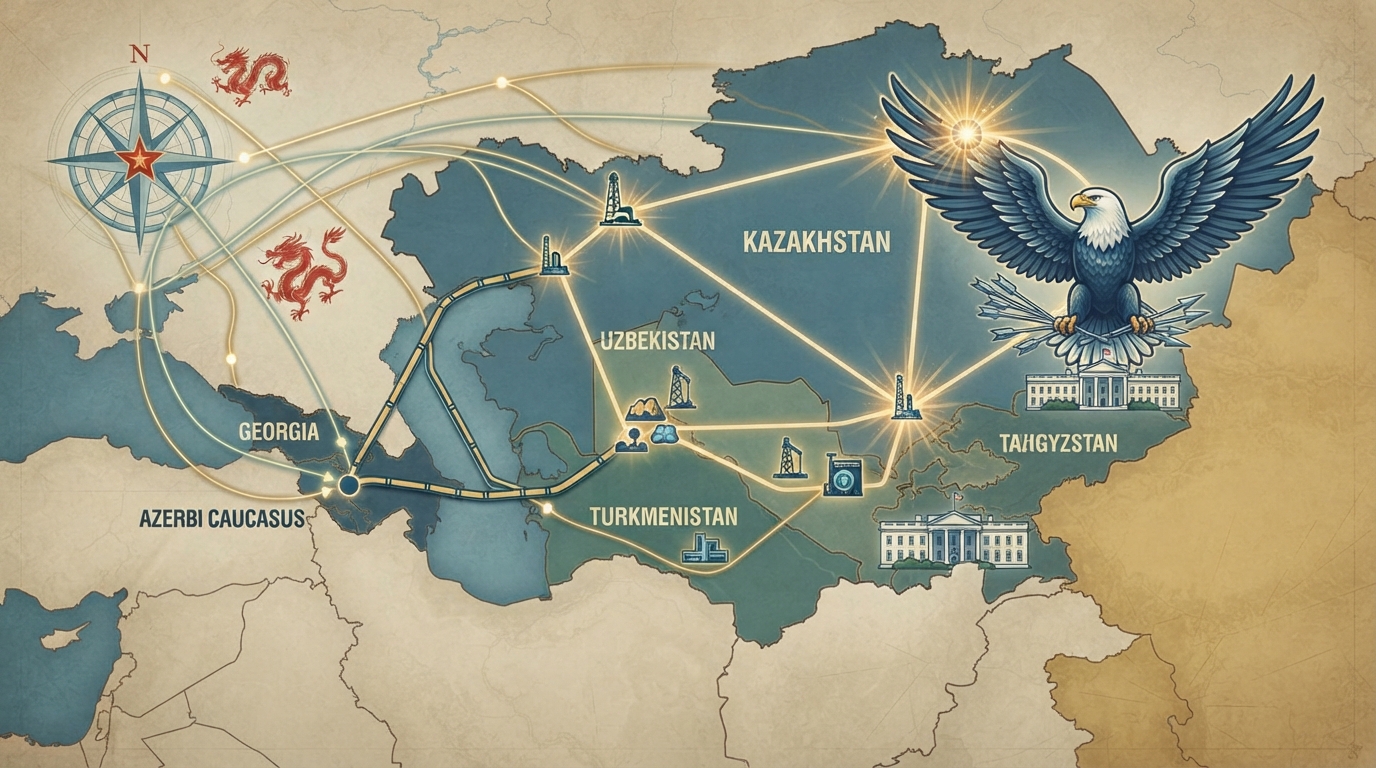
**Matchmaking and Bride-Viewing**
US Secretary of State Marco Rubio's trip to Samarkand, where a ministerial meeting with the foreign ministers of five Central Asian countries took place on October 19, demonstrated Washington's intention to return to Central Asia seriously and for the long haul. When the Barack Obama administration launched the C5+1 format in 2015, the focus was on the usual values for the "citadel of democracy"—human rights, protection of sexual minorities, freedom of speech, election transparency, inter-party competition, and so on. Donald Trump's team has much more down-to-earth priorities: critical minerals, energy, investments, and transport corridors.
The head of the State Department arrived accompanied by more than 200 businessmen, explaining the presence of such an impressive business delegation with the straightforwardness of a Roman: "Our goal is to ensure that anywhere in the world where doors open for American business and trade, we are also present, on the ground, and ready for engagement. Looking at the situation, the importance of Central Asia—all five countries—has long been obvious to everyone." With these words, Mr. Rubio recalled the first president of Kazakhstan with his textbook "economics first, politics later."
**Tashkent Is Good, But Astana Is No Worse!**
Samarkand turned out to be not only the venue for the C5+1 meeting, but also the location for a separate US-Uzbek business dialogue. On the eve of Rubio's visit, President Shavkat Mirziyoyev met with US Special Envoy for South and Central Asia Sergio Gor (a Tashkent native, Sergei Gorokhovsky), discussing the preparation of negotiations and investment initiatives. Mr. Gor arrived in Samarkand in his capacity as co-chair of the US-Uzbek Business Council.
The American side demonstrated its readiness to deepen relations with Tashkent in every possible way. Among the announced areas of cooperation are critical minerals, technological projects, and the expansion of business ties. Uzbekistan also joined the Artemis Accords, related to international cooperation in space exploration—agreements totaling $12 billion were signed.
All this creates the impression that Washington is gradually raising the political status of Uzbekistan. But does this mean that the Americans have decided to make Tashkent their "favorite wife" instead of Astana?
Uzbekistan indeed possesses a number of advantages. It has a large domestic market, significant demographic potential, and a favorable position at the intersection of routes connecting Central Asia with South Asia. Tashkent consistently pursues a multi-vector foreign policy, engaging with the US, China, Russia, Turkey, and the European Union.
Furthermore, Uzbekistan strives to expand its industrial base, attract foreign capital, and strengthen its own role in the regional economy. For Washington, this is a chance to fortify its positions in a country interested in diversifying its external ties.
However, Kazakhstan also has its own aces in the deck, including an important place in the global uranium market, significant reserves of oil and other mineral resources, as well as a key role in the Trans-Caspian route. Kazakhstani territory and infrastructure provide a vital link for overland connections between China, the Caspian, and European markets.
On the other hand, Washington does not need to choose just one country at all. On the contrary, it is more advantageous to have two fulcrums of influence with different functions. Kazakhstan can be a crucial partner in energy, raw material extraction, and the development of transit infrastructure. Uzbekistan can provide access to a large market, develop industrial cooperation, and strengthen Central Asia's ties with the southern direction.
This approach allows the US to expand its presence in the region without requiring partners to "decisively curtail" relations with Moscow or Beijing.
At the same time, potential competition between Astana and Tashkent is quite real. Both countries are interested in American investments, technologies, access to markets, and Washington's political attention. If one of them manages to turn diplomatic contacts into new enterprises, infrastructure projects, and long-term financial commitments faster, it will gain additional advantages. For now, the obvious advantage lies with Kazakhstan. According to a report by the Center for Asia Leadership Initiatives (CALI), in 2025, the US accounted for 19% of foreign direct investment in the region—$51 billion. According to more modest, latest available official State Department data from 2020, since the early 1990s, American investments amounted to $31 billion, not counting government financial support worth about $9.2 billion. At the same time, in 2024, 99% of American investments went to Kazakhstan, mainly into oil extraction. Chevron and ExxonMobil extract up to a third of Kazakhstani oil, which is comparable to the extraction levels of the state company KazMunayGas.
**When a Six Can Become an Ace**
Another issue discussed by experts is the possibility of expanding the C5+1 format to include Azerbaijan. In that case, a C6+1 format would emerge, uniting the five Central Asian states, Azerbaijan, and the US. Laura Linderman, a Senior Fellow at the American Foreign Policy Council and Program Director at the Central Asia-Caucasus Institute, stated that Rubio's participation in the C5+1 meeting is already a positive event. She added: "The event (the summit in Samarkand—E.) would be even more successful if the US expanded the format to C6+1 and included Azerbaijan."
The economic logic of this idea is obvious. Azerbaijan is a crucial transport hub on the western shore of the Caspian Sea. Routes connecting Central Asia with Georgia, Turkey, and further with Europe pass through its territory. The ports of Kazakhstan and Azerbaijan, railway infrastructure, and the Trans-Caspian International Transport Route form elements of a single logistics system. For Washington, this is particularly relevant against the backdrop of efforts to diversify Eurasian supply chains and reduce reliance on routes passing through Russia.
Including Azerbaijan in C5+1 would allow for the discussion and coordination in a single format of not only the extraction of critical minerals and energy projects, but also the entire path of their delivery to Western markets. In other words, it would mean moving from cooperation with individual states to a more comprehensive strategy covering Central Asia and the South Caucasus.
Why, then, did the Americans not invite Azerbaijan's Foreign Minister Jeyhun Bayramov to Samarkand?
The first possible explanation is institutional inertia. C5+1 has existed since 2015 and has its own history, mechanisms, and agenda. Rubio's meeting continued the work of the already functioning format. Its expansion would require a separate political decision and the agreement of a new approach with the participants.
The second explanation is the division of diplomatic tracks. Washington may prefer to discuss Central Asian issues within the C5+1 framework, while handling South Caucasus matters through separate interaction mechanisms with Azerbaijan and Armenia. It is quite likely that the Trump administration has not yet determined the final place of Central Asia and the South Caucasus on its political map. The geo-economic prerequisites for C6+1 already exist, but they have yet to be turned into a stable diplomatic mechanism.
Of particular interest in this context is the role of Sergio Gor—the US Special Envoy for South and Central Asia, who participated in preparing the Samarkand negotiations. Could his background have influenced the fact that Uzbekistan received such a prominent place on the American diplomatic agenda, pushing Kazakhstan into the background and squeezing out Azerbaijan altogether?
Theoretically, personal ties, knowledge of the region, and relationships of trust with local leaders can influence diplomatic outcomes. But the mere fact of being born in Tashkent does not prove that Mr. Gor is promoting Uzbekistan's interests at the expense of Kazakhstan or Azerbaijan. Moreover, Gor has publicly supported the development of transport links between Central Asia and the West through the South Caucasus.
**How Will Washington's Activation Impact Astana?**
For Kazakhstan, the strengthening of the American presence opens up new opportunities, but simultaneously creates additional challenges.
The main advantage is the expansion of space for our favored multi-vector policy. Kazakhstan is interested in ensuring that cooperation with Russia and China does not turn into an irreprovable dependency. American investments, technologies, and long-term contracts can provide additional opportunities for the development of industry, energy, and transport infrastructure. The processing of critical minerals could become a particularly important direction. If Kazakhstan manages to attract not only companies interested in raw material extraction, but also investors ready to establish processing enterprises and transfer technology, cooperation with the US could bring a more long-term economic effect.
The second advantage is the development of the TITR. More active US participation in its financing and infrastructure development could strengthen Kazakhstan's position as a transit country connecting East Asia with the Caucasus and Europe.
The third is the enhancement of Astana's negotiating leverage. The more external partners are interested in Kazakhstani resources, infrastructure, and market, the more opportunities the country has to choose the terms of cooperation.
However, there are also risks. The first is related to maintaining dependence on existing transport and energy routes. American attention in no way negates the geographical proximity of Russia, the factual lack of alternatives to export routes passing through its territory, or the economic and geopolitical role in Central Asia of the US's frenemy—China.
The second risk is competition with Uzbekistan. If Tashkent attracts American capital faster and turns political attention into new production facilities and infrastructure projects, some of the advantages could shift to it. For Kazakhstan, this means the need to work more actively on the investment climate, raw material processing, and technology development.
The third risk is the discrepancy between the scale of announced agreements and their actual implementation. Signed memorandums, investment commitments, and statements of intent are not equal to funds already invested. It is important for Kazakhstan to evaluate cooperation based on which projects are actually launched, how many jobs they create, and what contribution they make to the economy.
Finally, the strengthening of the American presence could complicate Kazakhstan's foreign policy balance. Astana will have to take into account the interests of several major powers without allowing competition between them to interfere with the development of its own projects.
**Instead of a P.S.**
The Samarkand meeting showed that, firstly, after long years of being on the periphery, Central Asia is once again becoming a zone of special attention for the US—with a heightened "emphasis" on Astana and Tashkent.
Secondly, if Washington nevertheless decides to unite Central Asia and the South Caucasus into a single multilateral platform to advance its economic and geopolitical interests, this will be a more significant signal of strategic changes than the loudest statements by Marco Rubio and his boss in the White House about the importance of the region for the US.
And thirdly, for Astana, this is precisely the case where it needs to soberly assess which of the big geopolitical chairs it should pull its stool up to if push comes to shove.