

Many Nepalis swept away in the floods aren't officially dead, leaving families in limbo
Relatives are finding themselves with no compensation and facing an administrative nightmare.
Many Nepalis swept away in the floods aren't officially dead, leaving families in limbo
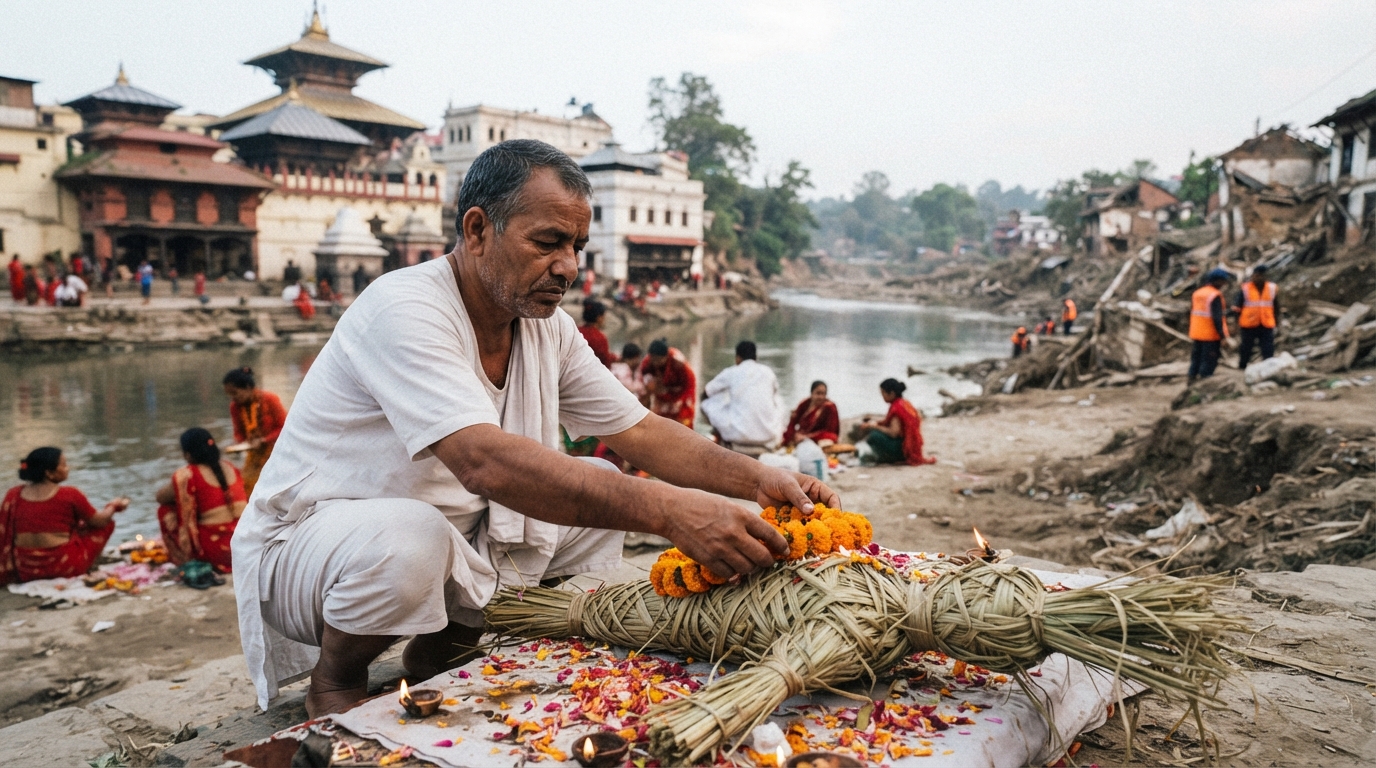
At Pashupatinath temple on the banks of the Bagmati River in Kathmandu, Madan Lal Lawat joined other families in paying tribute to loved ones who were lost when a deadly flood ripped through the China-Nepal border last month.
Under Hindu custom, when a body cannot be found, a symbolic effigy is created from sacred "kusha" grass to stand in for the dead, enabling relatives to carry out last rites.
With more than 5,000 people still missing and rescue operations now ended by the government, this is the only way people like Lawat can honour the dead.
Five of his relatives - including his brother - were swept away and remain missing. Lawat survived because he was driving his bus outside his village, Betrawati.
The last thing Lawat heard from survivors was that his brother Mangal died while going door-to-door to warn others to evacuate.
"I don't know how to start over. Police say they're still searching for the bodies, but I'm not sure they'll ever be found," Lawat says.
He has little doubt they are dead.
But legally, their status is much more complex. In Nepal, a missing person is not presumed dead until 12 years have passed.
Section 40 of Nepal's Civil Code does allow certain exceptions, but it does not include a provision for disasters such as last month's flood.
Families like Lawat's have told the BBC they are struggling to secure death certificates, affecting everything from access to flood compensation to property transfers and even inheritance.
Relatives can receive up to 25,000 rupees (£122; $162) for funeral expenses, along with about 200,000 rupees (£981; $1,302) in bereavement compensation for the first relative who died, and 100,000 rupees (£491; $651) for each additional death.
But that is only possible once they provide a death certificate. So as families try to rebuild their lives, many are now trapped in an administrative nightmare.
"In view of the current disaster, the law is outdated," says constitutional law expert Bipin Adhikari.
He says the law was designed to cover people who went abroad and were not heard from for years. "But technology has advanced now, it isn't as difficult to send or receive information," he argues.
For Lawat, the legal maze has made an already devastating loss even harder to deal with.
When he went to get a death certificate last week, officials at the local municipality office turned him away. "They said they're still discussing the death certificate issue. We aren't sure what to do now. There's so much uncertainty," he tells us.
Even when bodies are recovered, identifying them is a slow and difficult process. More than 1,400 bodies have been recovered so far, and Nepal has little experience handling DNA at this scale. In some cases, authorities have collected DNA samples and then buried the bodies with markers in the ground in case families come forward.
Given the extent of the destruction and loss, families say compensation is urgently needed.
Nepal's latest assessment says 7,570 private buildings were damaged or destroyed, housing nearly 33,000 people based on census data.
The BBC visited Lawat's village, Betrawati, just days after the disaster, once roads to the district of Rasuwa had been cleared. For days, the area had been cut off from Kathmandu and was struggling with shortages of basic supplies including petrol.
The destruction in the village was overwhelming. The ground was covered only in hardened mud and silt. Video of the flood showed it had swallowed most of the village in minutes. There was no trace of its busy market, the local Uttargaya School was in ruins, houses had been swept away, and school buses were overturned.
Rasuwa and Nuwakot, and is part of Bidur municipality, where the government estimates more than 3,000 buildings have been damaged or destroyed. That is the highest total of any municipality.
Local governments are now urging the prime minister's office to find a way to settle the death confirmation issue.
"Everything is on hold," Bidur's Mayor, Rajan Shrestha, told the BBC.
He said it could take up to 12 years for relatives to access the funds they are entitled to.
For one of South Asia's smallest economies, finding money for compensation is difficult, and the amounts offered are small compared with the scale of the losses.
More than 5,000 people are still missing after the floods, leaving families stricken with grief
The government estimates damage to personal belongings alone at £123 million ($165 million) across more than 8,300 households.
That suggests losses of about £14,800 ($20,000) on average per household, though the figure is based only on census data and modelling and does not reflect the exact cost for each family.
The financial burden makes death certificates crucial for families trying to recover from the disaster.
Shrestha is urging the federal government to resolve the matter as soon as possible. Until then, he says his hands are tied.
"We understand the emotional pain for families who have already performed funeral rituals, but officials must work within legal boundaries to avoid future liabilities."
The government has told the BBC it is trying to find a solution.
In a statement, the prime minister's office said it was "aware of the difficulties" the law may cause families in "exceptional circumstances, including disasters". The home ministry said the government was taking the issue seriously and was ready to amend the law, if required.
The legal obstacles families face come as Nepal confronts a steep reconstruction bill, which the government says could reach £3.6bn ($4.8bn).
At the UN General Assembly in New York, Prime Minister Balen Shah said rebuilding the country would require more than 10% of its gross domestic product, an enormous strain on the economy.
Dozens of public buildings including schools, health clinics and hospitals have been destroyed by the floods. Roads, bridges, wastewater treatment plants and hydropower projects have also been damaged.
Shah is now seeking grant-based international support rather than new loans. Nepal is one of the world's lowest emitters of greenhouse gases, yet one of the countries most vulnerable to global warming.
"When a climate-driven disaster destroys infrastructure of a poor country, the answer cannot simply be another mega-loan or a patchwork of small grants," he told a room full of world leaders.
This is not the first time Nepal has had to rebuild after a devastating natural disaster.
For Tisum Ghale, the past month has felt painfully familiar.
He and his family lost their home in the 2015 earthquake and were displaced for months. They eventually settled in Betrawati.
But the place that once served as a refuge is where 19 of his relatives were killed in last month's flood, including five of his sisters. He survived because he was doing construction work outside the village.
Once again, he has no home.
"I have lost everything," he said.
So far he has received no compensation. He urgently needs the money after his home was washed away, and he cares for eight children left behind by his sisters. He is one of thousands displaced and living across 37 holding centres in northern Nepal.
Like Lawati and thousands of other families, Ghale plans to hold a funeral without the bodies of his loved ones.
He hopes the law will eventually recognise what he already knows: his loved ones will not be coming home.