

Many Canadians are boycotting the US, so this is where they're travelling instead
From exploring their own backyard to travelling abroad, many Canadians are spending their money elsewhere to send a message to the US president.
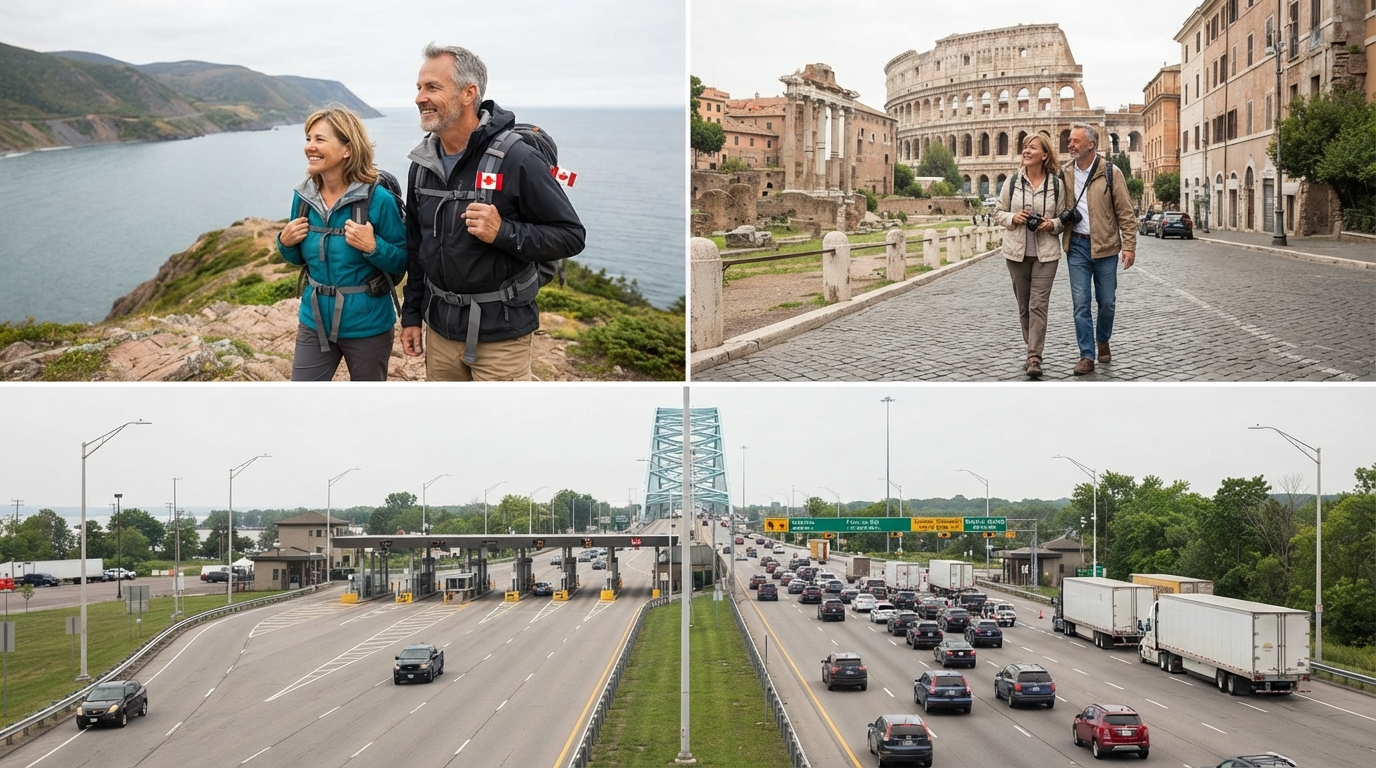
Many Canadians are choosing to travel elsewhere as they boycott the United States.
Kent Truscott, from London, Ontario, and his family had frequently visited the US, including California and New York in 2023, before Donald Trump's re-election. However, since late 2024, Truscott stated to the BBC, "my family and I have completely decided to boycott the United States."
This decision led to the cancellation of a planned trip last spring to Texas, where he and his brother intended to watch a SpaceX Starship launch. They had anticipated spending "thousands of dollars" on flights from Toronto, a rental car, and a week-long stay. Instead, Truscott and his wife opted to spend that money within Canada, specifically exploring Nova Scotia and Prince Edward Island in the Atlantic provinces.
Their boycott is a direct response to US tariffs and President Trump's remarks about annexing Canada. Over a year after Trump's return to the White House, numerous Canadians, like Truscott, are maintaining their stance against traveling to the US.
Despite a slight increase in road trips to the US in April, national data indicates that Canadians made 800,000 fewer trips that month compared to April 2024, before Trump's election. This boycott resulted in an estimated loss of C$3.3 billion ($2.35 billion; £1.75 billion) in travel revenue for the US last year, as Canadians redirected their spending to international destinations or within their own country.
American cities and states have felt this financial impact, prompting them to launch targeted advertisements and special offers to entice Canadians back. For instance, in July, New York City's tourism board announced a 30% discount on Broadway tickets and hotel rooms for Canadian tourists.
The BBC interviewed several Canadians to understand their reasons for avoiding the US, their alternative travel choices, and what might prompt their return. While some cited the declining Canadian dollar as a factor making the US less affordable, many emphasized that the relationship between Canada and the US has reached a breaking point, suggesting that a significant shift would be required for them to reconsider US travel, if at all.
Upon deciding to vacation in Atlantic Canada, Kent Truscott and his wife embraced the opportunity to discover their own country. They rented a vehicle, hiked the picturesque Cabot Trail, and stayed at an all-female-run resort on the Atlantic Ocean. Truscott fondly recalled, "I had the best halibut dinner in my life, caught by someone that morning out on the bay."
He expressed uncertainty about when he would return to the US, stating, "There has been a fundamental break." Truscott cited anti-immigration raids and other Trump policies he disagrees with, alongside the president's rhetoric and actions against Canada. He added, "As much as I would like to say that when Donald Trump leaves everything will go back to normal, well, 70 million people voted for it."
Lynda and Joe Rousseau, who had lived in Texas for 19 years before retiring to Canada, accelerated their planned move back to February 2025 from last summer due to their dissatisfaction with Trump's re-election. Rousseau, now residing in Ottawa, explained, "We just couldn't stand the idea of living there while he was running things."
Their decision to boycott the US entirely solidified after Trump began referring to Canada as "the 51st state" and its former prime minister, Justin Trudeau, as "governor." That summer, the couple canceled a cruise scheduled to depart from New York City and traverse the Panama Canal. Instead, they rebooked with the same company for a different cruise through Rome and Barcelona, where Rousseau enjoyed exploring ancient ruins and savoring local cuisine.
Rousseau acknowledged, "I mean it's not New York's fault… but Trump is in charge of it all, and so it all takes a hit." The couple, who hold dual US and Canadian citizenship, also abandoned their plans to become "snowbirds," a term for Canadians who spend winter months in warmer US states like Florida and Arizona. They now only cross the border occasionally to collect mail, carefully avoiding any spending while in the US.
Rousseau expressed regret over the lost convenience of easily driving and spending time in the US, which is often more affordable to visit than most overseas destinations due to its proximity. However, she noted that the boycott has instilled "a little more pride in Canada."
Nick Smith, a retiree from Vancouver, was never a supporter of Trump. He ceased taking road trips to Seattle and major US national parks with his children after Trump's initial election in 2016. He resumed these trips when Joe Biden took office but is now once again avoiding the US, particularly after observing many fellow Canadians doing the same. "Now we're just not even considering it," he stated.
Smith has even avoided connecting flights through American cities to other destinations. Last autumn, he and his friends traveled to Mexico City, opting for a direct flight from Vancouver. Earlier this year, he and his wife Sylvia embarked on their first trip to Morocco, visiting cities like Marrakech, Fez, and Essaouira. One of their most memorable experiences, he shared, was experiencing the Muslim country during Ramadan.
"It was actually quite an interesting time to be there, and realising how important religion is to the people of Morocco and how seriously they take the fasting ritual," Smith remarked. "We just don't have anything like that in Canada." When asked if he would return to the US if Trump leaves the White House, Smith replied, "It certainly is going to have to be more than that." He added, "I would need to see some sense of reconciliation (with Canada)... actions that would show a return back to amicable relations."
Christie Mitchell, a 50-year-old mother of two from Powell River, British Columbia, has made countless trips to the US throughout her life. She has hiked national parks, attended American football games, and driven an RV through several states to Florida. She even recalls a time when a passport wasn't required to cross the border. "I'm of that generation where I thought (Canada and the US) were just one big country," she said. "I just always felt welcome."
However, Mitchell stated that this feeling has diminished under the current administration, which she is unwilling to support with her purchasing power. "It breaks my heart, because I love Americans and I love America."
Boycotting travel to the US prompted Mitchell to achieve a long-held goal: hiking the 490-mile (790-km) Camino Francés route through Spain. She undertook the popular hike earlier this year to celebrate her 50th birthday, choosing it over a quick and cheaper trip to Las Vegas, which she had initially considered for her celebration before the boycott. Mitchell particularly enjoyed the people she met along the route in Spain.
"Some people do the hike for personal reasons, and many of the people I talked to were in a transition," she explained, noting that the hike provided an opportunity for "very lovely conversations with complete strangers." Mitchell indicated that she would be open to visiting the US again if a different president were in office and if relations with Canada were restored.
The Canadian boycott of US travel shows no signs of abating. Carney is reportedly exploring "all options" as Trump announces 50% tariffs on Canada. Carney suggests that Canada's boycott of US alcohol could be resolved if Trump addresses the tariffs.